Key Notes
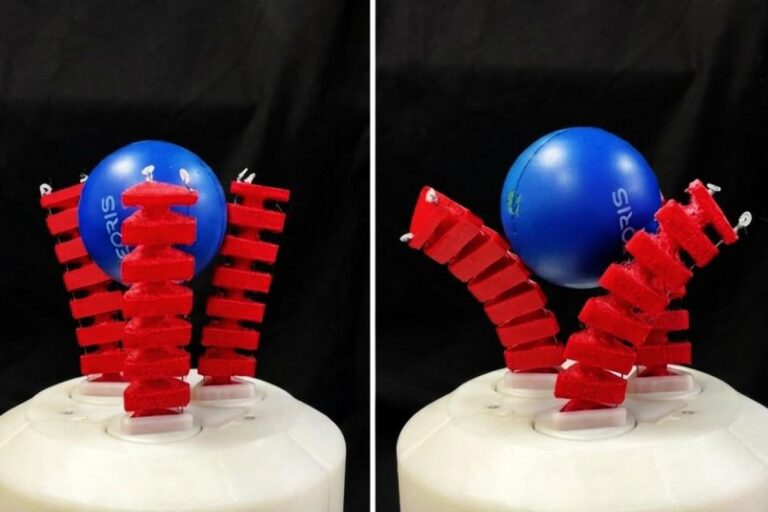
- Three soft fingers combine tendon-driven bending with active base rotation.
- The gripper maintains contact while reorienting an object.
- Laboratory tests used objects below about 100 grams; thin objects can slip, and autonomous control remains future work.
Researchers at Spain’s Universidad Carlos III de Madrid (UC3M) and Public University of Navarre (UPNA) have developed a soft robotic gripper that can rotate an object between its fingers without putting it down. The prototype combines flexible fingers with rotating bases, adding dexterity to a design intended to adapt to different shapes.
UC3M announced the work on October 2. The peer-reviewed study, led by Carlos Relaño with Alberto Rodríguez-Sanz, Lisbeth Mena and Concepción A. Monje, was published in Bioinspiration & Biomimetics on August 11.
Three Fingers Add Movement After the Grasp
Each of the three independently actuated fingers has three degrees of freedom. Tendons bend the soft structures, while active rotation at their bases changes their orientation. Coordinating those movements lets the fingers turn a held object while maintaining contact.
The asymmetric joints use their geometry to limit excessive deformation. Their flexibility varies with the direction of movement, giving the mechanism both compliance and mechanical protection. The modular layout also allows individual fingers to be replaced without rebuilding the entire gripper.
This addresses a useful distinction in robotics: lifting a part and positioning it for the next operation are separate tasks. Reorienting something within the grip could reduce the need to set it down and pick it up again.
Rubber Ducks and Screwdrivers Test Adaptability
The team tested objects including a water bottle, a cube, tissues, a fidget spinner, a rubber duck, stuffed toys and a screwdriver. The university’s demonstration video shows the mechanism in action.
The tests do not establish reliable manipulation of every object. The full paper reports an unsuccessful artificial-flower trial caused by slippage. Small, thin or asymmetric objects can also lose stable contact during rotation, so the range it can manipulate is narrower than the range it can grasp.
Industrial Uses Still Need Further Testing
The experiments used objects weighing below approximately 100 grams, positioned within the gripper’s workspace under laboratory conditions. Payload capacity, grasp force and long-term actuator performance still require systematic measurement. Force and tactile sensing, more advanced control and autonomous manipulation are future work.
The researchers identify assembly, food handling, logistics and laboratory work as potential applications. Turning a component before insertion is one possible use; the announcement does not describe a deployed production system.
RobotsBeat’s coverage of Atlas’ redesigned hands explores the same challenge of adjusting objects after pickup. Harvard’s soft robots take another approach, using printed pneumatic channels to shape movement. The Spanish prototype adds a tendon-driven route to flexible grasping and reorientation.
Disclaimer: RobotsBeat is an independent media brand owned and operated by NuvexMedia LLC, publishing news, research, and insights on artificial intelligence, emerging technologies, automation, and related industries. NuvexMedia LLC invests in and collaborates with companies across the AI, Robotics, technology, software, and digital innovation sectors. These relationships do not influence RobotsBeat's editorial coverage, and the publication maintains full editorial independence to provide accurate, timely, and objective information. © 2026 NuvexMedia LLC. All rights reserved. This content is for informational purposes only and should not be considered legal, tax, investment, financial, or other professional advice.