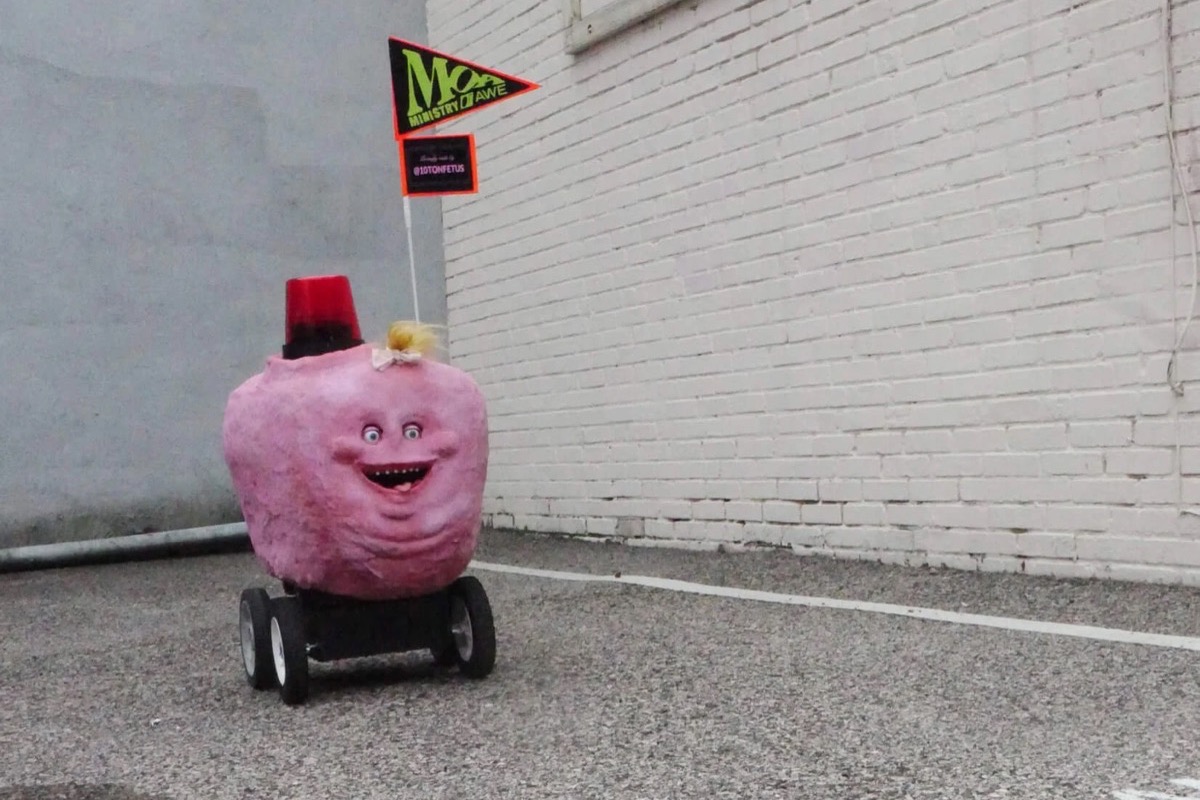
Philadelphia’s Ministry of Awe has taken its immersive art experience onto the sidewalk with Orifice, a small pink robot known as the Awebot. Created by artist Madison Polidoro with the MoA team, the mobile sculpture uses encounters with pedestrians to turn a piece of machinery into a public attraction.
The project’s official page describes an artwork intended to spark curiosity and connection. Its purpose is cultural rather than commercial delivery: the robot serves as a moving introduction to the Ministry of Awe’s Old City venue.
A Robot With a Human at the Controls
Orifice operates through a wireless remote, rather than navigating independently, The Philadelphia Inquirer reported. The publication describes a roughly two-foot-tall creature with blue eyes, blond hair and a protruding tongue. Polidoro built an aluminum base beneath weatherproof urethane rubber, leaving a central compartment capable of holding objects.
The eyes blink at intervals and can also be controlled by the operator. The reported controller range lets the person steering remain some distance away, giving passers-by the experience of meeting a wandering character even though a human directs its movements.
Watch Awebot in footage shared by Inquirer columnist Stephanie Farr.
Public Interaction as the Main Function
MoA presents Awebot as an extension of the experience inside its building at 27 North Third Street. The robot’s role is to draw people into that experience through surprise, photographs and spontaneous encounters, making the sidewalk part of the artwork’s setting.
That puts the project alongside a different strand of robotics coverage: machines built to attract attention and communicate a personality. RobotsBeat previously covered Poland’s robot influencer, which uses public appearances as part of a media and marketing project. Awebot’s remote-controlled approach is technically distinct, but both illustrate how a physical character can become an attraction outside a laboratory.
Character Design Rather Than an AI Breakthrough
The relevant engineering question here is how movement, materials and expression shape an encounter. A recognizable face and an unusual body give pedestrians immediate cues about how to respond. Those design choices can matter even when the machine has no independently demonstrated intelligence.
RobotsBeat’s coverage of robotic entertainment offers another example of machines entering cultural settings. The systems and control methods differ, so public appeal alone should not be read as evidence of equivalent robotic capabilities.
What Remains Unspecified
The reviewed materials do not establish onboard AI, autonomous navigation or commercial availability for Awebot. It is best understood as an artist-led mobile installation with a human operator. Its contribution is a distinctive use of robotic movement in public art, rather than a claim to automate work.
Disclaimer: RobotsBeat is an independent media brand owned and operated by NuvexMedia LLC, publishing news, research, and insights on artificial intelligence, emerging technologies, automation, and related industries. NuvexMedia LLC invests in and collaborates with companies across the AI, Robotics, technology, software, and digital innovation sectors. These relationships do not influence RobotsBeat's editorial coverage, and the publication maintains full editorial independence to provide accurate, timely, and objective information. © 2026 NuvexMedia LLC. All rights reserved. This content is for informational purposes only and should not be considered legal, tax, investment, financial, or other professional advice.