
Key Notes
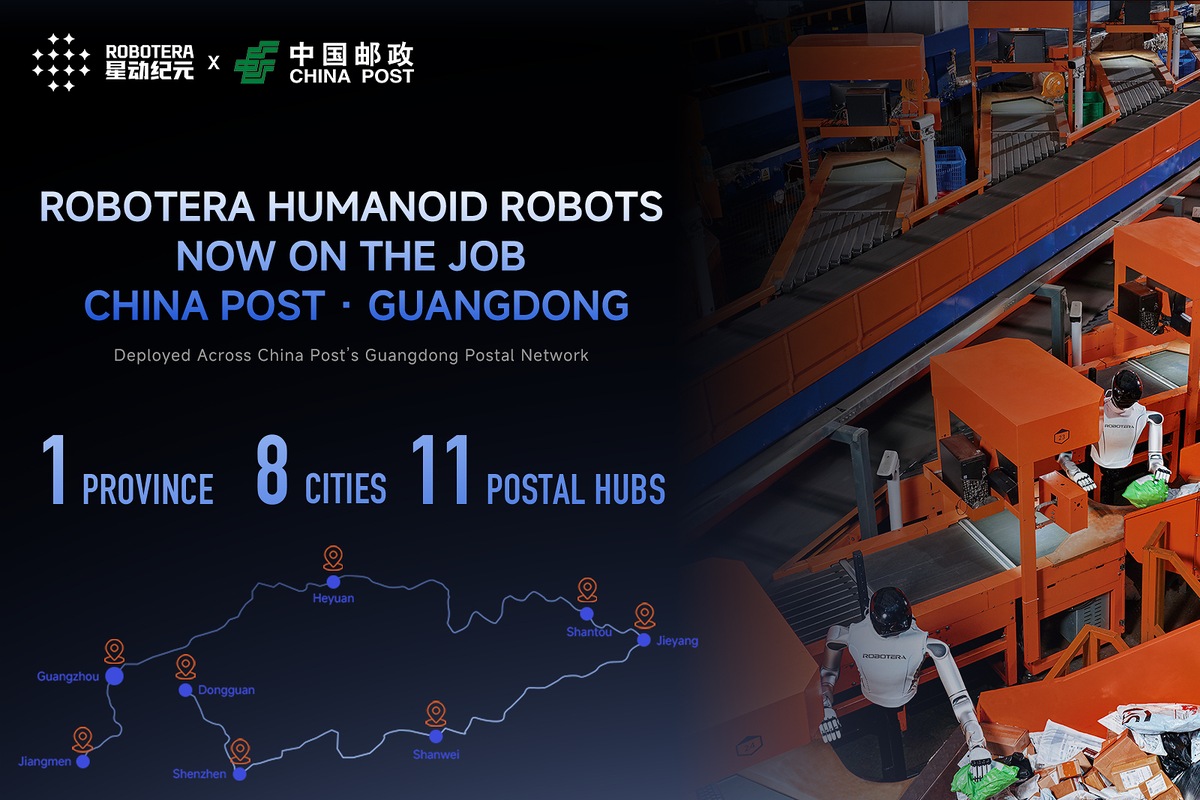
- ROBOTERA reports humanoid deployments at 11 China Post hubs across eight Guangdong cities, following a Guangzhou pilot that began in March.
- The company’s claimed parcel induction rate exceeds 1,500 items an hour, but the release provides no robot-count breakdown or independent evaluation method.
- Five-finger handling, irregular-item rejection and adaptive speed control target the practical demands of postal sorting, while detailed uptime and cost figures remain undisclosed.
ROBOTERA says its humanoid robots are now deployed at 11 China Post hubs across eight cities in Guangdong, expanding a postal sorting project that began with a Guangzhou pilot in March. The company detailed the wider rollout in a November 17 announcement.
The project is being implemented with China Post Group Guangdong Branch. Its reported footprint covers Guangzhou, Shenzhen, Dongguan, Jiangmen, Shantou, Shanwei, Jieyang and Heyuan. The 11-hub figure describes locations, not the number of robots installed.
A Postal Pilot Expands Across Different Sorting Sites
The Guangzhou Postal District Center pilot began in March 2026. ROBOTERA reports an average parcel induction rate above 1,500 items an hour since that work began, describing it as comparable to experienced human workers.
Induction means feeding parcels into a sorting process. It is one stage in a larger operation that also includes transport, identification, routing and dispatch. The reported rate should not be treated as the throughput of an entire postal hub or proof that the robots run without support.
The release does not provide a test method, robot-count breakdown, intervention rate or uptime data for each location. Its performance statement is a company-reported pilot result, rather than an independent benchmark covering every site.
Parcel Handling Requires More Than Repeating a Pick
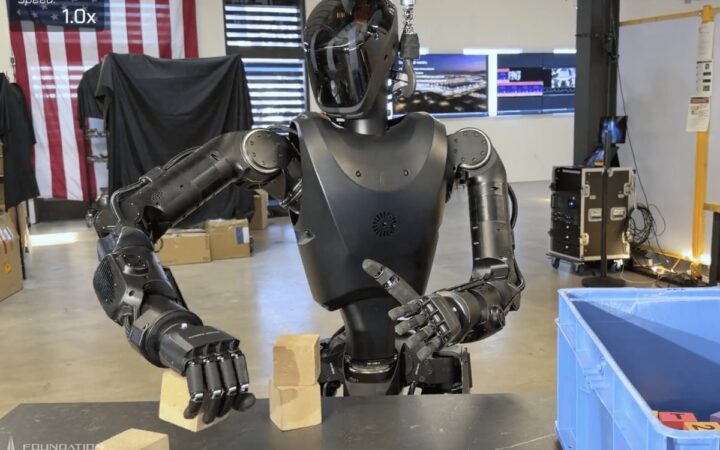
ROBOTERA describes a system with irregular-item rejection and adaptive speed control intended to reduce jams, collisions and missed items. A self-developed five-finger hand handles parcels, while different power options are intended to suit the operating requirements of individual sites.
Parcel variation creates a practical manipulation problem. A soft bag, a rigid box and an awkwardly shaped item can require different contact and placement strategies. The useful result is successful entry into the sorting flow, including how the system handles an item it should reject or cannot grip.
The announcement does not identify the hand variant used in this postal project. Our separate XHAND Pro-U report covers the company’s November 16 research-hardware release; its specifications should not automatically be assigned to these postal robots.
Deployment Scale Still Needs Site-Level Evidence
ROBOTERA also reports postal deployments in East China, without providing a matching breakdown of locations or machines. Its broader aim is to support peak parcel demand while people handle maintenance, operational coordination and quality control.
For logistics operators, the next questions concern full-shift availability, recovery from blocked conveyors and how much staff time is needed to keep the system working. A network of installations provides more operating environments in which to measure those results, but the site count alone does not establish the economics.
Our coverage of GXO’s Apollo trials examines another logistics program with a path toward wider deployment. ROBOTERA’s update describes a different stage: an existing pilot expanded across a named postal network, with detailed reliability and cost figures still undisclosed.
Disclaimer: RobotsBeat is an independent media brand owned and operated by NuvexMedia LLC, publishing news, research, and insights on artificial intelligence, emerging technologies, automation, and related industries. NuvexMedia LLC invests in and collaborates with companies across the AI, Robotics, technology, software, and digital innovation sectors. These relationships do not influence RobotsBeat's editorial coverage, and the publication maintains full editorial independence to provide accurate, timely, and objective information. © 2026 NuvexMedia LLC. All rights reserved. This content is for informational purposes only and should not be considered legal, tax, investment, financial, or other professional advice.