Key Notes
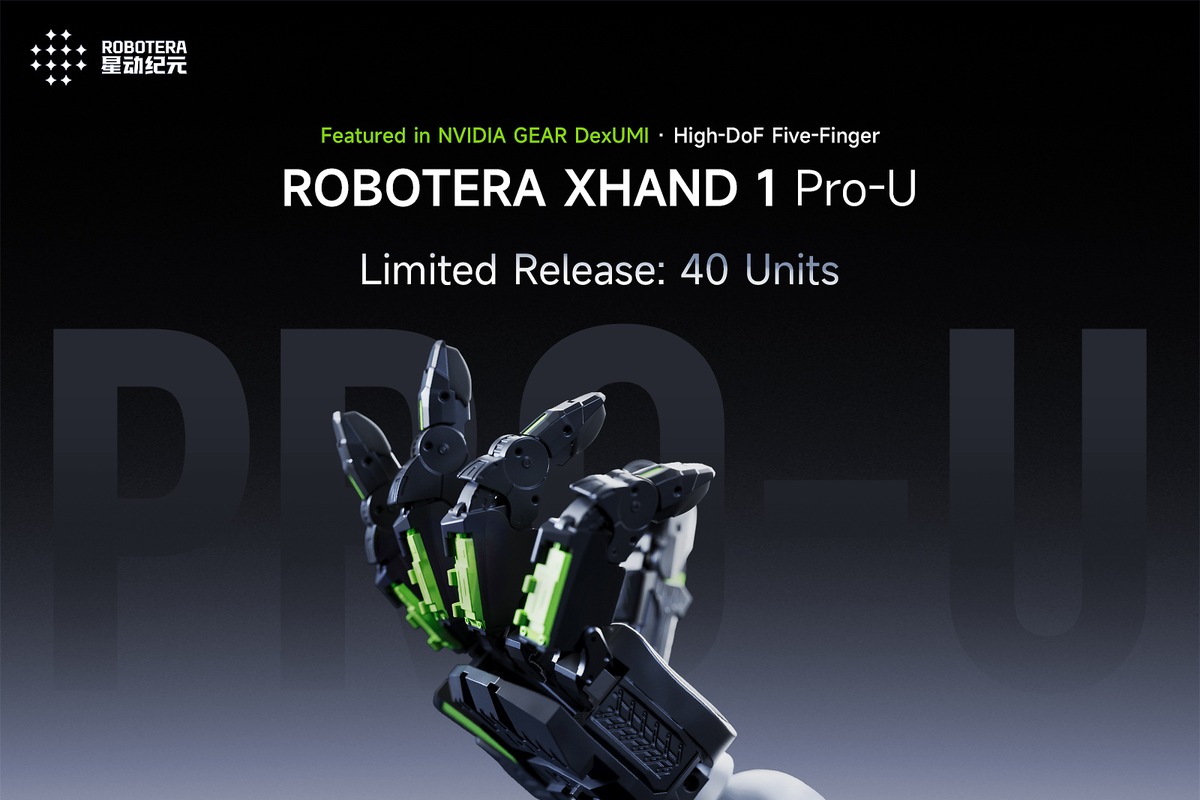
- ROBOTERA has opened orders for an initial 40 XHAND 1 Pro-U hands with a 16-degree-of-freedom design aligned to DexUMI.
- Human movements and fingertip forces captured through the wearable system become training data without remotely operating the target robot.
- Reported task success rates describe the complete GR00T 2 demonstration setup rather than a universal hardware reliability benchmark.
ROBOTERA has opened commercial orders for XHAND 1 Pro-U, the five-finger robot hand used in NVIDIA’s GR00T 2 DexUMI demonstrations. The November 16 launch announcement limits the initial release to 40 units, aimed at research teams, robot developers and industry partners.
The hand has 16 degrees of freedom and a mechanical layout closely aligned with NVIDIA GEAR Lab’s DexUMI exoskeleton. ROBOTERA says the matching joint structure reduces the motion conversion needed to transfer a demonstrated human movement to a robot.
Matching the Capture Device to the Robot Hand
A person wears DexUMI while directly manipulating real objects. The device records movements and fingertip force information, producing training data about both motion and physical contact. Data collection therefore does not require the person to remotely drive the target robot.
That arrangement separates skill capture from robot execution. The human works with an object through the wearable interface; a robot later attempts the task using a trained policy. It can reduce dependence on having the full robot available for every demonstration, while still requiring accurate mapping between the capture hardware and robotic fingers.
GR00T 2 Demonstrations Connect Human Data to Two-Handed Tasks
NVIDIA’s research page shows DexUMI demonstrations being transferred to a Tianji dual-arm robot fitted with two ROBOTERA hands. The examples include preparing banana yogurt, scooping granola and lighting a lamp with a match before putting the match in water.
ROBOTERA reports task success rates of 60%, 80% and 75%, respectively. These are results for the demonstrated GR00T 2 system, combining the model, training data, robot and hands. They should not be read as universal reliability figures for the hand itself.
For those tasks, the company says post-training used DexUMI data without extra task-specific robot teleoperation or robot play data. That is a statement about how the task adaptation data was collected, rather than a claim that the model needed no prior training.
A Limited Hardware Release for Manipulation Research
The Pro-U design also revises thumb positioning, palm-side tactile sensing and articulation to accommodate demonstrated movements and different grasping postures. The launch release does not disclose a price or detailed delivery schedule, so opening orders should not be equated with 40 units already shipped.
The practical test for a developer is how the hand performs with its own objects, sensors and control loop. Joint alignment can simplify transfer, but grip stability, recovery after an error and repeatable contact control still depend on the complete system.
Our GR00T 2 coverage follows the broader demonstrations. The CoRL report explains the simulation and evaluation tools surrounding that model; this launch adds a purchasable hardware component for teams studying dexterous manipulation.
Disclaimer: RobotsBeat is an independent media brand owned and operated by NuvexMedia LLC, publishing news, research, and insights on artificial intelligence, emerging technologies, automation, and related industries. NuvexMedia LLC invests in and collaborates with companies across the AI, Robotics, technology, software, and digital innovation sectors. These relationships do not influence RobotsBeat's editorial coverage, and the publication maintains full editorial independence to provide accurate, timely, and objective information. © 2026 NuvexMedia LLC. All rights reserved. This content is for informational purposes only and should not be considered legal, tax, investment, financial, or other professional advice.