Key Notes
- NVIDIA’s CoRL 2026 programme connects human data, GR00T 2, physics simulation, industrial evaluation and agent-generated robot programs across the development workflow.
- AlphaNIST, DexBench, VABAR and Graph-as-Policy address distinct questions about practice, task variation and recovery, with research results tied to specific evaluation conditions.
- GR00T 2 code is listed for December and Isaac Lab 3.0 predates CoRL, while real deployment still requires reproducible performance, safe operation and manageable support costs.
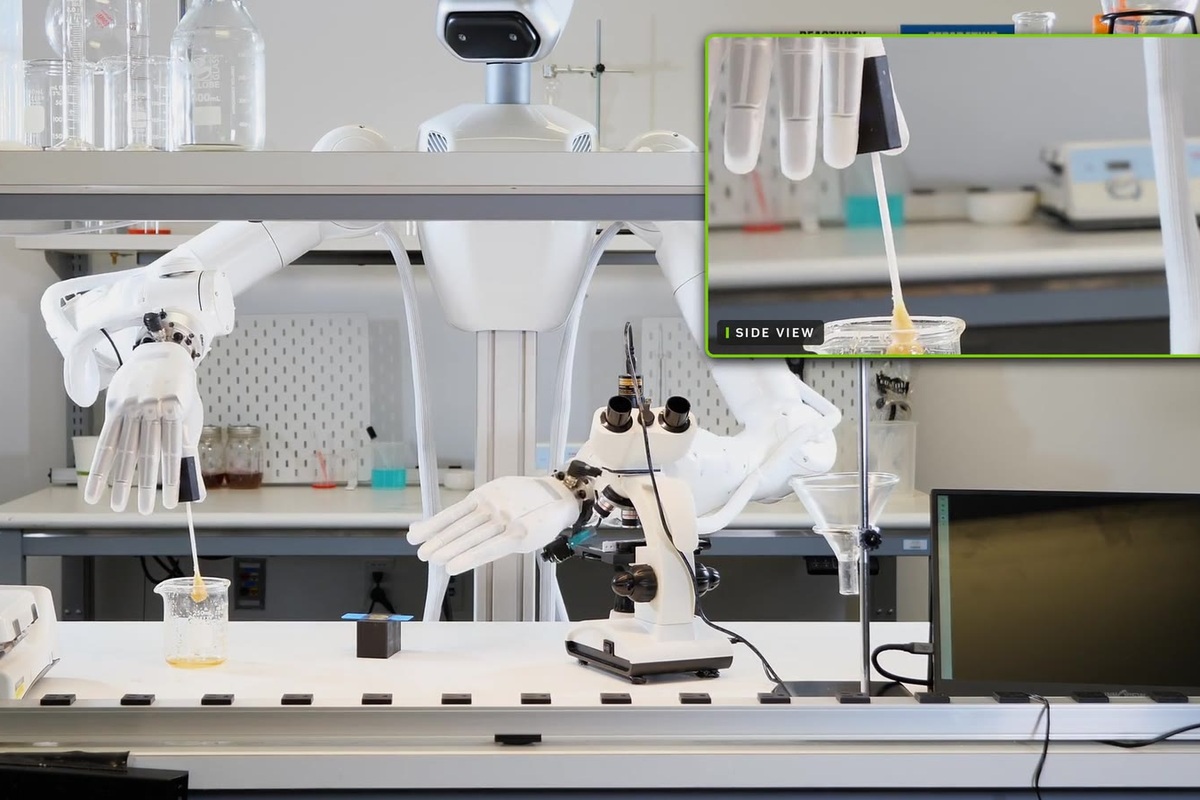
NVIDIA’s CoRL 2026 announcements bring together several pieces of a difficult robotics problem: learning a useful physical skill, adapting it to a different machine and repeating it reliably when conditions change. GR00T 2 supplies a new model family, while simulation, evaluation and agentic programming tools address how those skills are developed and tested.
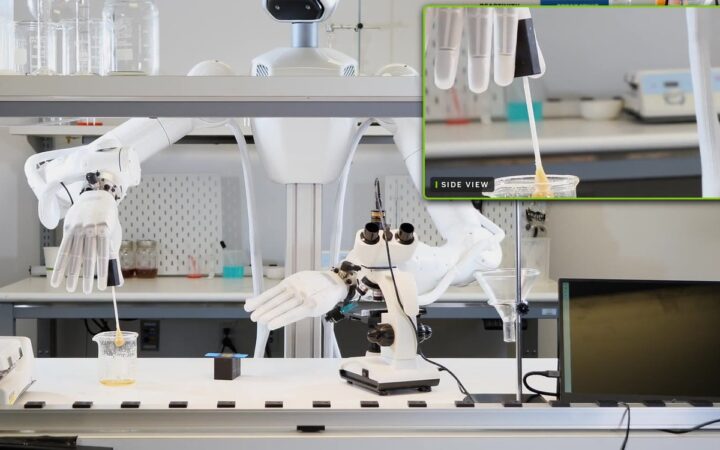
The company’s CoRL overview places manipulation at the center of this effort. Aligning a connector, handling a cable or fitting an assembly part requires more than reaching a position. The robot must manage contact, recognize failure and choose a useful next action.
Our recent reports examine GR00T 2, HiPHI-Hand data and Isaac Lab 3.0 separately. This overview connects those developments with the training methods, benchmarks and robot programs presented around the conference.
GR00T 2 Connects Predicted Outcomes With Robot Actions
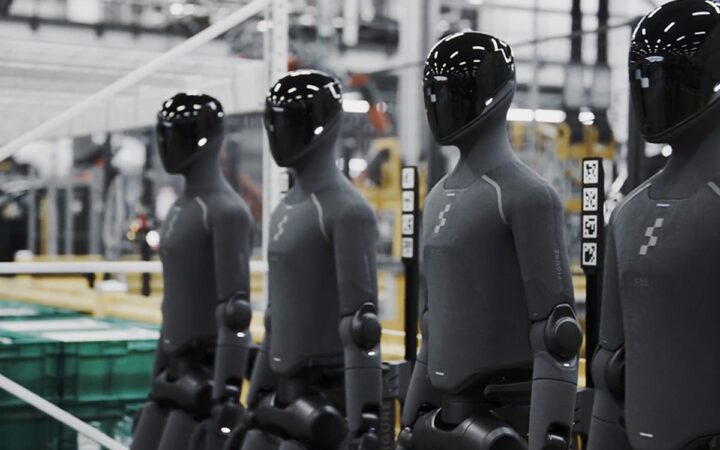
GR00T 2 is a world-action model: it predicts future video and robot actions together. NVIDIA’s research page describes a system that uses recent images, an instruction and robot-state information to generate an action sequence alongside an expected visual outcome.
The intended benefit is transfer. A useful robot-learning system should extract something from a human demonstration or another robot’s experience without requiring the target machine to repeat every training example itself. Differences in hands, reach and control remain part of the adaptation problem.
On NVIDIA’s 50-task evaluation, the model achieved 40% average trial success without task-specific demonstrations on the target robot. One demonstration per task raised that figure to 71%, and five raised it to 95%. Separately, 40 of the 50 tasks succeeded at least once in the zero-shot setting. That second measure describes task coverage, not an 80% average success rate.
The page lists code availability for December. The results are research findings under stated conditions, and do not establish a ready-made solution for every factory task. Our focused model report provides the details without treating a small set of demonstrations as proof of sustained industrial reliability.
Human Video Becomes More Useful With Measured Motion
Video records the visible result of an action, but it may not reveal the full hand pose, contact force or motion hidden behind an object. Researchers therefore need ways to convert observation into representations that a controller can use, and reference measurements with which to assess reconstruction quality.
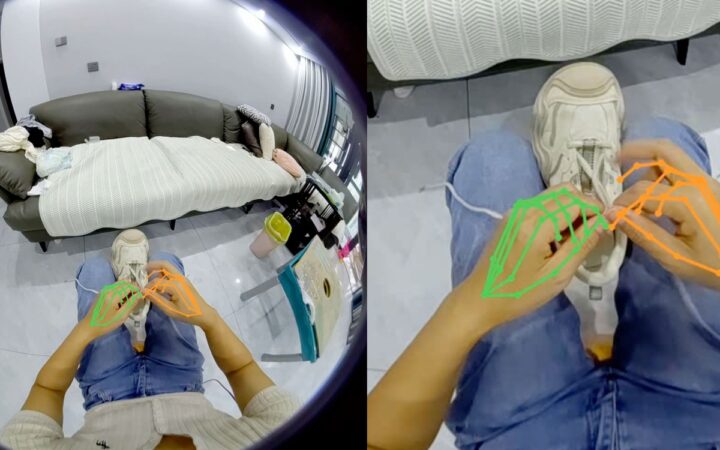
Noitom’s HiPHI-Hand announcement is one example: it describes synchronized first-person recordings and optical hand-motion measurements used as a real-world source in NVIDIA EgoHand training. Our dataset report explains the capture and its research licensing separately from the commercially usable model.
NVIDIA’s EgoHand documentation describes reconstruction of hand poses, joints and meshes from video, calibration and hand boxes. Camera localization can place those reconstructions in world coordinates. That supplies structured information about human behavior; mapping it to reliable robot control still requires further work.
Isaac Lab and Newton Provide the Practice Environment
A policy is the system that selects a robot’s actions from its observations. Training one in simulation allows a team to repeat attempts, vary conditions and inspect failures before committing physical hardware to the same workload.
Isaac Lab 3.0 was already available before CoRL. Its modular design lets developers select supported physics and rendering components, while Newton extends the range of physical interactions that can be modeled. This is infrastructure for experimentation, not another version of the GR00T model itself.
NVIDIA’s Newton documentation describes an extensible engine built on Warp and OpenUSD, developed with Google DeepMind and Disney Research and managed by the Linux Foundation. Physics modeling includes rigid and soft bodies, contact, friction and actuator and sensor behavior.
Those details matter when the object changes shape or when a small contact error can derail a task. A cable does not behave like a rigid block, and a grasp can alter the object being grasped. Greater simulation detail is useful only when it captures the behavior relevant to the decision the robot must make.
AlphaNIST Shows Why the Choice of Practice Matters
The AlphaNIST project applies reinforcement learning to precision assembly in simulation. A shared policy trains across 20 NIST Assembly Task Board tasks, with parts as small as 4 millimeters and a binary reward for task success.
The project reports 98.2% training success for the shared policy with binary rewards, compared with 81.4% for separate policies under that comparison. These are simulation-training figures, not a production-line yield or proof that one physical robot has passed every task under arbitrary conditions.
AlphaNIST also illustrates the importance of initial conditions. Practice can begin from loose parts, an existing grasp or a partially completed assembly. Starting near completion gives the system opportunities to learn the final step before it can solve the entire sequence.
The related Success-Guided Sampling research concentrates practice on configurations a policy solves about half the time. Rather than spending most attempts on already-mastered or currently unreachable cases, the sampler changes the training mix as capability improves. Its authors also report real-robot transfer on selected assembly tasks, which should be kept separate from AlphaNIST’s broader simulation result.
DexBench and VABAR Test Variation Within Workflows
Learning a skill and measuring its limits are different jobs. Isaac Lab-Arena provides an evaluation framework for composing repeatable tasks, running parallel simulations and analyzing where a policy fails. A benchmark built on that framework supplies the actual tasks, variations and scoring rules.
RLWRLD’s DexBench presents 15 tasks across retail, logistics, assembly-line and hotel food-and-beverage scenes. Its scope reflects the need to test skills in workflows, beyond a single tabletop action.
The VABAR project, with contributors from UC Berkeley, NVIDIA and Siemens, focuses on bounded industrial variation: a known workcell and task, but changing object geometry and pose. Its six task classes include tool sorting, tool hanging, gear meshing, syringe packing, cable insertion and cable routing.
That middle ground is commercially relevant. A manufacturer may not need a machine that performs any conceivable task. It may need a dependable system that handles a defined family of parts arriving in different positions. Testing that variation makes a stronger deployment case than demonstrating one ideal arrangement repeatedly.
Graph-as-Policy Turns Skills Into Inspectable Programs
An isolated skill is only part of a longer job. The robot may need to detect an object, choose a grasp, transport it, verify placement and decide whether to retry. An agentic system can help assemble that sequence, provided the result can be tested and reviewed.
The Graph-as-Policy project uses agents to compose reusable skills into executable graphs, then refine them through simulation feedback. The graph represents the actions and the routes taken after success or failure, making the control flow available for inspection.
Its researchers report a popcorn-making example that improved through simulation rehearsal and reached 18 successes in 20 physical-robot trials. That is evidence for a specific experimental setup, rather than a general industrial reliability guarantee. The value of the approach is that failures can lead to changes in an explicit program that engineers can examine.
NVIDIA’s overview identifies Ambi Robotics, Bosch Research and Siemens as exploring agentic workflows. Exploration does not mean every pictured system or customer installation already uses the full research stack.
GRAIL and RoboTTT Address Data Generation and Memory
Two other research directions show why the CoRL story extends beyond a single new model. GRAIL begins with specified 3D assets and scenes, uses world models to generate interactions and recovers motion that can be retargeted to humanoids. The purpose is to create robot-compatible training experience without rebuilding every physical collection setup.
By contrast, RoboTTT asks what a policy can do with a much longer interaction history. Its researchers describe scaling visuomotor context to 8,000 timesteps using a changing internal state, with experiments on long-horizon manipulation and imitation from a human video shown in context.
These projects address different bottlenecks: generating relevant experience and retaining useful context during execution. Neither should be assumed to be a feature already integrated into every GR00T 2 deployment.
What Would Establish Useful Progress After CoRL?
The strongest practical evidence would connect a clearly described task with accepted output, failure frequency, recovery time and required supervision. A result also needs its denominator: which attempts were counted, what was excluded and how much adaptation data was supplied.
Robot-learning announcements often combine model success, simulation speed and deployment examples. These measure different things. Faster training may shorten development, while a higher task-success rate may reduce interruptions; neither alone establishes a customer’s total operating cost.
NVIDIA’s CoRL programme brings those stages into a more connected workflow. Its significance will depend on how well developers can reproduce the research, identify failures before deployment and demonstrate dependable performance when the robot leaves the benchmark.
Frequently Asked Questions
Is GR00T 2 a new physical robot? It is a robot foundation model family. Hardware, low-level control and deployment software remain separate parts of a working system.
Did Isaac Lab 3.0 first launch at CoRL? No. It was available before the conference and forms part of the wider training infrastructure presented there.
Does a simulation result prove real-world reliability? It provides evidence within the modeled conditions. Physical testing must establish whether relevant behavior, failures and operating constraints transfer to the intended use.
Disclaimer: RobotsBeat is an independent media brand owned and operated by NuvexMedia LLC, publishing news, research, and insights on artificial intelligence, emerging technologies, automation, and related industries. NuvexMedia LLC invests in and collaborates with companies across the AI, Robotics, technology, software, and digital innovation sectors. These relationships do not influence RobotsBeat's editorial coverage, and the publication maintains full editorial independence to provide accurate, timely, and objective information. © 2026 NuvexMedia LLC. All rights reserved. This content is for informational purposes only and should not be considered legal, tax, investment, financial, or other professional advice.