Key Notes
- HiPHI-Hand combines first-person recordings with optical hand-motion measurements and contributed real-world training data to NVIDIA’s EgoHand model.
- Capture precision and model reconstruction accuracy are different measures, so sub-millimeter reference data does not establish equally precise predictions in every scene.
- The dataset’s noncommercial research license differs from EgoHand’s commercially usable model license, an important distinction for developers building products.
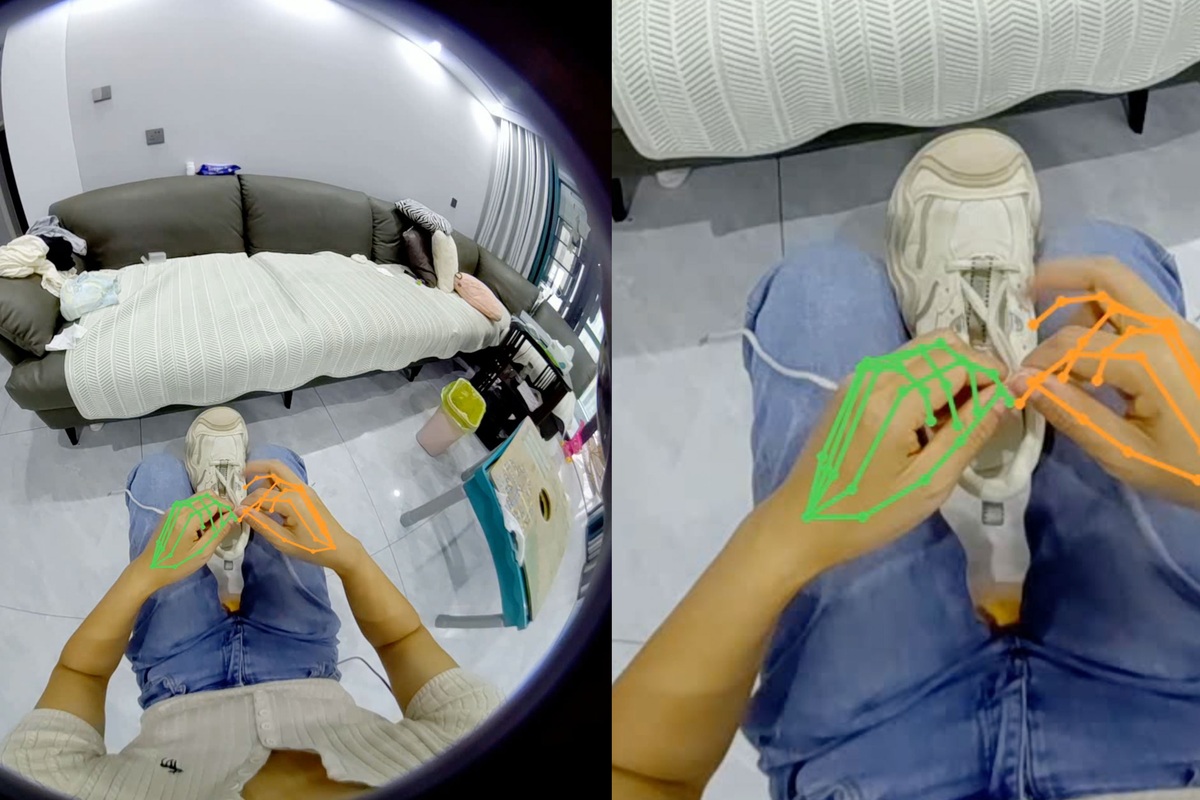
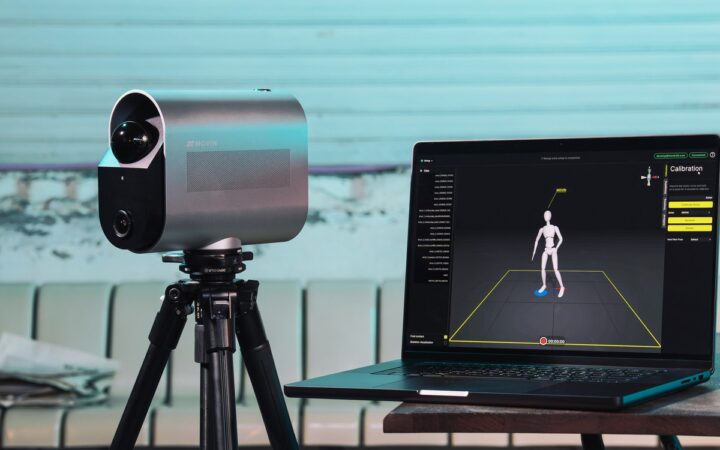
Noitom Robotics has announced HiPHI-Hand, an 11-hour dataset of synchronized first-person video and precise hand-motion measurements used as a training source for NVIDIA’s EgoHand. The release targets the data behind embodied AI research, rather than introducing a physical robotic hand.
The company’s November 9 announcement describes dual-fisheye video from its SOL headset, camera extrinsics referenced to the headset IMU and optical motion-capture hand-joint positions. Noitom says finger micro-markers provide sub-millimeter reference measurements, including when the first-person camera cannot see the hands clearly.
Reference Measurements Help Models Learn Hidden Motion
A camera image can show what an interaction looks like without revealing the exact position of every finger joint. Occlusion makes that problem harder: the object being manipulated, one hand or the camera angle can hide important details.
Pairing video with separately measured motion gives researchers a reference against which to train or evaluate a reconstruction model. The claimed precision concerns the capture system’s ground truth; it does not mean a model will reconstruct every unseen hand movement with sub-millimeter accuracy.
Noitom says NVIDIA processed the capture into its SOMA-Hand representation as one of EgoHand’s real-world training sources. The company identifies November 9 as the dataset’s Hugging Face release date, with noncommercial research, education and evaluation covered by the ModalityNet Open Research License and commercial licensing handled separately.
EgoHand Reconstructs Hands From First-Person Video
The EgoHand paper describes a monocular model trained on 14 million images combining synthetic material, real-world video and multi-camera motion capture. It reconstructs hand pose and shape using the SOMA-Hand representation and reports evaluations on the HOT3D, ARCTIC and H2O benchmarks.
The authors report inference latency of approximately 9 milliseconds in their evaluation. That is model inference timing, rather than a guarantee for the entire headset-to-display pipeline on any computer. They release the model and source code under OpenMDW, which permits free commercial use—a different licensing position from the HiPHI-Hand capture dataset.
NVIDIA’s Isaac Capture documentation describes EgoHand inputs including video frames, camera calibration and hand boxes. It also supports integration with camera localization to express reconstructed hands in world coordinates.
Better Perception Data Supports Robot Learning
Hand reconstruction can help turn human demonstrations into more structured learning material. A useful representation must still be translated to the robot’s own joints, reach and control limits, and then tested on physical hardware. Accurate visual reconstruction alone does not provide reliable grasping or autonomous task execution.
Our motion-capture coverage examines another approach to recording human movement for robot learning. The MaxInsights report follows related efforts to build training-data infrastructure.
Noitom’s release adds a more focused hand-level resource to that wider effort. Its research value will depend on how well the captured interactions support reproducible model evaluation and transfer to new viewpoints, objects and users.
For the broader development workflow, read our NVIDIA CoRL overview, covering robot models, simulation, evaluation and agentic programming.
Disclaimer: RobotsBeat is an independent media brand owned and operated by NuvexMedia LLC, publishing news, research, and insights on artificial intelligence, emerging technologies, automation, and related industries. NuvexMedia LLC invests in and collaborates with companies across the AI, Robotics, technology, software, and digital innovation sectors. These relationships do not influence RobotsBeat's editorial coverage, and the publication maintains full editorial independence to provide accurate, timely, and objective information. © 2026 NuvexMedia LLC. All rights reserved. This content is for informational purposes only and should not be considered legal, tax, investment, financial, or other professional advice.