Key Notes
- NVIDIA’s November 13 video highlights GR00T 2 research that transfers skills from human demonstrations to robot arms, dexterous hands and humanoids, reducing the need to demonstrate each task on every machine.
- The transfer pipeline combines task demonstrations with knowledge of the receiving robot’s body, while separate breakfast-preparation footage shows skills learned from wearable-hand recordings.
- NVIDIA lists GR00T 2 code availability for December, and the reported experiments and industrial evaluations do not establish unrestricted skill sharing or a general commercial rollout.
NVIDIA has shared new GR00T 2 videos showing robots learning skills from human demonstrations and carrying that knowledge across different bodies. The company’s November 13 video brings fresh attention to a central challenge in robotics: teaching a useful skill without repeating the entire process on every machine.
The footage follows the model’s introduction at the Conference on Robot Learning on November 9. GR00T 2 is a world-action model, combining predictions of future video with the actions a robot should take. Its research demonstrations span robot arms, five-fingered hands and humanoids.
Human Demonstrations Become Robot Skills
NVIDIA calls the transfer capability X-Adaptability. In its research paper, the company describes people recording tasks with motion-capture gloves, handheld grippers or a wearable hand exoskeleton. The demonstrations specify the job, while separate, task-agnostic robot data help the model understand the receiving machine’s body.
That distinction matters when interpreting the idea of robots sharing skills. The research concerns transferring learned behavior through a model and an adaptation pipeline. A hand with different fingers or a gripper with different cameras still needs an appropriate mapping to its controls.
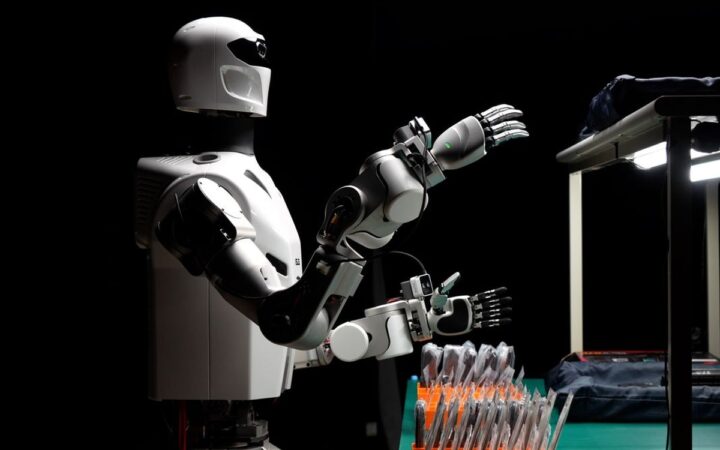
One experiment transfers a toy-truck assembly task from demonstrations made with a handheld gripper to a YAM robot arm, reaching 60% success in NVIDIA’s tests without task-specific YAM teleoperation. Another uses DexUMI wearable-hand demonstrations to teach a two-handed robot breakfast preparation, including handling a banana and a granola jar.
The breakfast footage above is NVIDIA’s physical robot demonstration. It gives readers a closer view of coordinated hand movements, where the relevant challenge includes gripping, opening and repositioning objects as a sequence. NVIDIA’s reported results remain measurements of defined research tasks, with the training arrangements described in its paper.
Predicting the Next Action and Its Consequences
On its project page, NVIDIA explains that GR00T 2 predicts future observations and actions together. That gives the model a way to connect a movement with an expected change in the scene. The system can then use fresh observations as it continues the task.
For a robot, the destination alone is an incomplete instruction. Moving a cup requires a reachable grasp, a suitable path and a controlled release. Changing the robot’s hand changes those mechanics even when the goal remains identical. Transferring a skill therefore means preserving the useful parts of the demonstration while generating actions that the receiving machine can execute.
The lighter GR00T 2 Turbo extends the approach to a Unitree G1 humanoid. NVIDIA reports that it runs onboard Jetson Thor and works with the SONIC controller for whole-body movement. Demonstrations include serving popcorn and clearing objects from a table, bringing balance and locomotion into the same workflow as manipulation.
Our earlier GR00T 2 analysis examines the architecture, adaptation results and benchmark qualifications in detail. This latest footage provides a visual companion to those findings, rather than evidence of a new commercial robot rollout.
What Comes Next for Real-World Deployment
Industrial interest is already part of NVIDIA’s announcement. In its November 9 CoRL update, the company says Foxconn is applying GR00T 2 to server-manufacturing automation, Siemens is evaluating industrial use cases and Nexuni is testing robotic laundry handling. Those statements describe company activity without establishing a shared production schedule or a measured factory-wide improvement.
The commercial question is how well a transferred skill survives changes in objects, lighting, layouts and equipment. Collecting fewer demonstrations could make a new task easier to introduce, but operators also need repeatable performance, recoveries from mistakes and a clear way to check when the robot should stop. Our broader CoRL coverage explains how simulation and evaluation tools address that testing work.
As of November 13, the GR00T 2 project page lists code availability for December. The new videos show the research direction clearly: human demonstrations can become reusable training material across machines, while each physical deployment still depends on the robot, its controls and the conditions in which it works.
Disclaimer: RobotsBeat is an independent media brand owned and operated by NuvexMedia LLC, publishing news, research, and insights on artificial intelligence, emerging technologies, automation, and related industries. NuvexMedia LLC invests in and collaborates with companies across the AI, Robotics, technology, software, and digital innovation sectors. These relationships do not influence RobotsBeat's editorial coverage, and the publication maintains full editorial independence to provide accurate, timely, and objective information. © 2026 NuvexMedia LLC. All rights reserved. This content is for informational purposes only and should not be considered legal, tax, investment, financial, or other professional advice.