
Key Notes
- Beijing’s new action plan seeks annual production capacity for 200,000 embodied AI robots by 2028, while coordinating manufacturers and component suppliers across the Beijing-Tianjin-Hebei region.
- The roadmap connects factory expansion with more than one million hours of training data, dedicated computing resources and testing in real operating environments.
- Reliability, battery endurance and commercial applications are explicit development goals, so the capacity headline should be read alongside the work still required to build useful machines and secure customers.
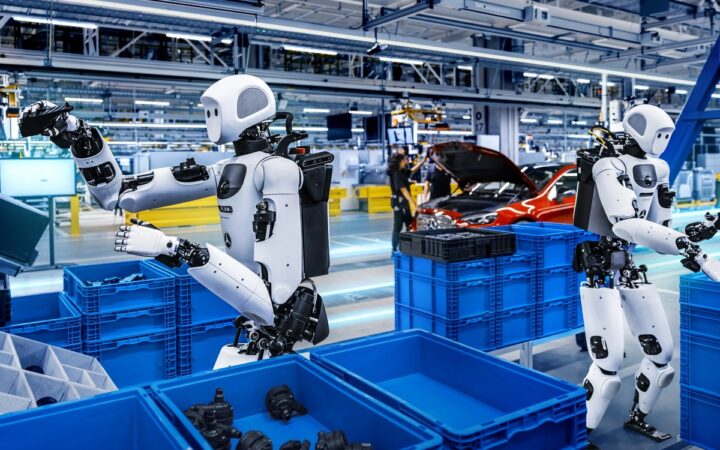
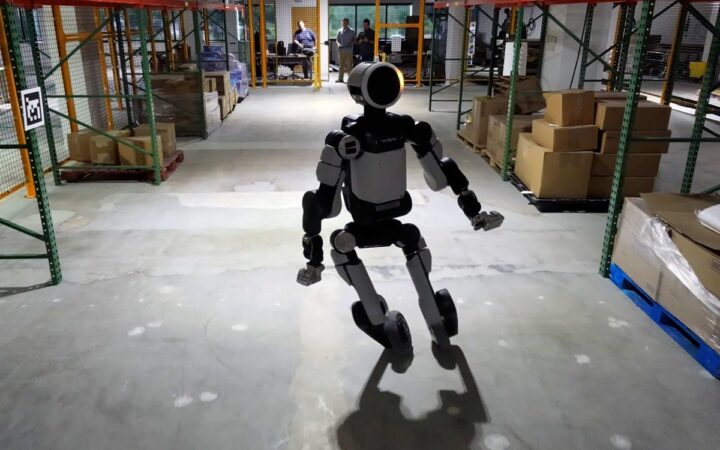
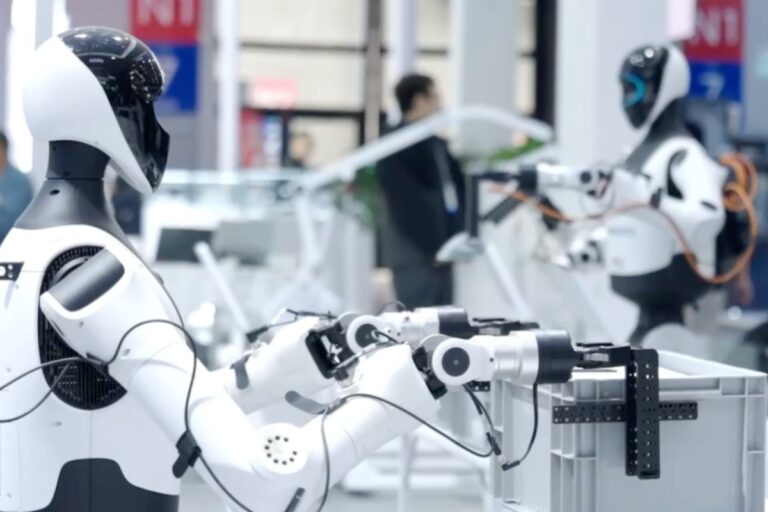
Beijing has set a goal of building annual production capacity for 200,000 embodied AI robots by 2028, under a new industrial roadmap published on November 11. The plan reaches beyond robot assembly, linking manufacturing expansion with AI models, training data, components, commercial applications and safety testing.
The Beijing Municipal Bureau of Economy and Information Technology’s action plan covers 2026–2028. Its figures describe development goals: factory capacity will still have to translate into machines that customers can deploy economically.
A Regional Supply Chain Behind the Capacity Goal
The 200,000-unit target concerns annual whole-robot production capacity in Beijing, supported by both contract manufacturing and companies’ own production lines. It is not a forecast of confirmed sales or a count of robots already operating.
The broader roadmap seeks to give the Beijing-Tianjin-Hebei region 25% of China’s whole-robot production capacity and raise regional component support above 60%. That connects the capital’s research and robot companies with manufacturing and suppliers in neighboring areas.
For buyers, assembly capacity is only one part of scale. A robot also needs repeatable component quality, maintenance support and a task valuable enough to justify its operating cost. Those requirements make the plan’s engineering and application targets as consequential as its production headline.
Training Infrastructure Becomes an Industrial Priority
The roadmap calls for more than one million hours of high-quality data from at least 100 real-world settings. It also proposes dedicated embodied AI computing clusters with combined capacity exceeding 50,000 PFLOPS and a testing environment spanning different robot bodies.
The data target addresses the variety of situations robots encounter beyond a fixed demonstration. A model trained on one workspace needs evaluation when objects, lighting, layouts or hardware change. Increasing the volume of data is useful only alongside checks on its quality and relevance.
Beijing already has companies building that supporting infrastructure. X-Humanoid’s data platform describes collection services for different robot configurations and workflows connecting collection, training, inference and deployment. Our reporting on China’s robot trainers examines the human labor behind such datasets.
Reliability and Endurance Get Concrete Targets
The plan sets hardware goals including rated payload above 40% of a robot’s own weight, mean time between failures exceeding 2,000 hours, a design life longer than five years and more than four hours of battery endurance under continuous operation.
These are development objectives rather than independently verified specifications for robots currently on sale. Mean time between failures is a reliability measure; it should not be treated as a guarantee that every machine will run for exactly that period without an incident.
The emphasis is commercially significant. A fast demonstration cannot establish how much useful work a machine will complete over a shift. Charging, recovery, repairs and interventions all affect whether an installation delivers the productivity its buyer expects.
Applications and Safety Must Grow With Manufacturing
The roadmap seeks benchmark applications across industrial, service and specialist settings, along with scalable solutions for work, commerce, homes and elder services. It also calls for third-party testing and a one-robot, one-code identity system covering the machine’s lifecycle.
Those measures would help connect development to practical acceptance: users need to define tasks, test performance and trace problems after deployment. The policy does not itself establish that the planned applications have been delivered or that all commercial robots already meet its reliability goals.
A Broader Physical AI Competition
Our coverage of Tien Kung 3.0 follows one Beijing platform aimed at developers and practical applications. The new roadmap addresses the surrounding conditions needed for many such platforms to grow, from parts supply to training and validation.
Runway’s Praxis-1 release shows another part of the competition: opening robot AI models to outside developers. Beijing is setting a wider industrial agenda around embodied AI. The test through 2028 will be whether that coordination produces reliable, repeatable work and customer adoption alongside added factory capacity.
Disclaimer: RobotsBeat is an independent media brand owned and operated by NuvexMedia LLC, publishing news, research, and insights on artificial intelligence, emerging technologies, automation, and related industries. NuvexMedia LLC invests in and collaborates with companies across the AI, Robotics, technology, software, and digital innovation sectors. These relationships do not influence RobotsBeat's editorial coverage, and the publication maintains full editorial independence to provide accurate, timely, and objective information. © 2026 NuvexMedia LLC. All rights reserved. This content is for informational purposes only and should not be considered legal, tax, investment, financial, or other professional advice.