
Key Notes
- Serve launched its AV Delivery Developer Portal on November 11, letting applications and AI assistants request quotes, create delivery jobs and track them through completion.
- Sandbox testing uses simulated couriers, while live dispatch requires separate production credentials, Serve’s approval and access to an active operating zone.
- The company’s existing fleet remains subject to available robots, service hours, cargo limits and trained remote supervision, rather than becoming an unrestricted public robot network.
Serve Robotics has opened a public delivery API and developer portal that lets outside applications request jobs from its sidewalk robot fleet. The November 11 announcement extends access beyond large delivery-platform partners to developers, businesses and AI assistants.
The public sandbox supports testing with simulated robots. Live dispatch requires Serve’s approval, a production credential and access to a supported service area, so the launch does not give every developer immediate control of a real courier.
Quote, Dispatch and Track a Delivery
Serve’s developer documentation describes three core steps. An application requests a delivery quote, creates a job using that quote and then tracks the job through completion. The quote returns a fee and estimated arrival time without reserving a robot or charging for a delivery.
The distinction separates checking whether a job is practical from committing it to the fleet. Serve handles dispatch, routing, navigation and supervision, while the application supplies the pickup, destination and delivery information. An AI assistant would use that same service interface rather than replacing the robot’s navigation system.
Sandbox Testing Comes Before Fleet Access
The sandbox runs a delivery lifecycle without moving a real courier. It also lets an integration exercise failure cases before a customer depends on it. Serve’s documentation says partner signup is not yet fully self-service, with interested teams directed to a waitlist.
A working sandbox integration therefore establishes that the software can communicate with the service. Production use adds separate fleet access and credentials, as well as the requirement that both ends of the delivery fall inside an active operating zone.
Availability Still Depends on Robots and Routes
The developer guide makes several operating limits explicit. A quote expires after five minutes and can be used once. A couriers-busy response means no robot is currently free, and repeated delivery requests need to be handled so that a retry does not create a second job.
The company also limits deliveries to active service areas, operating hours and cargo that fits inside the robot. It says trained supervisors continue to monitor API-dispatched couriers. Those conditions remain part of the service even when the request originates in an automated workflow.
Opening the Fleet Is a New Product
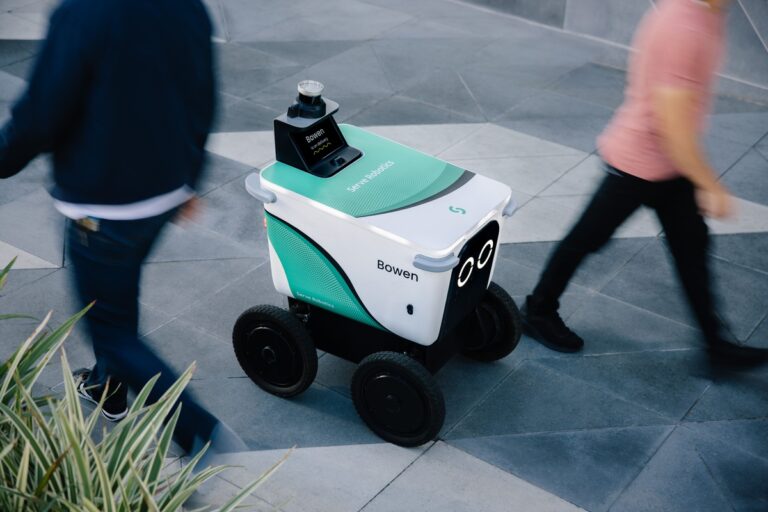
Serve describes a fleet of more than 2,000 robots deployed across the United States and Australia, with its delivery network serving more than 150 neighborhoods in 20 US cities. These are company-reported coverage and deployment figures; they do not establish that every robot is available for API jobs at a particular time.
RobotsBeat previously covered Serve’s infrastructure services, announced November 5 for companies building robots. The new portal opens access to delivery operations on Serve’s own fleet, rather than supplying that underlying technology to another manufacturer.
Our Avride delivery coverage follows another route to expanding robot delivery through a platform partnership. Serve is adding a developer channel, with the commercial test now resting on how new applications translate into completed jobs within the network’s operating limits.
Disclaimer: RobotsBeat is an independent media brand owned and operated by NuvexMedia LLC, publishing news, research, and insights on artificial intelligence, emerging technologies, automation, and related industries. NuvexMedia LLC invests in and collaborates with companies across the AI, Robotics, technology, software, and digital innovation sectors. These relationships do not influence RobotsBeat's editorial coverage, and the publication maintains full editorial independence to provide accurate, timely, and objective information. © 2026 NuvexMedia LLC. All rights reserved. This content is for informational purposes only and should not be considered legal, tax, investment, financial, or other professional advice.