Key Notes
- Impossible Metals says Eureka autonomously collected about 450 grams of scientific samples at a depth beyond 4,000 meters during a September Pacific expedition.
- The robot hovers above the seabed and is designed to select nodules without visible life, while environmental benefits still require measured validation.
- The November 9 announcement precedes a planned 2027 environmental study of a larger vehicle and does not establish commercial-scale collection throughput.
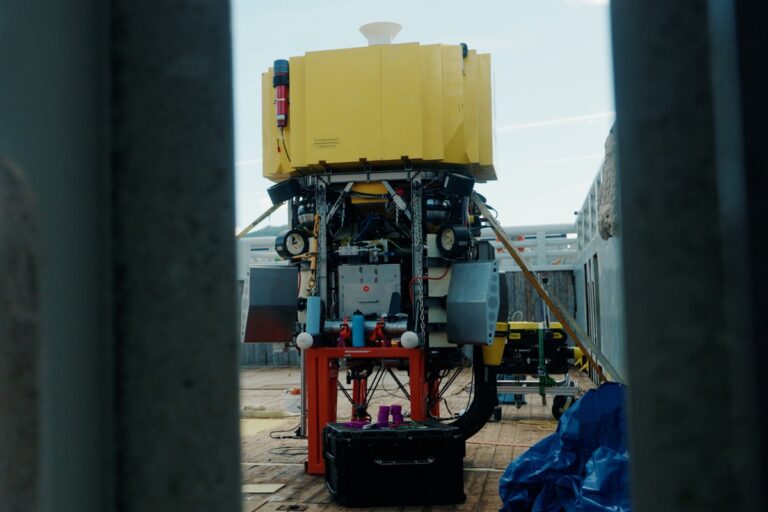
Impossible Metals says its autonomous Eureka robot has collected polymetallic nodules from more than 4,000 meters below the Pacific Ocean’s surface. Announced on November 9, the trial tested a machine that hovers above the seabed and selects individual targets instead of driving a collector across the ocean floor.
The company’s announcement describes a scientific dive in the Clarion-Clipperton Zone. The robot recovered approximately 450 grams of nodules for research partner Viridian Biometals to study the bacteria living within them. The small sample reflects the stated scientific purpose of the expedition.
An Autonomous Mission at Deep-Ocean Pressure
Reuters reported that the test took place during a September expedition. According to that account, the vehicle navigated to the seabed, retrieved its sample and returned to the surface. The announcement is new; the physical dive did not take place this week.
For robotics, the result brings perception, manipulation and underwater vehicle control into one mission. A machine working at that depth must identify a target, maintain its position while collecting it and complete the return journey. Demonstrating that sequence is a different milestone from establishing the throughput of a commercial fleet.
Selecting Nodules Rather Than Sweeping the Seabed
Impossible Metals says its perception system looks for visible life on and around nodules and leaves those targets in place. A buoyancy mechanism lifts the payload through water displacement, avoiding the riser pipe used by other collection approaches.
The company website describes Eureka as a system built around individual collection decisions. The environmental aim is reduced disturbance, but avoiding visible organisms does not by itself establish the full impact on habitats, sediments or less visible life. The company itself says environmental performance has to be measured.
A Scientific Trial Before Larger-Scale Testing
The company says scientific data from the dive will be published openly. It also plans a 2027 environmental study involving the larger Eureka III vehicle, an independent scientific team and the German research vessel RV SONNE, under a study initiated by Germany’s Federal Institute for Geosciences and Natural Resources.
Those are future validation steps. The release does not turn a 450-gram research sample into evidence of sustained commercial output, and the 2027 plan should not be read as a completed environmental assessment.
Robotics as a Service for Resource Holders
Impossible Metals intends to supply and operate the collection system for licensed resource holders through a robots-as-a-service model. It also disclosed backing from In-Q-Tel and the Smith family of FedEx, without announcing a new funding-round amount.
Our report on Kraken’s subsea orders covers the batteries and sensing systems behind underwater operations. The Greenland robot expedition illustrates another research use of ocean robots. Eureka adds a deep-ocean manipulation trial, with scaling, operating economics and environmental evidence still needing separate evaluation.
Disclaimer: RobotsBeat is an independent media brand owned and operated by NuvexMedia LLC, publishing news, research, and insights on artificial intelligence, emerging technologies, automation, and related industries. NuvexMedia LLC invests in and collaborates with companies across the AI, Robotics, technology, software, and digital innovation sectors. These relationships do not influence RobotsBeat's editorial coverage, and the publication maintains full editorial independence to provide accurate, timely, and objective information. © 2026 NuvexMedia LLC. All rights reserved. This content is for informational purposes only and should not be considered legal, tax, investment, financial, or other professional advice.