
Key Notes
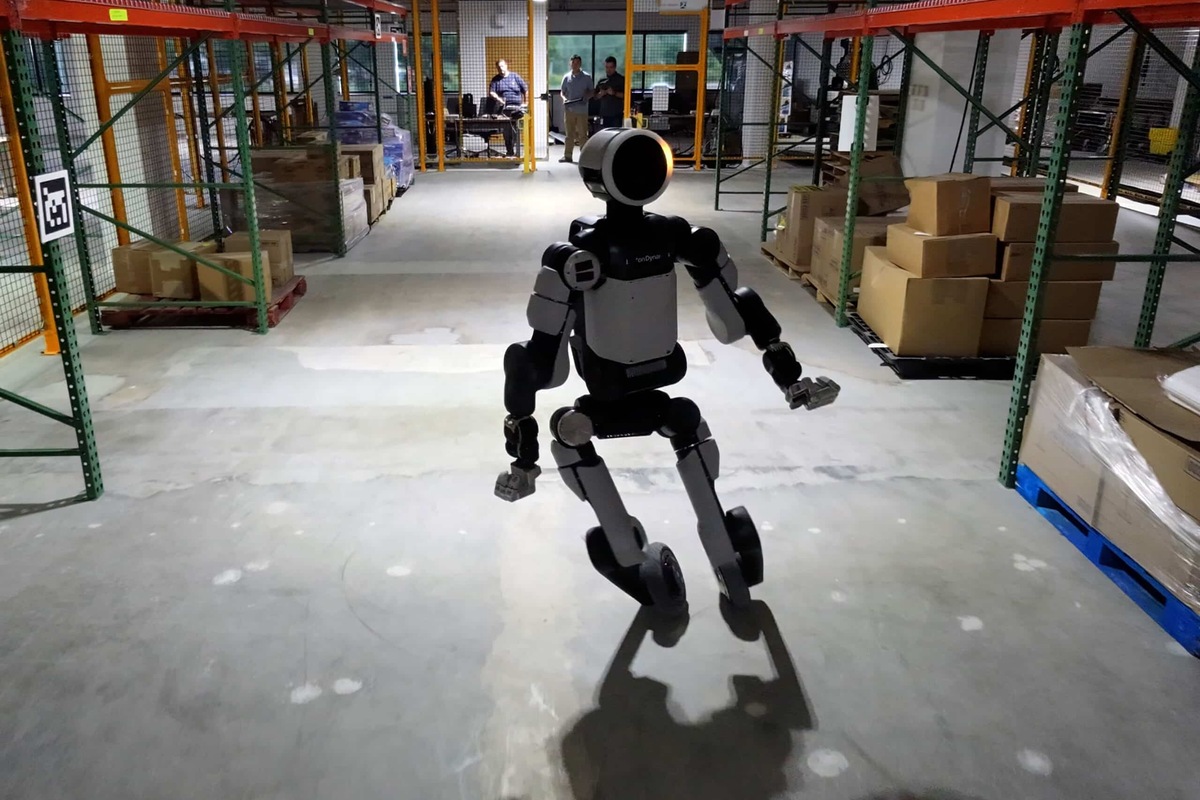
- Boston Dynamics has demonstrated Atlas rolling, drifting and performing a 360-degree jump after replacing its feet with wheels for a motor-control research experiment.
- The team combines reinforcement learning in simulation with measured actuator behavior, while some maneuvers draw on human motion-capture examples.
- The wheeled configuration is a research testbed, with lessons being adapted to standard Atlas and further work planned on responses to actuator failures.
Boston Dynamics has fitted wheels to Atlas, sending its humanoid robot skating, drifting and jumping through a full 360-degree turn. The company’s November 9 video presents the unusual configuration as an experiment in motor performance and learned whole-body control, with lessons intended for the standard robot.
The embedded official video follows Atlas controls engineer Xiaoyu “Andy” Wu through the project. The wheeled machine is a research testbed, and Boston Dynamics has not announced it as a product for sale.
Why Put Wheels on a Humanoid?
Wheels create a demanding combination of continuous load, speed and torque during starts, turns and stops. In a technical account, Wu describes fitting scooter rims to existing ankle actuators with a custom adapter. The robot model then treats each wheel as an ankle capable of continuous rotation.
That relatively small physical change creates a very different control problem. A robot that rolls must coordinate its body with a moving support point; a command that changes direction also changes how the machine must balance. The experiment gives engineers a way to examine those interactions on the same core humanoid hardware.
Human Motion Helps Teach the 360-Degree Jump
Wu says the spinning jump began with a motion-capture recording of a person performing the movement. A trajectory-tracking policy learned to follow that example, and he reports that the hardware attempt worked on its first try. That statement describes the demonstration, rather than a published success rate across repeated trials.
The video also explains the sideways dashes. Where the human reference involved sliding feet, the learned controller used the wheels to roll. Wu describes driving the robot and exploring the response, so the footage should be understood as a control experiment rather than evidence of autonomous navigation through an unfamiliar workplace.
Making Simulation Respect the Motors
Boston Dynamics says the team aligned low-level control settings and tuned its simulated motor model against measurements from Atlas. The engineering objective is to stop a learned policy depending on movements that an idealized simulation permits but the physical actuators cannot deliver.
In practical terms, a convincing simulation must represent the limits that matter during a maneuver. Otherwise a movement can look stable on a screen and fail when real motors, contact and load enter the loop. Our CoRL coverage examines the wider effort to connect simulation, robot training and physical evaluation.
What the Experiment Means for Standard Atlas
The company says insights from the wheeled setup are being adapted to Atlas in its standard configuration. In the video, Wu identifies another research direction: helping learned controllers respond when an actuator fails. This is ongoing work, without a demonstrated general solution to hardware failures in the release.
RobotsBeat’s reports on Atlas’s four-finger hands and the prototype workshop show other parts of that development process. Better manipulation, serviceable hardware and dependable movement have to work together before an industrial humanoid can perform useful jobs consistently.
Disclaimer: RobotsBeat is an independent media brand owned and operated by NuvexMedia LLC, publishing news, research, and insights on artificial intelligence, emerging technologies, automation, and related industries. NuvexMedia LLC invests in and collaborates with companies across the AI, Robotics, technology, software, and digital innovation sectors. These relationships do not influence RobotsBeat's editorial coverage, and the publication maintains full editorial independence to provide accurate, timely, and objective information. © 2026 NuvexMedia LLC. All rights reserved. This content is for informational purposes only and should not be considered legal, tax, investment, financial, or other professional advice.