
Key Notes
- Reported robot-training jobs pay 4,000–6,000 yuan monthly, a range from individual roles rather than a national wage average.
- One worker described repeating dishwashing and table-wiping around 200 times a day, illustrating the repetition involved in producing physical demonstrations.
- Recorded episodes still require quality checks and real-robot evaluation, so data-collection work should not be confused with proof that robots can perform those chores independently.
Workers in China are earning money by repeatedly performing household chores to create robot-training data, highlighting the human labor behind efforts to automate physical work. Reported roles pay 4,000–6,000 yuan a month, described by the South China Morning Post as roughly US$600–US$900.
The newspaper’s October 14 report describes workers wearing motion-capture equipment while demonstrating ordinary actions. The wage range concerns the reported jobs; it is not a national average or a guarantee for everyone entering the field.
Repetitive Chores Become Training Examples
One worker, 40-year-old Liu Yun, described washing dishes and wiping tables around 200 times a day as her limit. At the Beijing studio where she worked, the reported daily quota was 160 samples, while leading performers exceeded 260. The 200 figure therefore reflects an individual account rather than a uniform requirement across the industry.
The report also describes a student earning 120 yuan for a day shift or 135 yuan for a night shift, and a home-based worker earning around 4,000 yuan monthly. These arrangements show differing hours and working conditions rather than a single standardized robot-trainer job.
Recording a Movement Is Only the First Step
In this work, the immediate product is usable data rather than a clean plate or folded garment. A demonstration needs to capture the action clearly enough for a training pipeline to interpret it and connect it with the task.
Data-capture company PhysenAI describes a workflow that combines human demonstrations, cameras and contact signals with data curation, policy training and robot evaluation. Its platform emphasizes defined task protocols, quality checks and targeted collection after failures.
That distinction matters when assessing productivity targets. Counting recorded episodes alone does not establish how much useful learning they provide. Repeated examples can help expose variation, but inconsistent recordings or poorly defined tasks can leave developers with more material to review rather than better robot behavior.
The Workforce Behind Physical AI
RobotsBeat’s earlier trainer coverage examined the role of specialized training centers. The newer worker accounts add a different perspective: the pay, repetition and practical demands of producing the data those systems consume.
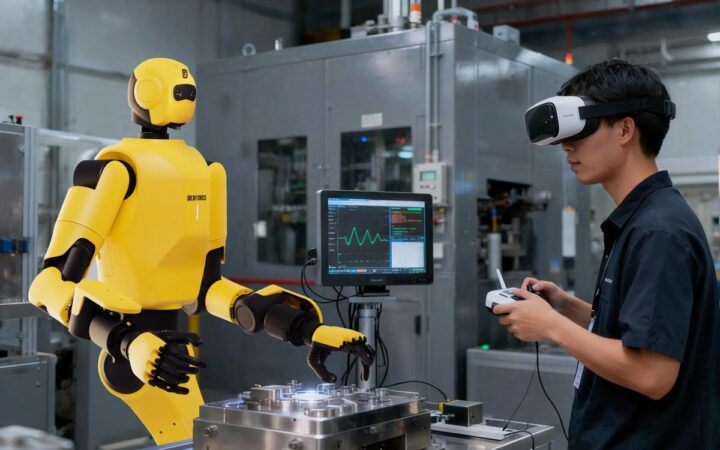
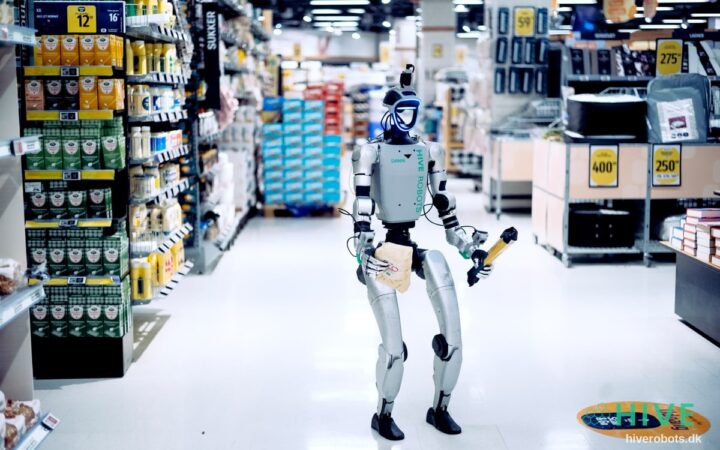
Other developers are trying to reduce dependence on repeated physical demonstrations. Dexforce’s approach uses synthetic scenes, while the Føtex pilot collects demonstrations within a working supermarket. These approaches address different parts of the data problem.
The reported jobs do not establish that robots can already replace the people demonstrating the tasks. That requires a separate test of autonomous performance. For now, the story reveals a labor-intensive step between the ambition to automate chores and the evidence needed to make a machine perform them reliably.
Disclaimer: RobotsBeat is an independent media brand owned and operated by NuvexMedia LLC, publishing news, research, and insights on artificial intelligence, emerging technologies, automation, and related industries. NuvexMedia LLC invests in and collaborates with companies across the AI, Robotics, technology, software, and digital innovation sectors. These relationships do not influence RobotsBeat's editorial coverage, and the publication maintains full editorial independence to provide accurate, timely, and objective information. © 2026 NuvexMedia LLC. All rights reserved. This content is for informational purposes only and should not be considered legal, tax, investment, financial, or other professional advice.