Key Notes
- Tether’s roughly 254-million-parameter TranscribePsy family offers local speech recognition as a building block for humanoid robots, phones and wearable applications.
- The main model supports 25 European languages, while specialized GGUF and Core ML mobile versions support eight languages with hardware-specific deployment requirements.
- The headline 1.65-second iPhone result measures batch transcription of a ten-minute recording excluding cold start, rather than streaming or complete robot response time.
Tether AI Research has released QVAC TranscribePsy, a compact speech-recognition model intended to let developers process voice locally on phones, smart-glasses companion devices and humanoid robots. The release targets the speech-to-text layer of those systems, rather than introducing a finished robot or wearable product.
Tether announced the model on October 14. It says local processing can avoid uploading audio for transcription, an important consideration for machines that listen in homes and workplaces.
A Compact Speech Model for Onboard Computing
The official model card describes a roughly 254-million-parameter family distilled from NVIDIA’s Parakeet-TDT-0.6B-v3. The main checkpoint supports 25 European languages, while specialized mobile builds cover eight: Dutch, English, French, German, Italian, Polish, Portuguese and Spanish.
The release includes PyTorch checkpoints, an 8-bit GGUF version for phone CPUs and a Core ML version for Apple’s Neural Engine. Open weights and evaluation materials allow developers to inspect and test the system, with the model cards listing an Apache 2.0 license and documenting underlying model and dataset licenses.
For a robot developer, a smaller transcription model could leave more computing capacity for perception and control. It would still need to be integrated with microphones, speech interpretation and the software that decides which actions are permitted.
What the iPhone Speed Result Measures
Tether highlights transcription of a ten-minute recording in 1.65 seconds on an iPhone 17 Pro Max. The Core ML documentation specifies that this measurement excludes cold start and concerns batch transcription, not streaming.
The same card reports 32.8 seconds for a different workload consisting of 160 short utterances totaling 40 minutes. It explains that fixed input windows make short clips less efficient than a sustained recording. The 1.65-second figure therefore should not be interpreted as the response time of an entire voice-controlled robot.
The documented Core ML limitations also include eight-language coverage, Apple hardware requirements and a warning against safety-critical automated decisions. These constraints matter when comparing a transcription benchmark with a real interaction involving speech, reasoning and movement.
Local Transcription Is One Part of Private Robotics
Keeping transcription on a device removes one reason to send audio to a remote service. It does not automatically determine whether recordings are retained, whether transcripts reach another model, or who can access the resulting information. Those choices depend on the application built around the model.
Likewise, recognizing a spoken instruction does not establish that a physical action is safe or authorized. A robot still needs checks for ambiguous commands, failed recognition and situations in which it should ask for clarification.
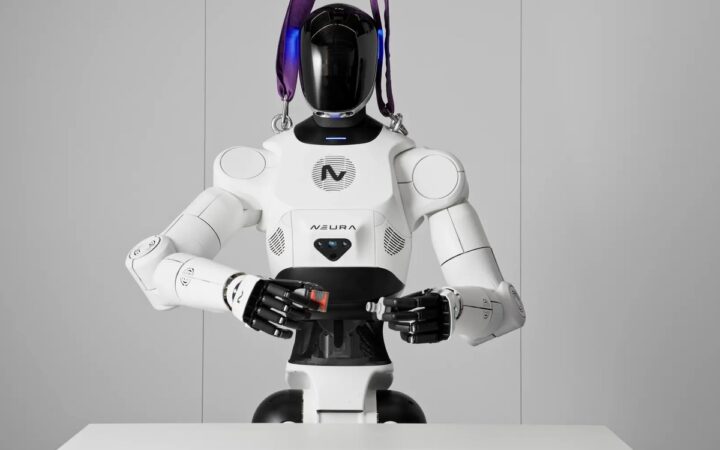
RobotsBeat’s coverage of airport assistants examines one setting for human-facing robots, while NEURA’s Neuron AI addresses a broader combination of sensory inputs. TranscribePsy contributes a narrower building block: converting audio into text on local hardware, with actual robot integration still a separate engineering task.
Disclaimer: RobotsBeat is an independent media brand owned and operated by NuvexMedia LLC, publishing news, research, and insights on artificial intelligence, emerging technologies, automation, and related industries. NuvexMedia LLC invests in and collaborates with companies across the AI, Robotics, technology, software, and digital innovation sectors. These relationships do not influence RobotsBeat's editorial coverage, and the publication maintains full editorial independence to provide accurate, timely, and objective information. © 2026 NuvexMedia LLC. All rights reserved. This content is for informational purposes only and should not be considered legal, tax, investment, financial, or other professional advice.