
Key Notes
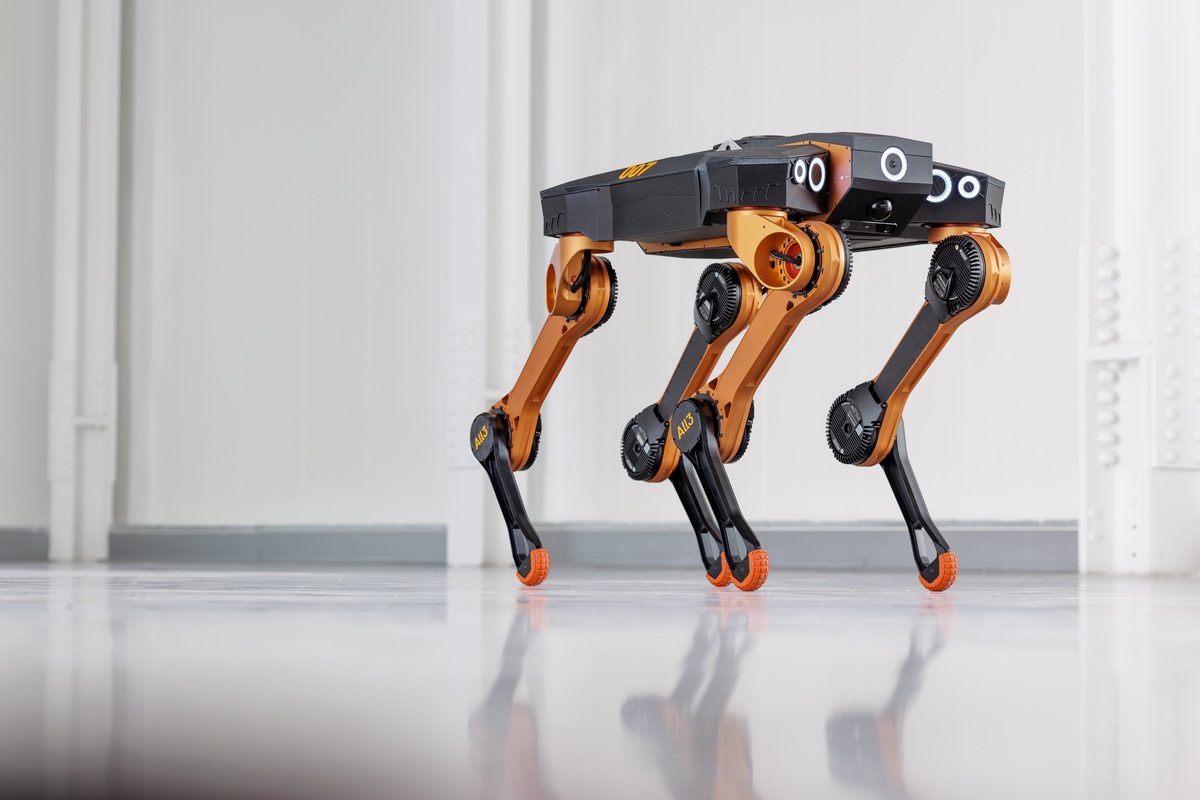
- All3’s redesigned Mantis uses a 135kg electric quadruped platform and a 45kg working arm, with autonomous stair climbing and structural fastening demonstrated in company tests.
- The robot is designed to carry up to 100kg while walking and fits through standard doorways, while its reported fastening precision of 0.5mm comes from repeated demonstrations rather than a reliability study.
- Live construction deployment is planned for early 2027, alongside a funded programme developing cooperative panel assembly, autonomous battery swapping and digital verification.
All3 has unveiled a redesigned Mantis construction robot that climbs stairs and drives structural screws autonomously in company tests. The four-legged electric platform is intended to assemble building components on-site, with its first live construction deployment planned for early 2027.
The company’s October 7 announcement describes a 135kg platform, excluding its working arm, designed to carry loads of up to 100kg while walking. In an October 8 interview, co-founder and CEO Rodion Shishkov and robotics lead Napo Montano explained why they built a machine around construction forces and access constraints rather than human proportions.
A Stable Base That Fits Through Doorways
Mantis changes between a wider working stance and a narrow configuration measuring 750mm across, allowing it to pass through a standard 900mm doorway. Its six-axis arm currently reaches about 1.8m; a telescopic version designed for 4m reach remains in development.
That layout separates working height from body height. The robot can extend a tool toward a wall without needing an unusually tall chassis, while four feet provide a base for resisting the reaction forces generated during fastening.
All3 says the platform climbed stairs autonomously with a 45kg arm attached, using onboard sensing rather than motion capture, a tether or joystick control. Its stated stair capability reaches a 35-degree incline. The company’s 100kg payload figure is a design target and should not be read as the load carried in that stair demonstration.
Fastening Moves Beyond Site Inspection
In repeated company demonstrations, Mantis located and drove screws into eight target holes without an operator. All3 reports tool-tip precision within 0.5mm, approximately 900 newtons of thrust and 20 newton-metres of torque. The company explicitly describes the fastening result as a demonstration outcome rather than a reliability statistic.
The distinction matters because reaching a target once is different from completing a shift across varying materials and site conditions. Repeat tests are evidence of progress, but their value for contractors depends on the range of conditions tested and the frequency of interventions.
RobotsBeat previously covered McLaren’s deployment of quadrupeds for inspection, scanning and progress verification. Mantis targets a different role: applying force to building components and recording the physical work completed.
Learned Walking, Separate Motor Control
Montano describes a layered control system with a dedicated real-time controller running 1,000 times per second. Learned components operate above that layer and do not directly command the motors. Walking uses a gait trained in simulation, while fastening combines learned hole detection with conventional control of the tool.
The split reflects two different requirements. Locomotion must adapt to changing footholds; a fastening tool must maintain alignment while pushing against a structure. Neither capability alone establishes that the complete construction workflow is ready for unsupervised use.
Mission Control connects the robot to the building model, dispatches tasks and receives results. All3’s approach also includes designing and manufacturing components for robotic assembly, so Mantis is part of a coordinated building process rather than a general-purpose machine added to any existing site.
Fleet Coordination Is the Next Step
An Innovate UK project, running for twelve months from August 2026, supports coordinated operation by multiple Mantis robots. Its objectives include one robot holding a panel while another fastens it, autonomous battery swapping and checking completed work against the digital building model.
Those are development goals. The platform already has two hot-swappable battery packs, but automatic swapping and sustained cooperative site operation belong to the next stage of validation.
Our coverage of Stuttgart’s construction teams examined similar questions about distributing assembly work across machines. For Mantis, the decisive milestone will be its planned move onto a live All3 project, where access, coordination and fastening must work together amid a changing building site.
Disclaimer: RobotsBeat is an independent media brand owned and operated by NuvexMedia LLC, publishing news, research, and insights on artificial intelligence, emerging technologies, automation, and related industries. NuvexMedia LLC invests in and collaborates with companies across the AI, Robotics, technology, software, and digital innovation sectors. These relationships do not influence RobotsBeat's editorial coverage, and the publication maintains full editorial independence to provide accurate, timely, and objective information. © 2026 NuvexMedia LLC. All rights reserved. This content is for informational purposes only and should not be considered legal, tax, investment, financial, or other professional advice.