
Key Notes
- South Korea opened the Army’s Pangyo physical AI hub on October 12, with Ajou University leading research and testing for humanoid and multilegged robots.
- Proposed missions include hazardous-area supply transport, explosive ordnance disposal, mine clearance and chemical, biological and radiological reconnaissance to reduce personnel exposure.
- Pangyo is the first opening in a five-hub program that also covers command and control, agentic AI, maritime logistics and Air Force applications, with field performance still to be validated.
South Korea opened a defense research hub at Pangyo Techno Valley on October 12 to develop physical AI for humanoid and multilegged robots. The facility will collect operational data and test AI models for dangerous missions, including explosive ordnance disposal, mine clearance and transporting supplies into hazardous areas.
The Defense Ministry’s launch announcement identifies the Army’s Pangyo site as the first opening in a planned network of five defense AI transformation hubs. Ajou University is the lead institution for the center, which connects military requirements with civilian research and technology companies.
Physical AI for Dangerous Field Tasks
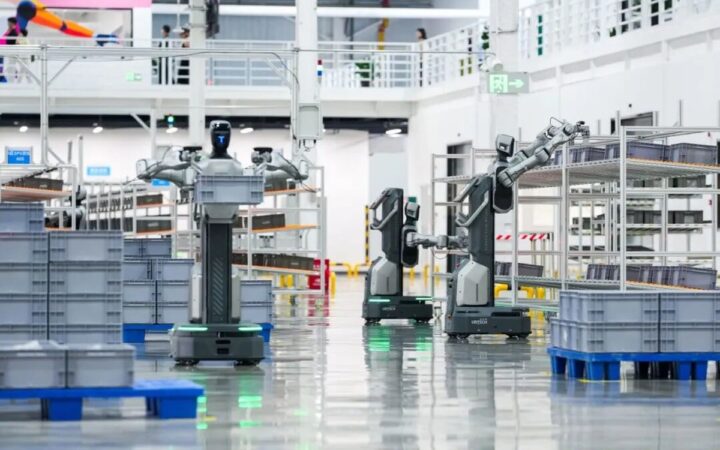
Pangyo’s focus is the connection between AI models and machines acting in the physical world. The ministry plans to gather physical AI data, use it to train models and validate those models on humanoid and multilegged platforms. Chemical, biological and radiological reconnaissance is another proposed application.
The intended benefit is to reduce personnel exposure while improving mission performance. These are development goals: the opening announcement does not establish that robots trained at the new center are already performing those missions operationally.
For such work, perception and movement have to remain dependable beyond a prepared demonstration. Uneven ground, unfamiliar objects and changing visibility can affect both what a robot understands and how it moves. A research hub provides a place to evaluate those problems before a system is accepted for field use.
That emphasis on removing people from immediate danger connects with Minerva’s Roger humanoid, previously covered by RobotsBeat. Minerva’s approach keeps a trained operator responsible for critical decisions while the robot handles parts of movement and control; the Korean announcement does not specify an equivalent control architecture.
Five Hubs With Different Military Roles
The wider program separates physical robotics from other defense AI applications. The Joint Chiefs of Staff’s Yongsan hub, led by Korea University, will test command-and-control applications using classified data. The Army’s Daejeon hub, led by KAIST, will concentrate on agentic AI.
In Busan, UNIST will lead work with the Navy and Marine Corps on maritime AI transformation, including intelligent logistics support. Seoul National University will lead the Air Force’s Yangjae hub, where automated target identification is among the planned research areas.
The ministry’s earlier program outline assigned 19 billion won to the cooperation-center initiative for 2026. That is funding for the broader program, rather than a disclosed budget solely for Pangyo. Hannam University was selected to provide common AI infrastructure across the centers.
Ajou’s June selection notice described Pangyo as a development and demonstration base for physical AI supporting battlefield awareness and manned-unmanned teaming. It also highlighted the local concentration of software companies and research organizations as a way to connect military demand with civilian expertise.
Turning Operational Data Into Tested Capability
The program includes shared computing resources and protected environments for working with defense data. That gives the centers a role beyond showcasing hardware: researchers need access to relevant information, a way to evaluate models and a route for testing results with military users.
Data collection is also central to the civilian robotics effort described in our LG coverage. The applications differ, but both efforts address the need to connect robot training with the environments in which machines are expected to work.
For Pangyo, the meaningful next milestones will be defined test tasks and measured results: successful completion, failure recovery, supervision requirements and safe behavior when conditions change. The opening establishes a place for that development; dependable field capability will have to be demonstrated through the research that follows.
Disclaimer: RobotsBeat is an independent media brand owned and operated by NuvexMedia LLC, publishing news, research, and insights on artificial intelligence, emerging technologies, automation, and related industries. NuvexMedia LLC invests in and collaborates with companies across the AI, Robotics, technology, software, and digital innovation sectors. These relationships do not influence RobotsBeat's editorial coverage, and the publication maintains full editorial independence to provide accurate, timely, and objective information. © 2026 NuvexMedia LLC. All rights reserved. This content is for informational purposes only and should not be considered legal, tax, investment, financial, or other professional advice.