
Key Notes
- The AWS Physical AI Toolchain combines cloud infrastructure with NVIDIA simulation and training tools, allowing developers to adopt individual modules or connect a broader workflow.
- Amazon cites experience operating more than one million robots, but the announcement does not provide public access to a dataset from the entire fleet.
- The Apache-licensed sample repository includes a robotic pick-and-place example, while its dedicated edge-deployment module and hosted AgentCore runtime remain planned.
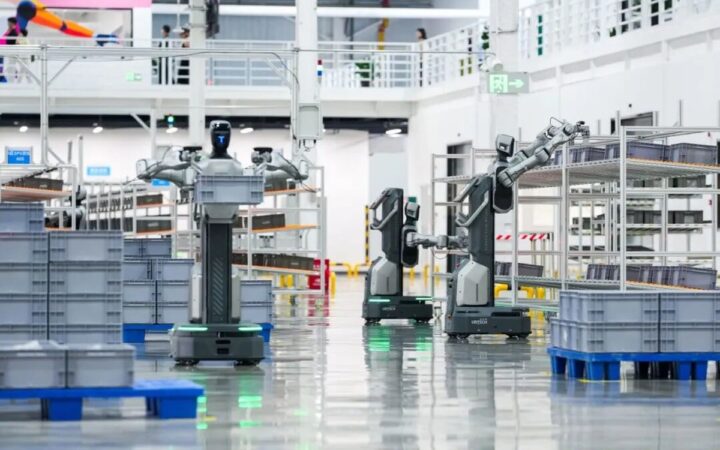
Amazon Web Services has launched the Physical AI Toolchain on AWS, bringing NVIDIA robotics software together with cloud infrastructure for training, simulation and deployment. The open-source project targets the engineering work between a robot demonstration and a system that can operate reliably in a factory or warehouse.
AWS published its technical announcement on October 7. The package includes reference architectures, infrastructure code and deployment automation, allowing developers to use individual components rather than replace their existing workflow.
From Training Data to Robot Behavior
The stack combines NVIDIA Isaac Sim for simulation, Isaac Lab for reinforcement learning, GR00T for learning from demonstrations and Cosmos for generating synthetic data. AWS supplies computing, storage and managed training services around those tools.
Amazon’s overview describes a development cycle covering synthetic data, model training, validation, deployment and feedback from working machines. The aim is to reuse operational lessons in subsequent training, instead of treating a model’s initial release as the end of development.
What the Million-Robot Fleet Contributes
Amazon says the toolchain draws on experience operating more than one million robots. That is different from publishing a dataset containing all of those machines’ observations: the announcement describes engineering guidance inspired by its operations, rather than unrestricted access to its warehouse data.
Its earlier DeepFleet announcement offers a concrete example of that operating experience. Amazon described a model trained using inventory-movement data to coordinate warehouse robots and reduce travel time by 10%, according to the company.
The new development platform is separate from the Proteus upgrade covered by RobotsBeat. Proteus concerns a particular autonomous machine; the toolchain supplies infrastructure that developers can adapt to different hardware and tasks.
Available Code, With Deployment Work Still Ahead
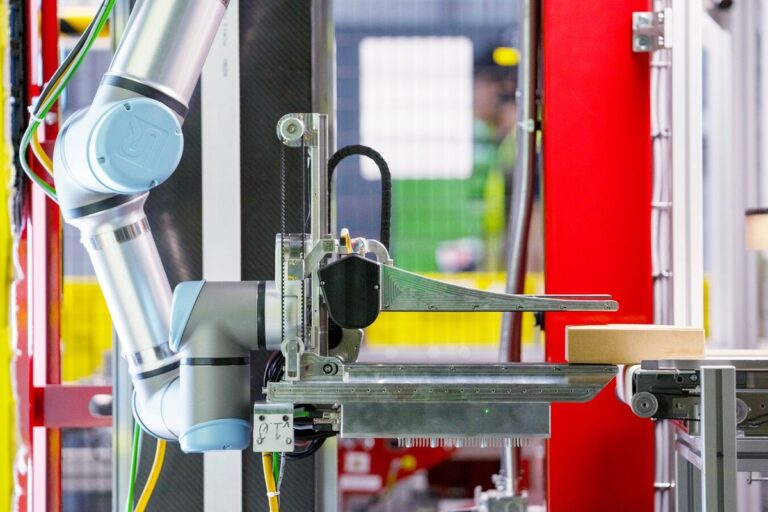
The public sample repository is licensed under Apache 2.0. Its pick-and-place example uses a UR3 robotic arm, a Robotiq gripper and 27 teleoperation episodes, giving developers a small working dataset before they substitute their own robot descriptions and recordings.
Availability varies by component. The repository lists simulation, training and orchestration modules as available, but marks its dedicated edge-deployment module as planned. It also identifies the Bedrock AgentCore hosted runtime as planned and Isaac Lab Arena evaluation as a preview. The advertised lifecycle therefore extends beyond a uniformly finished, production-ready package.
Open-source code does not make the cloud resources free. Running the examples requires an AWS account with appropriate GPU quotas, alongside access credentials for relevant NVIDIA containers and model downloads. Developers must manage the resources they provision.
Building on Earlier Physical AI Work
Amazon highlights NEURA Robotics among companies building physical AI on AWS. RobotsBeat previously covered the NEURA collaboration, including cloud-based training and exploratory work involving Amazon fulfillment centers. The toolchain broadens the infrastructure story beyond that individual partnership.
The feedback-loop approach also resembles the simulation and field-data cycle described in our Bonsai coverage. In both cases, virtual preparation supports development but still needs checks against physical hardware and changing operating conditions.
AWS’s technical documentation explicitly separates infrastructure from finished robot behaviors. For manufacturers, the practical question is whether shared tools reduce integration work while preserving validation, reliable control and the safeguards required for each operating environment.
Disclaimer: RobotsBeat is an independent media brand owned and operated by NuvexMedia LLC, publishing news, research, and insights on artificial intelligence, emerging technologies, automation, and related industries. NuvexMedia LLC invests in and collaborates with companies across the AI, Robotics, technology, software, and digital innovation sectors. These relationships do not influence RobotsBeat's editorial coverage, and the publication maintains full editorial independence to provide accurate, timely, and objective information. © 2026 NuvexMedia LLC. All rights reserved. This content is for informational purposes only and should not be considered legal, tax, investment, financial, or other professional advice.