Key Notes
- Musk’s late-2027 public-sales target depends on Optimus reaching high reliability, safety and functionality, rather than a confirmed launch commitment.
- Reported weekly output rose to several hundred robots in August, with more than 1,000 a week targeted by year-end as manufacturing and AI hurdles persist.
- Tesla says initial Fremont builds support training and development, while its million-unit factory ambitions describe future capacity rather than current deliveries.
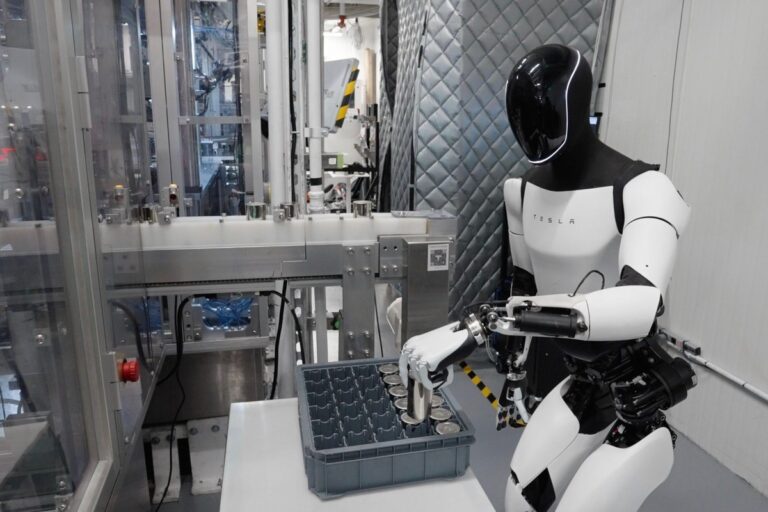
Tesla is scaling up Optimus manufacturing ahead of Elon Musk’s target of selling humanoid robots to the public by the end of 2027. The timetable remains a conditional goal: producing more machines does not establish that they are ready to work safely and reliably for customers.
An October 12 timeline review by TechRepublic brings together Tesla’s factory plans and earlier reporting on the program. It does not announce a newly confirmed release date. The distinction matters as Optimus moves from prototypes toward a business that must support robots beyond Tesla’s own facilities.
What the 2027 Sales Target Actually Means
Musk outlined the public-sales ambition at the World Economic Forum in January. In the event’s published conversation, he linked availability by the end of the following year to achieving high reliability, safety and a broad range of functions.
That puts late 2027 on the roadmap, but it does not give buyers a firm delivery commitment. The remarks also distinguish robots performing relatively simple industrial tasks from machines that could be trusted with a much wider range of requests.
For prospective customers, the useful question is what Tesla will actually support at launch. A machine supplied for a defined factory workflow could have a narrower operating envelope than a robot marketed for varied household chores. Those products require different training, support and safeguards even when they share the same body.
Fremont Production Is Growing, According to Reports
September reporting by The Information, summarized by Electrek, put output at several hundred Optimus units per week in August, up from a few dozen during the second quarter. It described an internal target of more than 1,000 weekly units by year-end. These are reported figures and goals, rather than an updated production total confirmed by Tesla.
RobotsBeat previously examined the production bottlenecks behind that ramp. The same reporting described labor-intensive hand assembly, supplier quality difficulties and software that still struggled with unfamiliar tasks. It also indicated that selected business customers might initially lease robots rather than buy them outright.
The commercial significance is straightforward: factory throughput measures how many robots can be built, while customers need to know how much useful work those robots can complete. A higher build rate becomes more valuable when it accompanies fewer failures, less supervision and predictable maintenance.
Tesla’s Factory Plans Extend Beyond the First Ramp
Tesla’s own July update said the Model S and Model X manufacturing lines at Fremont had been decommissioned and first-generation Optimus lines were being installed. Initial builds were intended for Optimus Academy, supporting training-data collection and further development of the robot’s functions.
The company also described continuing construction at Gigafactory Texas. In its earlier April update, Tesla set out a Fremont line designed for one million robots annually and a second-generation Texas line with a long-term design capacity of 10 million.
Those design capacities should not be read as current output or promised deliveries in 2027. Tesla explicitly distinguishes installed capacity from actual production rates. Equipment availability, component supply and the performance of new manufacturing processes can all constrain what a line delivers.
The conversion of automotive production space is nevertheless a concrete industrial commitment. Our earlier coverage of the Fremont teardown tracks the physical changes behind Tesla’s shift toward humanoid manufacturing.
Useful Autonomy Will Decide the Customer Rollout
Tesla’s robotics overview describes Optimus as a general-purpose humanoid intended for unsafe, repetitive or boring work. It identifies balance, navigation, perception and physical interaction as core software challenges. Building an integrated product requires those capabilities to work together, including when an object moves or a person enters the workspace.
For a deployment to pay its way, buyers would need evidence about task completion, intervention frequency, uptime and repair costs. An impressive demonstration can show that a behavior is possible; repeated operation under customer conditions establishes whether that behavior is dependable.
The next meaningful milestone is therefore a supported external deployment with clear limits and measurable performance. Until Tesla publishes firmer commercial terms and demonstrates that operating model, late 2027 is best understood as Musk’s sales ambition, with manufacturing progress providing one part of the path toward it.
Disclaimer: RobotsBeat is an independent media brand owned and operated by NuvexMedia LLC, publishing news, research, and insights on artificial intelligence, emerging technologies, automation, and related industries. NuvexMedia LLC invests in and collaborates with companies across the AI, Robotics, technology, software, and digital innovation sectors. These relationships do not influence RobotsBeat's editorial coverage, and the publication maintains full editorial independence to provide accurate, timely, and objective information. © 2026 NuvexMedia LLC. All rights reserved. This content is for informational purposes only and should not be considered legal, tax, investment, financial, or other professional advice.