Key Notes
- ABB’s IRB 1700 and IRB 1700ID families offer five variants with 6–12 kg payloads, with the longest-reach ID configuration extending to 1.85 m.
- The company claims up to 20% shorter cycle times than comparable market robots, while the separate 15% power-saving figure compares the IRB 1700 with its IRB 1600 predecessor at the same payload on OmniCore.
- Integrated cable routing on the ID models and oil-change intervals of up to 20,000 hours address installation and maintenance, with actual cell productivity depending on the complete application.
ABB Robotics has introduced the IRB 1700 and IRB 1700ID, two compact industrial robot families aimed at precision manufacturing. ABB says the machines deliver cycle times up to 20% shorter than comparable robots on the market, alongside lower power consumption and longer oil-change intervals.
The company’s October 12 announcement positions the range for electronics, automotive and general industry. The launch adds conventional articulated robots for defined production tasks, including handling, welding, sanding and machine tending.
Five Variants Balance Payload and Reach
ABB’s IRB 1700 page lists two configurations: a 12 kg payload with 1.45 m reach, and a 10 kg payload with 1.65 m reach. The IRB 1700ID offers those combinations plus a 6 kg version reaching 1.85 m.
The ID designation refers to integrated dressing, with cables and hoses routed inside the arm. ABB says this arrangement simplifies installation. For a system integrator, cable routing also forms part of the practical layout around a tool, fixture and workpiece.
The product pages specify path repeatability down to 0.03 mm and joint speeds up to 700 degrees per second. They list compatibility with OmniCore C30XT, C90XT, V250XT and V400XT controllers, providing several controller options for application requirements.
What the Performance Claims Compare
The 20% cycle-time figure is an “up to” comparison with other robots on the market. ABB’s launch release does not identify a single benchmark task and competitor model that would make that figure a universal prediction for every production cell.
Its separate claim of up to 15% lower power consumption has a more specific footnote: the IRB 1700 is compared with its predecessor, the IRB 1600, operating at the same payload on OmniCore. ABB also advertises intervals of up to 20,000 hours between oil changes.
These measures answer different purchasing questions. Shorter robot motion cycles can help where motion is the bottleneck, while energy consumption and maintenance affect running costs. A complete line can still be limited by a machine process, parts supply, inspection or downstream handling.
Tools and Integration Still Shape the Result
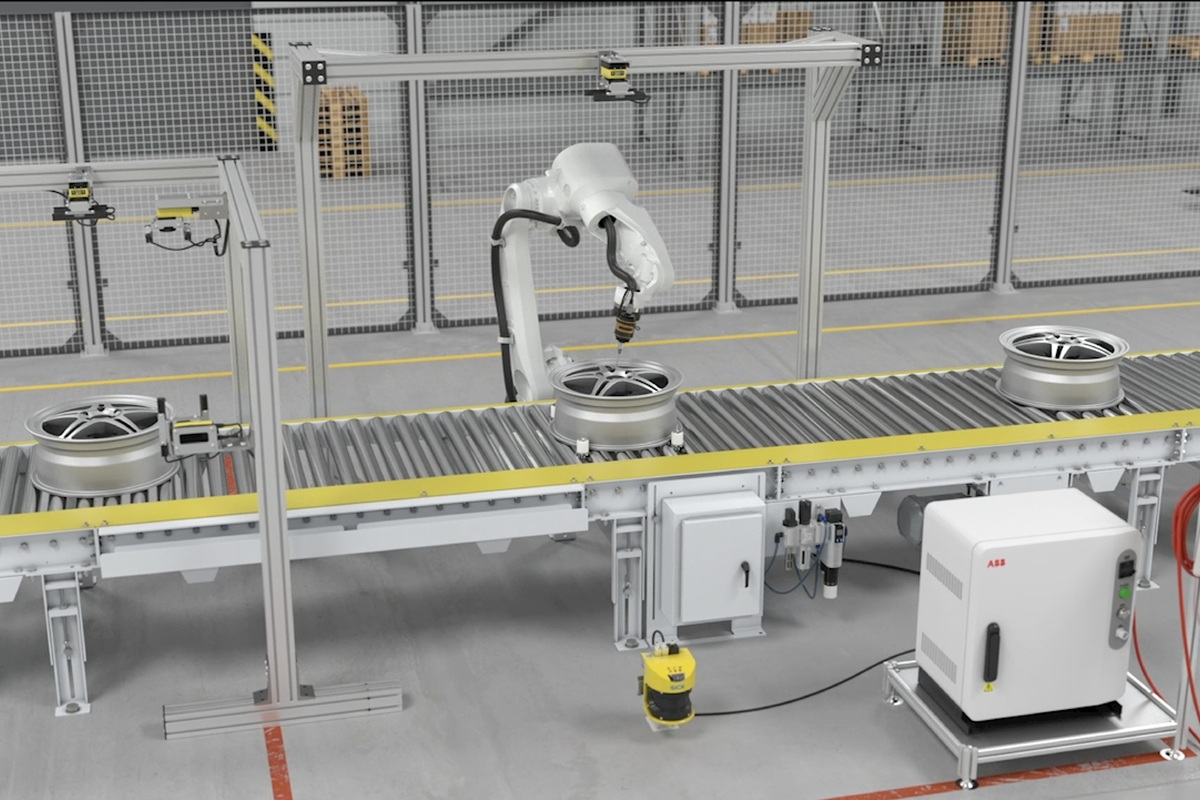
ABB is demonstrating the range in welding and sanding applications at the China International Industry Fair in Shanghai, held October 12–16. The company also identifies AI server rack assembly as a potential electronics application.
RobotsBeat’s coverage of ABB’s simulation work examines the software side of preparing factory robots. The new arms provide another hardware option, but selecting payload and reach is only the start: tooling, programming and the surrounding process determine the finished cell’s output.
For manufacturers, the useful next step is an application-specific comparison using the intended load, path and production requirements. That can establish how much of ABB’s advertised improvement transfers to a particular job, rather than treating the maximum figure as a guaranteed gain.
Disclaimer: RobotsBeat is an independent media brand owned and operated by NuvexMedia LLC, publishing news, research, and insights on artificial intelligence, emerging technologies, automation, and related industries. NuvexMedia LLC invests in and collaborates with companies across the AI, Robotics, technology, software, and digital innovation sectors. These relationships do not influence RobotsBeat's editorial coverage, and the publication maintains full editorial independence to provide accurate, timely, and objective information. © 2026 NuvexMedia LLC. All rights reserved. This content is for informational purposes only and should not be considered legal, tax, investment, financial, or other professional advice.