Key Notes
- ASUS has introduced Gallop, its first humanoid, and is testing motherboard-accessory packing at a factory within the group using a fixed-base, two-arm configuration.
- The company targets 99.5% success within 20 seconds, while learning combines worker demonstrations, simulation and operator-guided practice rather than relying on a published production benchmark.
- Customer pilots are planned for 2027 and market availability for the second half of 2028, with a wheeled version and an in-house tactile hand on the development roadmap.
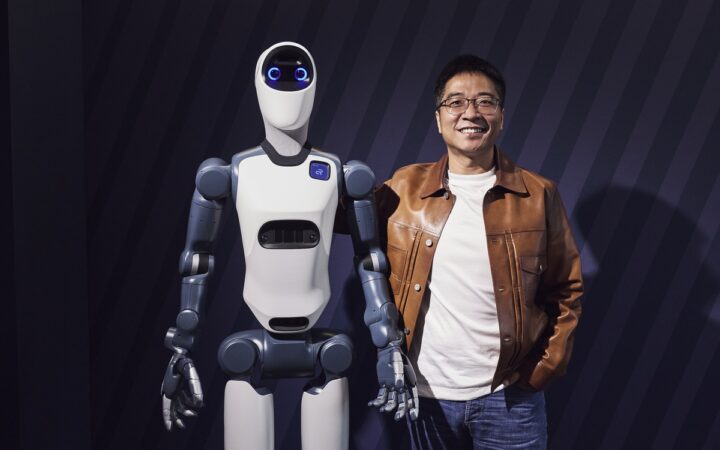
ASUS has introduced Gallop, its first humanoid robot, and is testing it on motherboard-accessory packing at an electronics factory within the group. The program gives the Taiwanese technology company a manufacturing application for physical AI, with customer pilots planned for 2027 and market availability targeted for the second half of 2028.
In a November 13 technical overview, ASUS describes a fixed-base robot with two arms and a roadmap toward a wheeled version. Its immediate job is workstation manipulation, rather than walking around a factory.
A Packing Station Sets the Performance Target
The selected station handles 15 small motherboard accessories, many inside thin, transparent bags. ASUS is targeting 99.5% success within a 20-second cycle, matching the standard it sets for a human operator. The company has not published a current measured success rate or a full-shift production result.
Thin packaging makes this a useful test of manipulation. A grasp can change the shape or position of the item, while reflective and transparent material complicates what a camera sees. Finishing one clean pick is only part of the job; a dependable station must complete the sequence and recognize when to recover.
ASUS already has experience with other robot forms. Our Kairo coverage examined its service-robot and orchestration announcements at Computex. Gallop adds a humanoid program focused initially on electronics manufacturing.
Learning From Workers, Then Practicing the Job
ASUS starts from existing open AI models and records experienced workers using head-mounted cameras with their consent. It combines those demonstrations with simulated variations and operator-guided practice using a VR headset and gloves. Data recorded during subsequent robot work feeds back into training.
This approach brings human experience into the learning process while retaining hands-on instruction. RobotsBeat’s reporting on CMU’s Pixel examines another effort to make demonstrations easier to collect. Our GR00T 2 report explores the separate challenge of transferring observed skills into robot actions.
The distinction matters for factory adoption: watching how a person handles a part does not automatically give a machine the same reach, grip or contact feedback. Demonstrations provide examples; practice and evaluation establish what the robot can repeat.
Modular Control and a Commercial Roadmap
Gallop runs on a single NVIDIA Jetson AGX Thor computer. ASUS describes separate layers for planning, supervising progress, executing manipulation skills and controlling motion. Fixed interfaces between those layers are intended to let the company replace AI models without rebuilding the machine.
ASUS is developing its own tactile dexterous hand and plans to integrate it over the coming year, alongside the move to a wheeled platform. A customer presentation at Computex 2027 is also planned. These are development milestones, rather than confirmation that every announced component is in the current factory configuration.
The near-term test is sustained performance at the existing station: cycle time, successful completion, interventions and recovery when something goes wrong. ASUS’s access to its own production environment gives it a place to measure those outcomes before expanding to external customers.
Disclaimer: RobotsBeat is an independent media brand owned and operated by NuvexMedia LLC, publishing news, research, and insights on artificial intelligence, emerging technologies, automation, and related industries. NuvexMedia LLC invests in and collaborates with companies across the AI, Robotics, technology, software, and digital innovation sectors. These relationships do not influence RobotsBeat's editorial coverage, and the publication maintains full editorial independence to provide accurate, timely, and objective information. © 2026 NuvexMedia LLC. All rights reserved. This content is for informational purposes only and should not be considered legal, tax, investment, financial, or other professional advice.