
Poland’s First Humanoid Influencer Draws Brands and Millions Of Views

A humanoid robot named Edward Warchocki has rapidly gained attention in Poland’s influencer market, attracting hundreds of thousands of social media followers and landing commercial brand partnerships.

By Daniel Krauss | Edited by Kseniia Klichova Published: Updated:
Poland’s First Humanoid Influencer Draws Brands and Millions Of Views
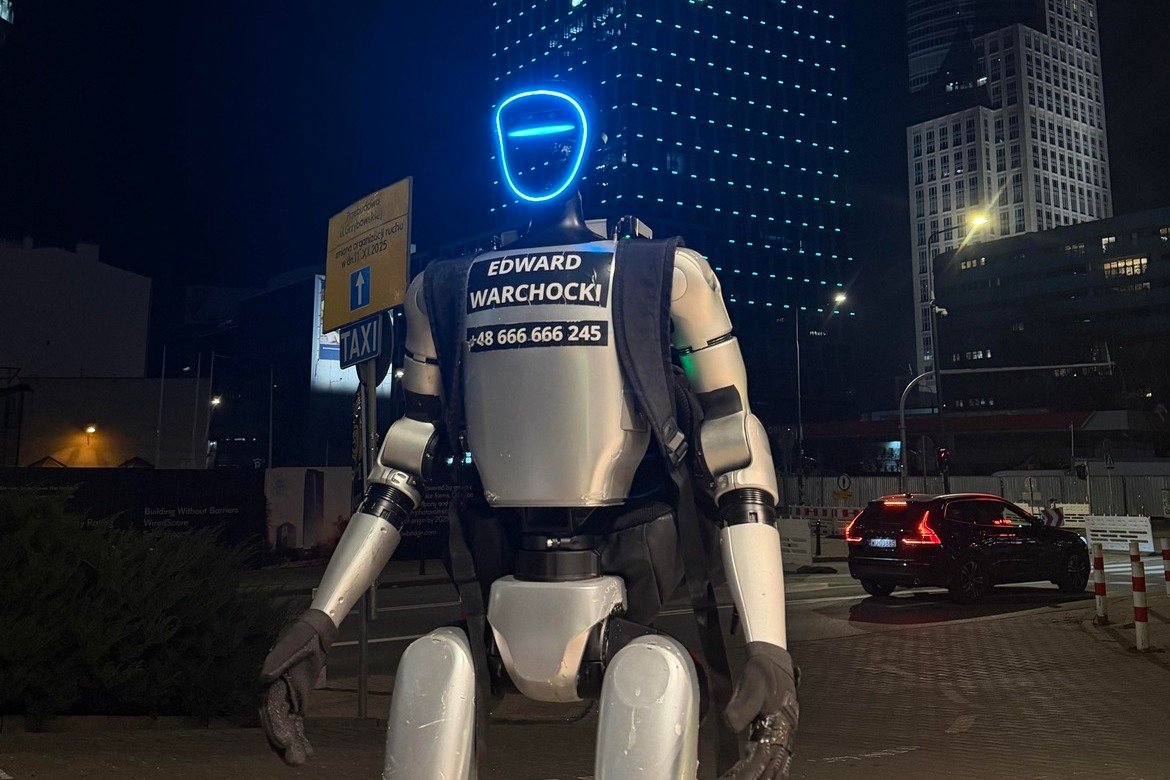
Edward Warchocki, a humanoid robot operating on the streets of Warsaw and Poznań, interacts with the public as part of a marketing experiment exploring robots as social media influencers. Photo: Project creators

A humanoid robot has entered Poland’s influencer economy, quickly drawing attention from brands, social media audiences, and technology observers.

The robot, named Edward Warchocki, has appeared on streets in Warsaw and Poznań interacting with passers-by while building a growing presence on social media platforms. Within roughly two weeks of its debut, the project amassed tens of thousands of followers on Instagram and more than 100,000 on TikTok, while videos featuring the robot reportedly generated hundreds of millions of views across platforms.

The experiment places a physical humanoid robot into a market previously dominated by human personalities and digital avatars.

For companies experimenting with new forms of marketing, the project represents an early test of how embodied AI could reshape influencer culture.

From Lab Experiment to Commercial Platform

Edward Warchocki began as a technology experiment initiated by entrepreneur Radosław Grzelaczyk and supported by artificial intelligence developer Bartosz Idzik, who created the system that powers the robot’s conversational behavior.

Unlike scripted promotional mascots, the robot is designed to interact dynamically with people in real-world environments.

According to the project’s creators, the system uses a combination of proprietary AI tools and existing technologies to generate responses during live interactions. The goal was to create a robot that could adapt to conversations rather than simply repeat preprogrammed lines.

Public reactions have ranged from curiosity to enthusiasm. Videos show people approaching the robot on city streets to shake hands, ask questions, and record short interactions for social media.

These spontaneous encounters have become a key part of the robot’s appeal.

Brands Experiment with a New Type of Influencer

The project has already begun attracting commercial interest.

Edward’s first advertising collaboration reportedly involved promoting a luxury watch valued at approximately 80,000 złoty, marking a symbolic entry into the influencer marketing industry.

For brands, robots introduce a different set of characteristics than human creators.

A humanoid influencer cannot become involved in personal scandals, take breaks, or deviate from a brand’s messaging strategy. The creators of the project argue that this level of control makes robots attractive marketing ambassadors for companies seeking predictable campaigns.

Some analysts also point to engagement metrics as a key factor. Early data from projects involving robotic or virtual influencers suggests that novelty and public curiosity can generate unusually high engagement rates compared with traditional creators.

Physical Presence in a Digital Industry

The rise of virtual influencers is not new. Computer-generated personalities such as Lil Miquela in the United States or Rozy in South Korea have already built large audiences and signed partnerships with major global brands.

However, those figures exist entirely in digital form.

Edward represents a different model: a physical robot capable of interacting with people face to face.

This physical presence creates a type of engagement that purely digital characters cannot replicate. Passers-by can approach the robot, speak with it, and record the interaction in real time.

In practice, the robot becomes both an influencer and a live attraction.

For social media creators and marketers, such encounters provide content that can spread quickly across platforms.

A New Category of Embodied Media

The project reflects a broader trend in robotics where machines are increasingly designed to operate in social environments rather than purely industrial settings.

Humanoid robots have traditionally been developed for research or automation applications. But advances in conversational AI and robotics hardware are opening the possibility of robots that function as public-facing personalities.

If the experiment succeeds commercially, it could mark the emergence of a new category within influencer marketing: embodied influencers.

Analysts estimate that the global virtual influencer market could reach nearly $16 billion by 2026. Robots capable of appearing in both online content and physical events may represent the next stage of that market’s evolution.

For now, Edward Warchocki remains an experiment.

But its rapid rise suggests that the intersection of robotics, artificial intelligence, and digital media may be creating a new kind of celebrity – one built from code, hardware, and algorithms rather than human charisma.

News, Robots & Robotics, Science & Tech

Irrigation Robot Maps Water Needs Tree by Tree, Challenging Farm Automation Norms

A field robot that maps soil moisture at the level of individual trees could reshape irrigation practices, reducing water use and improving crop health.

By Rachel Whitman | Edited by Kseniia Klichova Published:
Irrigation Robot Maps Water Needs Tree by Tree, Challenging Farm Automation Norms
A mobile field robot scans soil conditions in orchards, generating detailed maps that guide precise irrigation at the level of individual trees. Photo: UCR

A mobile irrigation robot developed by researchers at the University of California, Riverside is challenging one of agriculture’s most persistent assumptions: that crops in the same field require the same amount of water.

By mapping soil moisture at the level of individual trees, the system reveals significant variation even between neighboring plants, suggesting that conventional irrigation methods may be systematically inefficient.

The findings point to a broader shift in agricultural robotics, where mobile sensing systems are replacing static infrastructure to deliver more granular, data-driven decisions.

From Field Averages to Tree-Level Precision

Traditional irrigation relies on fixed sensors and uniform watering schedules, operating on the assumption that conditions are relatively consistent across a field. The robot developed at UCR takes a different approach, scanning soil conditions continuously as it moves through orchards.

In field trials across citrus groves in California, the system detected sharp differences in water availability between adjacent trees, despite identical irrigation inputs. These variations were linked to differences in soil composition, where finer soils retained water more effectively than sandier patches.

The robot measures electrical conductivity in the soil – a proxy for moisture – and combines those readings with calibration data from a limited number of ground sensors. The result is a detailed moisture map that identifies both under-watered and over-watered areas.

This level of resolution allows irrigation to be adjusted at a much finer scale, turning what has traditionally been a field-wide estimate into a localized decision.

Reducing Waste and Managing Risk

The implications extend beyond water conservation. Overwatering can damage crops by depriving roots of oxygen and increasing susceptibility to disease, while also washing fertilizers deeper into the soil, where they can no longer be absorbed.

By identifying these imbalances, the system enables growers to maintain soil moisture within a narrower, optimal range. In testing, the model achieved high accuracy with relatively few calibration points, suggesting that widespread deployment may not require dense sensor networks.

This efficiency is significant in an industry where the cost of installing and maintaining sensors can limit adoption of precision agriculture technologies.

The approach also aligns with broader pressures facing agriculture, particularly in water-constrained regions. As drought conditions intensify, growers are increasingly forced to either reduce production or find ways to use water more efficiently.

Robotics Expands Beyond Automation

Unlike many agricultural robots focused on harvesting or crop monitoring, this system highlights a different role for robotics: acting as a mobile data layer that enhances decision-making rather than directly performing physical tasks.

The platform used in the study is capable of autonomous navigation, although it was manually operated during trials. Future versions are expected to operate independently, covering larger areas and integrating more closely with irrigation systems.

Several challenges remain before commercial deployment, including adapting the system to different crops, soil types, and environmental conditions. The relationship between surface measurements and deeper soil moisture also requires further refinement.

The development reflects a broader trend in robotics toward combining mobility with sensing and AI-driven analysis. By moving through environments rather than relying on fixed points, robots can capture variability that static systems miss.

In agriculture, where small differences in soil conditions can have large impacts on yield and resource use, that shift may prove particularly consequential.

If validated at scale, tree-level irrigation mapping could redefine how farms manage water – not as a uniform input, but as a variable resource tailored to each plant.

Automation, News, Robots & Robotics, Science & Tech

Siemens, NVIDIA and Humanoid Test Factory-Ready Humanoid Robot in Live Production

Siemens, NVIDIA and Humanoid have tested a humanoid robot in a live factory environment, signaling progress toward industrial-scale physical AI deployment.

By Daniel Krauss | Edited by Kseniia Klichova Published: Updated:
Siemens, NVIDIA and Humanoid Test Factory-Ready Humanoid Robot in Live Production
The HMND 01 Alpha humanoid robot operates inside a Siemens factory, performing autonomous logistics tasks as part of a physical AI deployment. Photo: Siemens

Siemens, NVIDIA and UK-based Humanoid have jointly deployed a humanoid robot inside a live manufacturing environment, marking one of the clearest signals yet that physical AI is moving beyond controlled demonstrations and into production settings.

The companies confirmed that Humanoid’s HMND 01 Alpha robot has been tested at a Siemens electronics factory in Erlangen, where it performed autonomous logistics tasks as part of ongoing operations. The deployment is part of a broader effort to build fully AI-driven, adaptive manufacturing systems.

While humanoid robots have been widely showcased in labs and pilot programs, this test stands out for meeting defined industrial performance thresholds in a real facility.

From Demonstration to Measurable Output

In the Erlangen deployment, the HMND 01 Alpha was assigned tote-handling tasks – picking, transporting, and placing containers within the factory workflow. According to the companies, the robot achieved throughput of around 60 operations per hour, maintained uptime beyond a full shift, and delivered pick-and-place success rates exceeding 90%.

These metrics place the system closer to practical utility than many earlier humanoid demonstrations, which have often focused on mobility or isolated manipulation tasks rather than sustained operational performance.

The robot’s design reflects this shift. Instead of a purely bipedal system, the HMND 01 uses a wheeled base combined with dual-arm manipulation, prioritizing stability and efficiency over human-like locomotion. This hybrid approach suggests that early industrial humanoids may diverge from human form where it improves performance.

The Stack Behind Physical AI

The deployment underscores the importance of integration across multiple layers of the robotics stack. While the robot itself executes tasks, its performance depends on a combination of simulation, AI models, and industrial control systems.

NVIDIA provides the underlying AI infrastructure, including edge computing hardware and simulation tools used to train and optimize the robot’s behavior before deployment. This “simulation-first” approach has significantly reduced development timelines, allowing the system to move from design to operational testing in months rather than years.

Siemens, meanwhile, contributes the industrial backbone through its Xcelerator platform, which connects the robot to factory systems, enabling real-time coordination with equipment, workflows, and human operators. Without this level of integration, even advanced robots would remain isolated within the production environment.

Together, these components form what the companies describe as a full-stack approach to physical AI – combining perception, reasoning, and execution within a unified operational framework.

A Path to Adaptive Manufacturing

The broader goal of the collaboration is to create factories that can adapt dynamically to changing conditions, rather than relying on fixed automation systems. In this model, robots are not programmed for single tasks but can be reassigned as production needs evolve.

This flexibility addresses a longstanding limitation in industrial automation, where reconfiguring production lines can be costly and time-consuming. By contrast, AI-driven systems can adjust workflows through software, reducing the need for physical reengineering.

The deployment also reflects a response to labor shortages and increasing operational complexity in manufacturing. Humanoid robots, particularly those capable of working in human-designed environments, are positioned as a way to augment existing workforces rather than replace them outright.

The Erlangen test does not yet represent large-scale adoption, but it demonstrates that humanoid robots can meet the performance and reliability thresholds required for real industrial tasks.

More broadly, it highlights a shift in how robotics is being deployed: not as standalone machines, but as part of integrated systems that combine AI, simulation, and industrial infrastructure.

As physical AI continues to mature, the question is less whether humanoid robots can operate in factories, and more how quickly these systems can scale across production networks.

Skild AI Acquires Zebra Robotics Unit to Build Unified Warehouse Automation Layer

Skild AI has acquired Zebra Technologies’ robotics automation business, aiming to unify fragmented warehouse systems under a single AI-driven control layer.

By Laura Bennett | Edited by Kseniia Klichova Published:
Skild AI Acquires Zebra Robotics Unit to Build Unified Warehouse Automation Layer
Skild AI is combining its general-purpose robotics model with Zebra’s orchestration platform to coordinate diverse robot fleets across warehouse operations. Photo: Skild AI

Skild AI has acquired the robotics automation business of Zebra Technologies, a move that signals a shift toward unified control systems for warehouse robotics rather than isolated deployments.

The deal includes Zebra’s Symmetry Fulfillment platform, a system designed to coordinate fleets of robots and human workers in logistics environments. By combining this orchestration layer with Skild AI’s general-purpose robotics model, the company is aiming to address one of the most persistent challenges in automation: fragmentation across hardware, software, and tasks.

The acquisition positions Skild AI to move beyond model development into full-stack deployment, where AI systems not only control individual robots but manage entire warehouse operations.

From Task Specific Automation to Generalized Control

Warehouse robotics has traditionally been built around specialized systems, with different robots programmed for picking, transport, or inspection. These systems often operate independently, requiring significant integration effort and limiting flexibility.

Skild AI’s approach centers on what it calls an “omnibodied” model, designed to operate across different robot types without being tailored to a specific form factor. In principle, this allows the same AI system to control humanoid robots, mobile platforms, and robotic arms without retraining for each configuration.

The addition of Zebra’s orchestration software extends this capability from individual robots to coordinated fleets. The Symmetry platform enables real-time task allocation, workflow management, and human-robot interaction, providing the infrastructure needed to deploy heterogeneous systems in live environments.

Together, the two technologies suggest a shift from programming robots individually to managing automation as a unified system.

Orchestrating Mixed Fleets at Scale

The combined platform is intended to support a wide range of robotic systems within a single warehouse. This includes autonomous mobile robots for material transport, robotic arms for packing, and potentially humanoid systems for more complex manipulation tasks.

Such an approach reflects the operational reality of modern logistics, where no single robot type can handle all tasks efficiently. Instead, performance depends on coordination between different systems and their integration with human workers.

By embedding AI at the orchestration level, Skild AI is attempting to create a layer that can dynamically assign tasks, optimize workflows, and adapt to changing conditions without requiring extensive reprogramming.

This model also creates a feedback loop: data collected from deployments can be used to improve the underlying AI system, potentially increasing performance across all environments where it is deployed.

A Push Toward End to End Automation

The acquisition highlights a broader industry trend toward end-to-end automation platforms. Rather than selling individual robots or software components, companies are increasingly positioning themselves as providers of complete operational systems.

This shift is driven in part by the limitations of current approaches. Many warehouses still require significant manual configuration to integrate different automation tools, and retrofitting facilities to accommodate specific robots can be costly and disruptive.

Skild AI’s strategy suggests an alternative path, where existing warehouses are adapted through software and orchestration rather than physical redesign. By combining a general-purpose AI model with a proven coordination platform, the company aims to reduce the complexity of deploying automation at scale.

The approach also aligns with efforts by companies such as Nvidia to build infrastructure for physical AI, where simulation, data, and control systems are integrated into cohesive platforms.

The success of this strategy will depend on whether a single AI layer can reliably manage diverse robotic systems in complex, real-world environments. While the concept of “any robot, any task” remains ambitious, the integration of orchestration and intelligence represents a step toward more flexible and scalable automation.

As logistics operators seek to increase efficiency without overhauling existing infrastructure, the ability to coordinate mixed fleets of robots may become a defining feature of next-generation warehouse systems.

Automation, Business & Markets, News, Robots & Robotics

Humanoid Robot Chasing Wild Boars in Warsaw Highlights Real World Deployment Shift

A viral humanoid robot chasing wild boars in Warsaw has drawn attention to the rapid global spread of Chinese robotics hardware.

By Daniel Krauss | Edited by Kseniia Klichova Published: Updated:

A humanoid robot chasing wild boars through a parking lot in Warsaw is not an obvious signal of industry change. But the viral footage, widely shared across social media, offers a glimpse into a deeper shift in the global robotics landscape.

The robot, known locally as “Edward”, is built on hardware from Unitree Robotics and adapted by a Polish team at MERA Robotics. While the scene itself borders on spectacle, the underlying model – combining Chinese manufacturing with local software customization – is becoming an increasingly common pathway for deploying humanoid systems outside their country of origin.

From Viral Moment to Deployment Model

Edward’s popularity stems from its unexpected public appearances, including the now widely circulated incident in which it pursued wild boars in an urban setting. But beyond the novelty, the robot represents a practical approach to deploying humanoid technology.

Rather than developing systems entirely in-house, MERA Robotics has integrated Chinese-built hardware with its own operating software, tailoring the platform for local use cases. This hybrid model allows smaller companies to bypass the high costs and long timelines associated with building complete humanoid systems from scratch.

According to MERA co-founder Radoslaw Grzelaczyk, this approach reflects a broader trend. After studying robotics commercialization efforts in China, his team concluded that Chinese manufacturers offer a combination of availability, performance, and pricing that is difficult to match elsewhere.

The result is a growing ecosystem in which hardware is sourced globally, while software and applications are developed locally.

China’s Cost Advantage Extends Abroad

The Warsaw example highlights a structural advantage that Chinese robotics companies have begun to establish. Firms such as Unitree are scaling production and reducing costs at a pace that is enabling international adoption, even in markets traditionally dominated by Western technology providers.

Grzelaczyk estimates that China may be up to two years ahead of other regions in humanoid robotics development, particularly in terms of commercialization. This lead is not only technological but also economic, as lower-cost systems make experimentation and deployment more accessible.

This dynamic is already shaping global partnerships. European firms are increasingly importing humanoid robots and adapting them for regional markets, rather than attempting to compete directly on hardware manufacturing.

MERA Robotics, for example, plans to import around 100 humanoid units in the near term, using them as a foundation for locally developed applications.

Early Use Cases Remain Unclear

Despite growing visibility, the practical role of humanoid robots in everyday environments remains uncertain. Edward’s viral moment illustrates both the potential and the ambiguity of current deployments.

On one hand, the robot demonstrates mobility, autonomy, and the ability to operate in unstructured outdoor environments. On the other, the task itself – chasing animals in a parking lot – underscores how far the technology still is from clearly defined, scalable applications.

This gap between capability and use case is a recurring theme in the humanoid robotics sector. While hardware performance continues to improve, identifying consistent, economically viable roles for these systems remains an open challenge.

At the same time, public demonstrations and viral content are playing an increasing role in shaping perception and interest. Visibility, even in unconventional scenarios, may help accelerate experimentation and adoption.

The Warsaw incident may be remembered less for the robot’s actions and more for what it represents: a globalizing robotics industry where hardware, software, and applications are increasingly decoupled.

As Chinese manufacturers expand their reach and local developers build on top of their platforms, humanoid robots are beginning to move from controlled demonstrations into everyday environments – even if their purpose is still evolving.

News, Robots & Robotics

Boston Dynamics Integrates Google Gemini into Spot for Industrial Inspection

Boston Dynamics has integrated Google’s Gemini robotics model into its Spot platform, enhancing reasoning and inspection capabilities in industrial environments.

By Rachel Whitman | Edited by Kseniia Klichova Published: Updated:
Boston Dynamics Integrates Google Gemini into Spot for Industrial Inspection
Boston Dynamics’ Spot robot now uses Google Gemini-powered AI to analyze industrial environments, improving inspection accuracy and enabling higher-level reasoning. Photo: Boston Dynamics

Boston Dynamics has integrated a new generation of AI models from Google into its industrial inspection platform, marking a step toward more autonomous and context-aware robotics in real-world environments.

The update brings Google’s Gemini and Gemini Robotics-ER 1.6 models into Boston Dynamics’ Orbit AIVI-Learning system, which powers inspection workflows for robots such as Spot. The integration reflects a broader shift in robotics toward combining physical systems with advanced reasoning models capable of interpreting complex environments and making decisions in real time.

The rollout is already live for existing AIVI-Learning customers, with the company positioning the upgrade as a foundational improvement in how robots understand and monitor industrial sites.

From Detection to Interpretation

Industrial inspection has traditionally relied on rule-based systems that identify predefined objects or anomalies. The integration of Gemini introduces a different approach, where robots can analyze scenes more holistically and reason about what they observe.

Using the updated system, Spot can perform tasks such as reading gauges, assessing fluid levels, counting materials, and identifying safety hazards like spills or debris. These capabilities extend beyond simple detection, requiring the robot to interpret visual signals and determine their operational significance.

This shift is particularly important in environments where conditions are dynamic and difficult to model in advance. Rather than relying on static rules, the system can adapt to new scenarios, enabling broader deployment across facilities with varying layouts and equipment.

The addition of “transparent reasoning” features also allows operators to review how the system arrives at its conclusions, offering greater visibility into AI-driven decisions – a requirement that is becoming increasingly important in industrial settings.

Continuous Learning in Live Environments

A defining feature of the updated platform is its ability to improve over time through continuous data collection and model updates. The system operates as a cloud-connected service, allowing performance improvements to be deployed without interrupting operations.

This “zero-downtime” update model reflects a shift toward treating robotics systems as evolving software platforms rather than static hardware installations. As new data is collected from deployed robots, the models can be refined to better understand specific environments and use cases.

The approach, however, also introduces new considerations around data sharing. Customers using AIVI-Learning are required to share operational data with Boston Dynamics to enable ongoing model training, highlighting the growing role of data as a core component of robotics performance.

Toward Site Wide Intelligence

Boston Dynamics frames the integration as a move toward “site-wide intelligence”, where robots contribute to a unified understanding of industrial operations. By combining visual inspection data with higher-level reasoning, the system aims to provide insights across safety, maintenance, and logistics.

This aligns with a broader industry trend toward physical AI systems that integrate perception, reasoning, and action. Companies such as Nvidia have emphasized similar approaches, focusing on the convergence of simulation, AI models, and robotics hardware.

In practical terms, the upgraded system enables Spot to handle more complex inspection workflows, from monitoring equipment health to tracking material movement. The ability to interpret gauges and other analog instruments is particularly relevant in industries where digital integration remains incomplete.

The integration of Gemini into Boston Dynamics’ inspection platform highlights how quickly robotics is evolving from task-specific automation to more generalized, intelligent systems. By embedding reasoning capabilities directly into deployed robots, companies are beginning to close the gap between perception and decision-making.

The remaining challenge lies in scaling these systems across diverse environments while maintaining reliability and trust. As robots take on more responsibility in industrial settings, their ability to explain and justify decisions may become as important as their technical performance.

Artificial Intelligence (AI), News, Robots & Robotics, Science & Tech