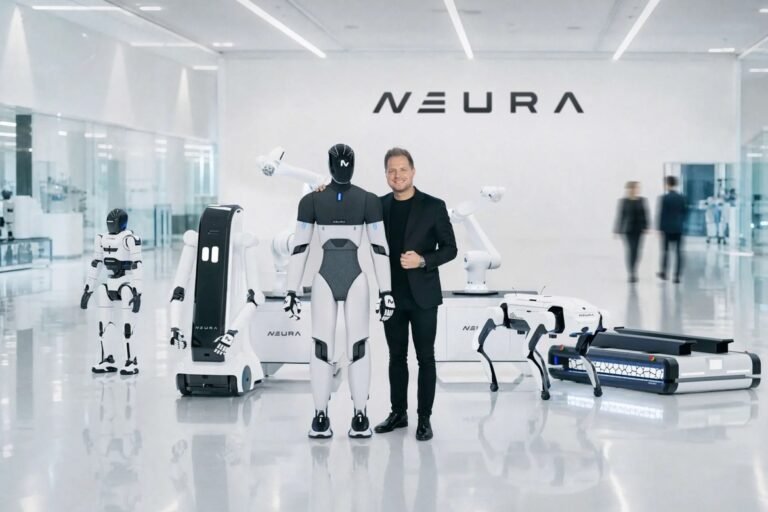
Neura Robotics has raised up to $1.4 billion in a Series C round led by Tether, the stablecoin issuer behind USDT and one of the most profitable companies in financial technology. The German robotics startup, based in Metzingen, is developing a portfolio that includes humanoid robots, precision arms, autonomous mobile robots, and service robots designed to operate across environments where human-machine collaboration generates operational value.
The round is one of the largest single funding events in the history of physical AI, and marks Tether’s most significant investment in a robotics company to date. The deal had been in discussions for several months before closing.
Tether’s Strategic Role Beyond Capital
The investment is not purely financial. Tether said it will provide and deploy technology within the Neura robotics ecosystem, with the central commitment being the integration of Tether’s Wallet Development Kit directly into Neura’s robotic systems.
“To be truly autonomous, robots need financial tools,” Tether said in its statement. The argument is that robots operating independently in commercial environments – executing transactions, receiving payments for services, or managing resource allocation – require embedded financial infrastructure rather than relying on human operators to handle monetary interactions on their behalf.
The integration of a crypto wallet at the hardware level in a humanoid robot is a novel proposition in the robotics industry. Whether enterprise customers operating Neura robots in logistics, manufacturing, or service environments will require or embrace embedded crypto transaction capability is an open question – but the architecture positions Neura robots to participate in autonomous machine-to-machine and machine-to-human economic activity as that category develops.
Neura’s Development Trajectory
Neura raised approximately $140 million in January 2025 in a round that included BlueCrest, C4 Ventures, Lingotto, and Volvo Cars Tech Fund. The Series C at up to $1.4 billion represents a ten-fold increase in capital raised in a single round, reflecting both the acceleration of investor appetite for physical AI and Neura’s progress in building a platform that spans multiple robot form factors rather than a single product.
The company’s partnership ecosystem includes AWS, which agreed earlier this year to provide cloud infrastructure for the Neuraverse platform and explore deploying Neura robots in Amazon fulfillment centers. Its technology partners span semiconductors, industrial deployment, and data creation, with Kawasaki, Schaeffler, Bosch, and Qualcomm Technologies among its named ecosystem members.
The Competitive Context
Neura is competing for a market that includes Tesla’s Optimus program, Hyundai’s Atlas deployment through Boston Dynamics, and a growing field of Chinese manufacturers led by Agibot and Unitree. The $1.4 billion round gives Neura the capital depth to accelerate manufacturing scale, AI model development, and international deployment at a pace that was not possible under its prior funding structure.
Tether’s involvement also introduces a financial technology dimension to the competition that is absent from most other humanoid programs – one that may appeal to specific enterprise customers but adds a layer of complexity to regulatory and enterprise adoption conversations in markets where cryptocurrency integration in operational hardware remains novel territory.
Disclaimer: RobotsBeat is an independent media brand owned and operated by NuvexMedia LLC, publishing news, research, and insights on artificial intelligence, emerging technologies, automation, and related industries. NuvexMedia LLC invests in and collaborates with companies across the AI, Robotics, technology, software, and digital innovation sectors. These relationships do not influence RobotsBeat's editorial coverage, and the publication maintains full editorial independence to provide accurate, timely, and objective information. © 2026 NuvexMedia LLC. All rights reserved. This content is for informational purposes only and should not be considered legal, tax, investment, financial, or other professional advice.