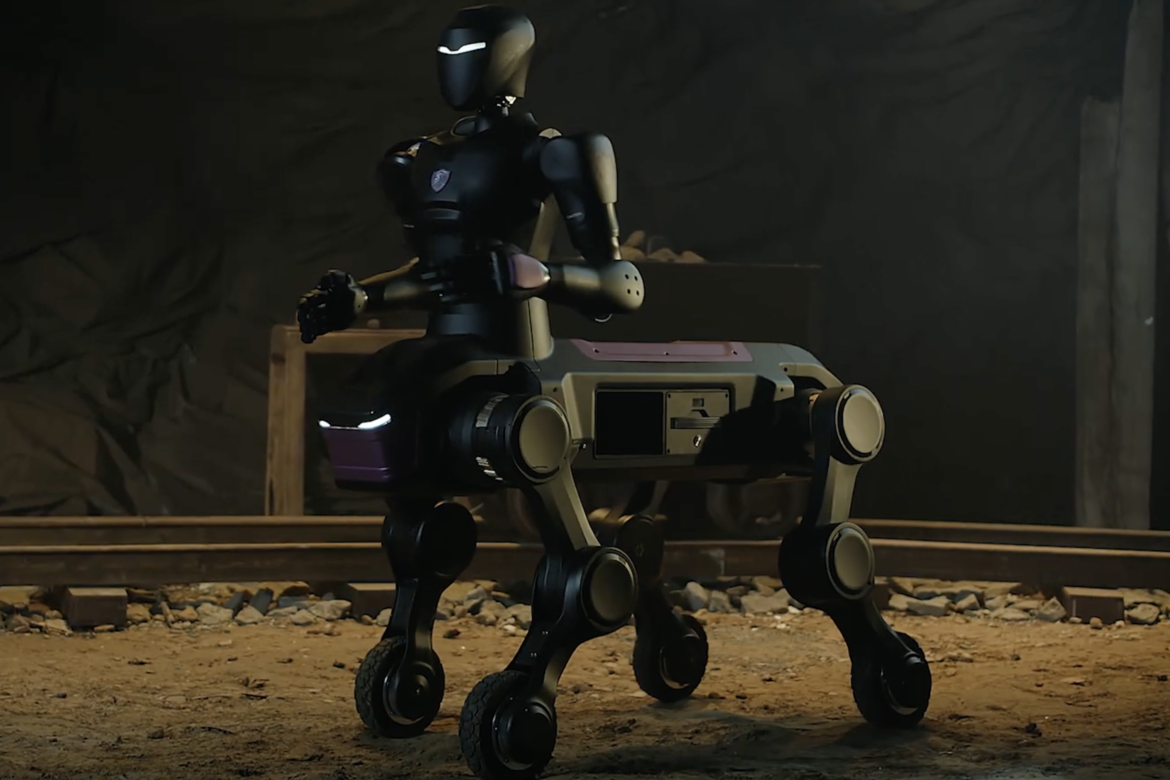
Shanghai-based Run Robotics has unveiled a centaur-configuration robot combining a humanoid upper body with a wheeled-legged hybrid lower body, targeting deployment in hazardous industrial environments where neither conventional humanoids nor wheeled robots can operate reliably. The robot is designed for nuclear plants, steel mills, oil fields, mining operations, and emergency response scenarios.
The platform carries 100 to 120 kilograms continuously and can support up to 210 kilograms in static configurations, with a peak torque of 830 Newton-meters. It incorporates tactile-sensing dexterous hands, end-to-end environmental perception, and an explosion-proof design suitable for facilities with flammable or volatile atmospheres.
The Centaur Configuration
The design places a humanoid torso and arms on a quadruped lower body where the legs terminate in wheels rather than feet, combining two locomotion modes in a single platform. On flat surfaces, the wheels provide speed and energy efficiency. On uneven terrain, stairs, or obstacles, the articulated legs provide the terrain adaptability that wheels alone cannot deliver.
This hybrid approach addresses a structural limitation shared by both bipedal humanoids and wheeled robots. Bipedal humanoids are designed for human-scale environments but sacrifice stability and payload capacity at the performance levels industrial hazardous environments require. Wheeled robots offer speed and reliability on flat surfaces but cannot navigate the stepped, cluttered, or vertically variable terrain of nuclear facilities, steel mills, or emergency response sites. The centaur configuration attempts to retain the most useful property of each – the humanoid upper body’s manipulation capability and the wheeled-legged lower body’s terrain versatility.
Precedents in Research
The centaur form factor has antecedents in academic robotics. The Italian Institute of Technology’s CENTAURO platform, developed for disaster response, uses a wheeled-legged quadruped chassis with a humanoid upper body and has been demonstrated navigating rubble and complex terrain. The University of Bonn’s Momaro robot used a similar configuration at the DARPA Robotics Challenge in 2015. Run Robotics’ platform advances the configuration toward commercial industrial deployment with the payload capacity, explosion-proof design, and dexterous hand integration that differentiate it from research demonstrators.
The Industrial Target
The environments Run Robotics is targeting share specific characteristics: extreme temperatures, toxic or flammable atmospheres, heavy loads, and complex terrain that makes human access dangerous or legally restricted. Inspection and maintenance in nuclear facilities, furnace-adjacent operations in steel mills, and emergency response in industrial accidents all fit this profile. The 100-120 kg continuous payload capacity means the robot can carry meaningful industrial equipment – not just navigate the environment and carry lightweight sensors – making it a practical work platform rather than an inspection-only system.
Run Robotics has not disclosed pricing, production timeline, or customer commitments for the centaur platform at this stage.
Disclaimer: RobotsBeat is an independent media brand owned and operated by NuvexMedia LLC, publishing news, research, and insights on artificial intelligence, emerging technologies, automation, and related industries. NuvexMedia LLC invests in and collaborates with companies across the AI, Robotics, technology, software, and digital innovation sectors. These relationships do not influence RobotsBeat's editorial coverage, and the publication maintains full editorial independence to provide accurate, timely, and objective information. © 2026 NuvexMedia LLC. All rights reserved. This content is for informational purposes only and should not be considered legal, tax, investment, financial, or other professional advice.