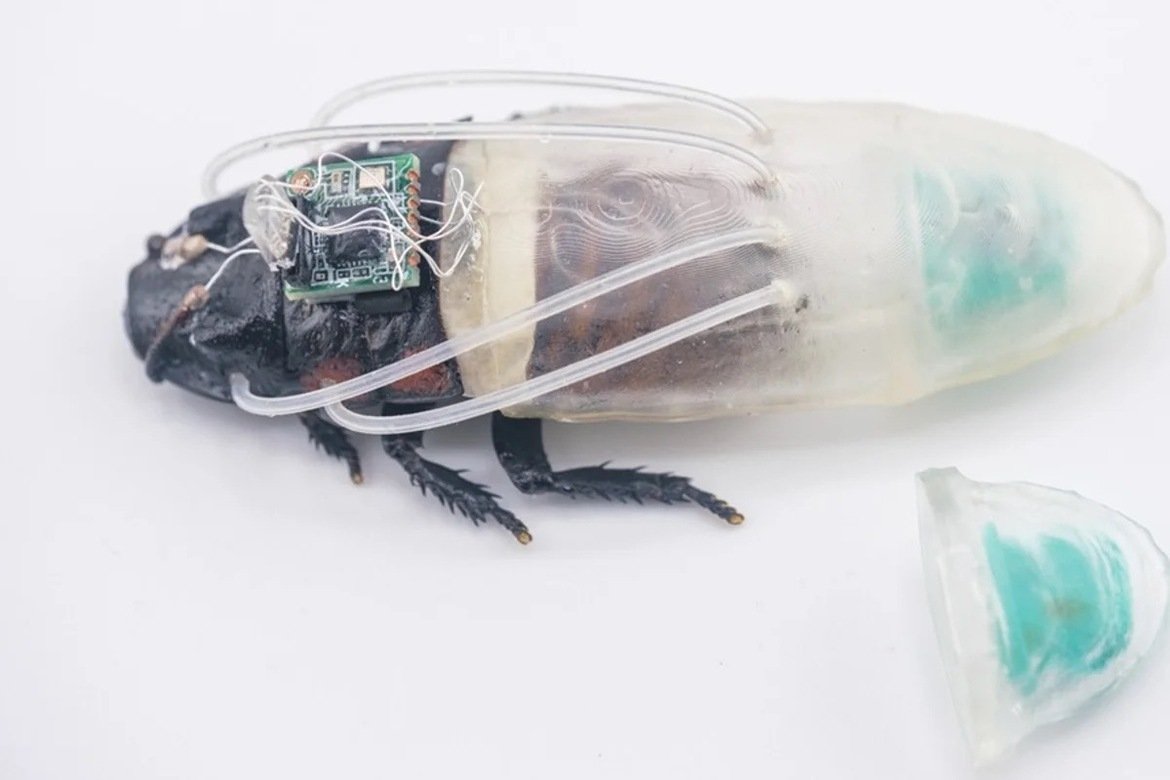
Scientists at Nanyang Technological University Singapore have developed a 3D-printed diving suit that allows cyborg cockroaches – living insects fitted with electronic controllers – to survive and move in underwater conditions for up to three hours. The research, led by Professor Hirotaka Sato, extends more than a decade of cyborg insect development and addresses a critical limitation: cockroaches cannot breathe underwater, which has previously restricted their use in the flooded conditions common to post-disaster search and rescue environments.
The technology was already deployed operationally. Cyborg insects from Sato’s team participated in Operation Lionheart, a search and rescue mission following the 7.7 magnitude earthquake in Myanmar on March 28, 2025.
How the Diving Suit Works
The suit functions on the same principle as a human scuba tank. It generates oxygen and delivers it directly to the cockroach’s thoracic spiracles – the breathing holes on its thorax – through attached tubes. “Our new insect diving suit works like the oxygen tank used by human divers,” said Sato. “It generates oxygen and delivers it directly to the insect’s breathing holes, allowing the cyborg cockroach to survive and move in underwater or low-oxygen environments.”
The tubes can be removed after deployment without causing harm to the insect. The suit was tested on Madagascar hissing cockroaches, selected for their relatively large size, robustness, and lack of wings. Testing involved plastic tubes simulating environments with low oxygen levels and elevated CO2, as well as fully underwater sections. Cockroaches equipped with the suit survived underwater for up to three hours.
The Search and Rescue Application
Disaster sites after earthquakes and floods present access conditions that human rescue teams and conventional robots struggle to navigate: flooded pipes, water-filled rubble voids, and narrow gaps too small for any current autonomous platform to enter. “Real disaster sites can be challenging after heavy rain or flooding, blocking access routes in the rubble, drains and narrow gaps,” said Sato. “By expanding the operating parameters of our cyborg insects to include underwater travel, we believe that they can enhance search and rescue efforts.”
Cyborg insects offer a capability profile that occupies a distinct niche from both small autonomous drones and robotic platforms: they navigate biological instinct combined with remote electronic guidance, carry infrared cameras and sensors, and can access spaces that purpose-built robots cannot reach. The Myanmar earthquake deployment demonstrated that the technology is sufficiently mature for actual operational use, not just laboratory validation.
Next Steps
The research team is conducting further tests in simulated disaster environments and working to integrate additional sensors and navigation systems into the diving suit configuration. The goal is a system that can be deployed as a coordinated swarm – insects released at a disaster site that independently navigate underwater and confined spaces while their attached cameras scan for survivors.
The researchers confirmed that no insects were harmed during the research and that all were treated in accordance with research guidelines.
Disclaimer: RobotsBeat is an independent media brand owned and operated by NuvexMedia LLC, publishing news, research, and insights on artificial intelligence, emerging technologies, automation, and related industries. NuvexMedia LLC invests in and collaborates with companies across the AI, Robotics, technology, software, and digital innovation sectors. These relationships do not influence RobotsBeat's editorial coverage, and the publication maintains full editorial independence to provide accurate, timely, and objective information. © 2026 NuvexMedia LLC. All rights reserved. This content is for informational purposes only and should not be considered legal, tax, investment, financial, or other professional advice.