Key Notes
- The Business Research Company forecasts a $10.03 billion hybrid robots market by 2030, at a 15.3% CAGR from 2026.
- The estimate covers hardware, software and services across several robot types.
- Newer IFR deployment data and a supervised textile-factory trial provide context rather than proof of the revenue forecast.
The global hybrid robots market is forecast to reach $10.03 billion by 2030, up from an estimated $5.68 billion in 2026, as manufacturers and logistics operators seek machines that combine autonomous operation with remote control and human assistance.
The Business Research Company’s market report projects a 15.3% compound annual growth rate over 2026–2030. The figures, reiterated in an October 5 press release, match the forecast RobotsBeat first covered in July.
What the Hybrid Robots Forecast Covers
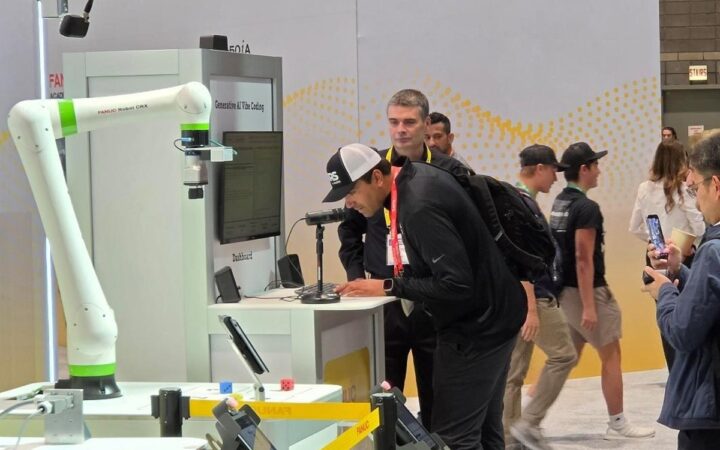
The report’s category extends beyond humanoids. It includes articulated robots, mobile platforms, collaborative robots and mobile manipulators, with revenue covering hardware, software and services. Its definition emphasizes systems that combine autonomous, remote and human-assisted operation.
The $10.03 billion figure is therefore a forecast for the publisher’s defined market, rather than a measure of humanoid sales or of the entire robotics industry. From the stated 2026 baseline, the projection implies roughly 77% growth over four years.
Smart manufacturing, field operations and work in hazardous environments are among the report’s proposed demand drivers. It identifies North America as the largest regional market in 2025 and expects Asia-Pacific to grow fastest during the forecast period.
Newer Factory Data Provides Context
Separately, the International Federation of Robotics reported on September 24 that the global stock of industrial robots exceeded five million in 2025, rising 9%. Annual installations increased 11% to more than 600,000 units.
Those deployment figures describe industrial robots broadly and use unit counts, so they cannot directly validate the hybrid market’s revenue forecast. They provide a more recent view of factory automation than the 2023 figures cited in the market report’s public summary.
Mobile Manipulation Moves Into Production Trials
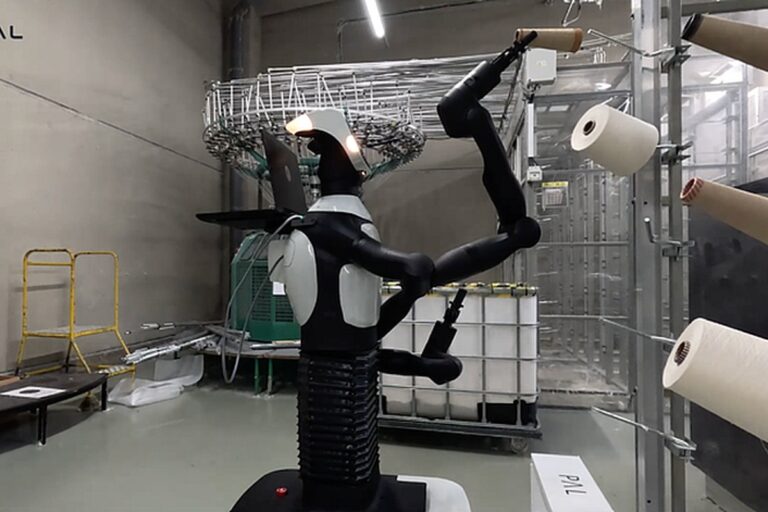
A September IFR case study describes PAL Robotics’ TIAGo Pro at Spanish textile manufacturer CETRIKO. The robot combines a mobile base, two arms, a lifting torso and an adaptive gripper to help replenish yarn cones in production equipment.
In supervised trials at the working factory, the system achieved 85% grasping success and managed 30 of 192 creel columns. The case study places it at Technology Readiness Level 7, distinguishing validation in a real environment from unattended commercial operation.
The example shows why buyers need task-specific results alongside market projections. Mobility and manipulation create useful possibilities, but reliability, integration and the amount of operator support determine what a system can contribute during a shift.
Commercial Growth Depends on Repeatable Work
Recent RobotsBeat coverage of RobCo’s planned Alfie launch and Dyna Robotics’ Taku demonstration follows different routes toward flexible robot work. Both put the emphasis on completing workflows, rather than demonstrating an isolated movement.
For the forecast to translate into durable demand, suppliers will need deployments that customers can operate and maintain economically. A growth estimate frames the opportunity; evidence from production trials and customer sites helps establish which systems can serve it.
Disclaimer: RobotsBeat is an independent media brand owned and operated by NuvexMedia LLC, publishing news, research, and insights on artificial intelligence, emerging technologies, automation, and related industries. NuvexMedia LLC invests in and collaborates with companies across the AI, Robotics, technology, software, and digital innovation sectors. These relationships do not influence RobotsBeat's editorial coverage, and the publication maintains full editorial independence to provide accurate, timely, and objective information. © 2026 NuvexMedia LLC. All rights reserved. This content is for informational purposes only and should not be considered legal, tax, investment, financial, or other professional advice.