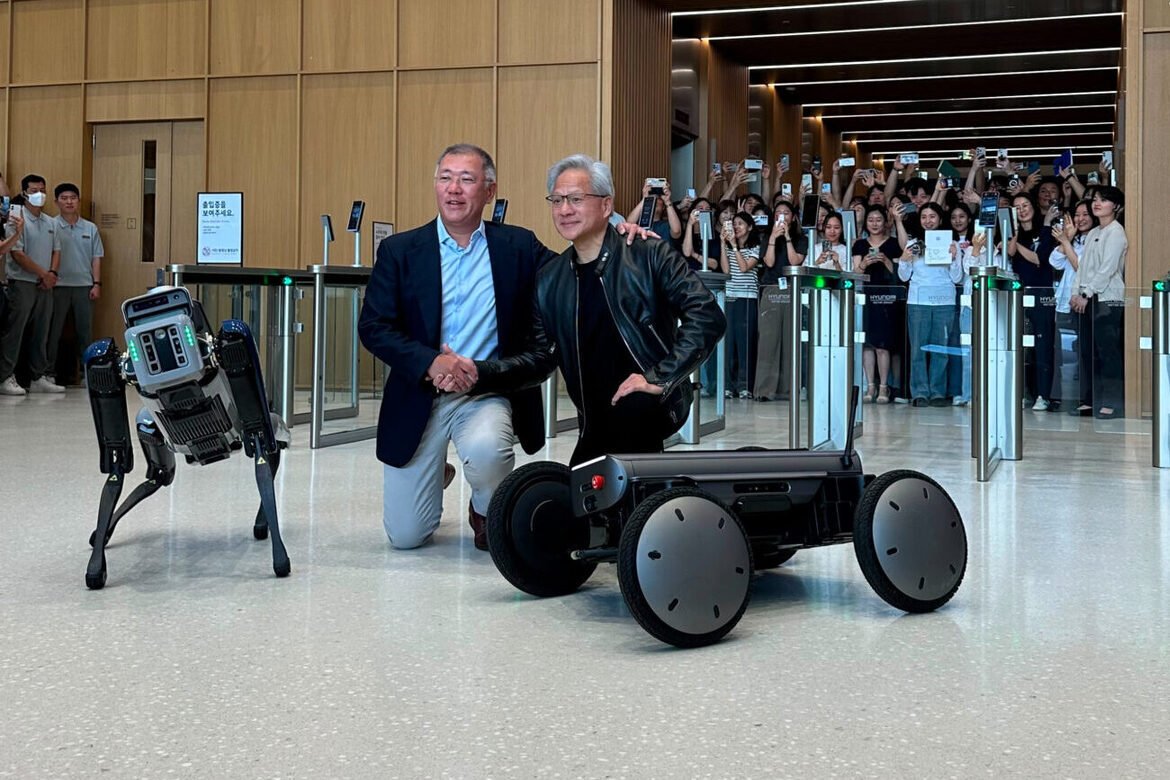

Nvidia CEO Jensen Huang declared humanoid robots “very very close” to industrial reality on Monday, as the company expanded its partnership with Hyundai Motor Group to accelerate the deployment of physical AI and robotics technologies across manufacturing and mobility. Huang and Hyundai Executive Chair Chung Euisun met to outline the deepened collaboration, with one of the central focuses being the transition of physical AI from laboratory environments to active factory floors.
“Hyundai is incredible at manufacturing, incredible at mobility, incredible at heavy industries, manufacturing at extremely large scales,” Huang said. He added that no other company is better positioned to take advantage of those manufacturing capabilities in the physical AI era.
Building on an Existing Foundation
The expanded partnership builds on an agreement announced last October, in which Hyundai committed to establishing a new AI factory powered by Nvidia’s Blackwell infrastructure. The current extension broadens that collaboration to cover physical AI technologies for mobility, manufacturing, and next-generation chip development.
For Nvidia, the Hyundai partnership provides access to one of the world’s largest and most sophisticated manufacturing networks – a deployment context that both validates Nvidia’s physical AI platform under real industrial conditions and generates the operational data that improves AI systems over time. For Hyundai, the partnership accelerates the AI and simulation toolchain underpinning its publicly stated plan to deploy 25,000 Atlas humanoid robots across its plants and build 30,000-unit annual production capacity by 2028.
The AI Valley Commitment
Chung also raised Hyundai’s nine trillion won – approximately $5.9 billion – initiative to build South Korea’s AI Valley, a national AI infrastructure project. Chung said Hyundai could create a complete AI ecosystem, including a joint data hub, if Nvidia joined the project. Huang confirmed he would participate.
The AI Valley commitment extends Nvidia’s footprint in South Korea beyond its bilateral corporate partnerships. Jensen Huang’s recent visit to Seoul – during which he also met with LG, Samsung, and SK Hynix – reflects a coordinated effort to position Nvidia as the central infrastructure provider for South Korea’s physical AI transition across its industrial and semiconductor base.
The Competitive Context
Huang’s “very very close” characterization of humanoid industrial readiness carries particular weight given Nvidia’s position as the supplier of simulation, training, and edge compute infrastructure to the majority of the humanoid robot industry. Nvidia’s Isaac platform, Omniverse digital twin tools, and Jetson compute modules are embedded in deployments from Boston Dynamics’ Atlas to Hexagon’s Aeon to NVIDIA’s own GR00T Reference Humanoid Robot announced last week.
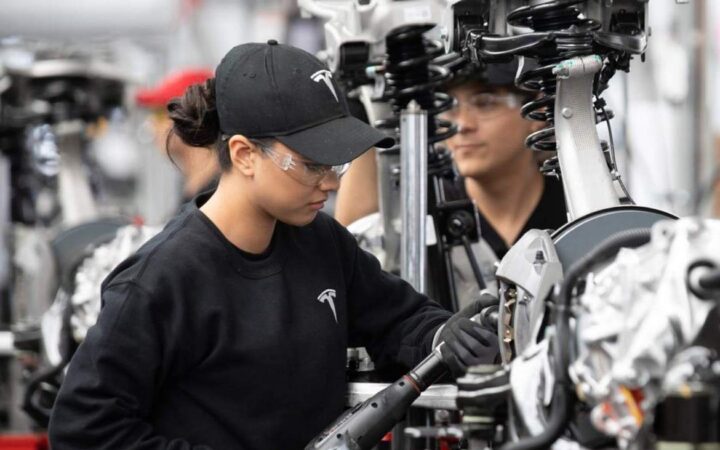
The Nvidia-Hyundai announcement brings into relief the competitive pressure on Tesla’s Optimus program, which is targeting commercial production from July-August 2026 but has not yet demonstrated deployment at the scale or operational maturity that Huang’s comments imply is now within reach across the broader industry.
Disclaimer: RobotsBeat is an independent media brand owned and operated by NuvexMedia LLC, publishing news, research, and insights on artificial intelligence, emerging technologies, automation, and related industries. NuvexMedia LLC invests in and collaborates with companies across the AI, Robotics, technology, software, and digital innovation sectors. These relationships do not influence RobotsBeat's editorial coverage, and the publication maintains full editorial independence to provide accurate, timely, and objective information. © 2026 NuvexMedia LLC. All rights reserved. This content is for informational purposes only and should not be considered legal, tax, investment, financial, or other professional advice.