Key Notes
- ALBATROSS uses the same rigid wings for autorotating descent and wind-powered sailing.
- Field tests demonstrated deployment from 150 meters and autonomous reservoir navigation.
- The platform remains a proof of concept for sheltered waters.
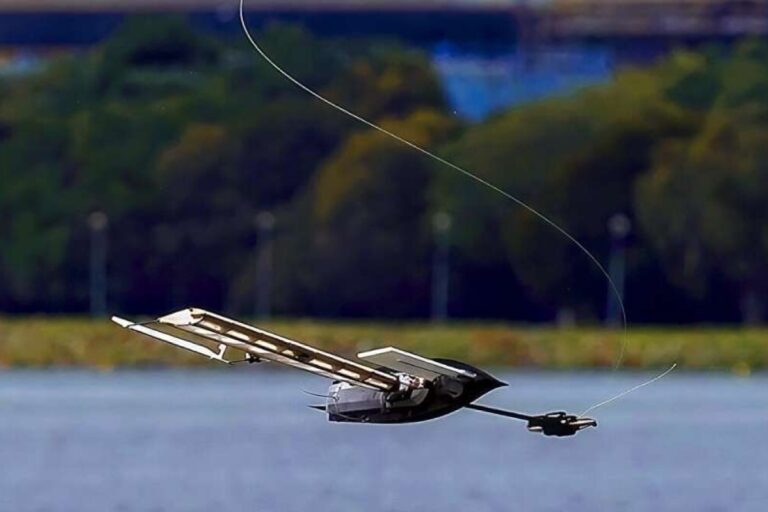
Researchers at the Singapore University of Technology and Design have developed ALBATROSS, a robot that slows its descent like a spinning maple seed, lands on water and becomes an autonomous sailboat. Field tests included a release from 150 meters, followed by passive self-righting and navigation on the water.
The concept is intended to put sensors into remote waters quickly and then use wind for movement. SUTD’s research announcement describes a proof of concept tested in sheltered reservoirs, with tougher open-sea missions still ahead.
The Same Wings Handle Descent and Sailing
ALBATROSS stands for Airborne Lander with Buoyant AuToROtating Sailing Sensor. Its rigid wingsails spin during descent, reducing the speed of the fall without a powered rotor. Once afloat, the same surfaces catch the wind to drive the craft across the water.
Its weight distribution helps it return upright after landing. A fish-tail-inspired rudder steers the craft and can oscillate to provide propulsion when wind is weak.
The design uses three actuators and three navigation sensors. Reusing components addresses a recurring difficulty in robots that cross between environments: equipment useful in one mode can become extra weight in another.
What the Reservoir Tests Demonstrated
SUTD reports that a larger test version sailed for around three hours, reached a peak speed just below one kilometer per hour and recorded environmental measurements. The team estimates that landing without autorotation would produce about 18.5x more impact energy.
Field sailing used a rule-based controller. Reinforcement-learning simulations explored waypoint navigation, a separate result from the reservoir trials. The distinction matters when assessing how much autonomous behavior has been demonstrated on the physical platform.
Design Files and Control Software Are Available
The work appears in Science Robotics. Lead author Shane Kyi Hla Win and colleagues have also published supporting materials on Zenodo, including mechanical designs, controller code, measurements and simulation environments.
The repository contains SolidWorks and STEP files, rule-based firmware for a Teensy 4.1 microcontroller, and Python reinforcement-learning scripts with MuJoCo assets. Those materials give other researchers a route to examining how the hardware and control methods fit together.
Open-Sea Operation Is the Next Challenge
Weeks-long monitoring is an ambition, rather than a demonstrated endurance result. The researchers identify stronger winds, waves and currents as challenges for future versions, alongside more durable construction and additional sensing equipment.
RobotsBeat previously covered an aerial-aquatic robot from MIT and EPFL that swims and flies using flapping wings. ALBATROSS takes a different route, combining aerial deployment with surface sailing rather than powered underwater swimming and takeoff.
Work on Southampton’s adaptive robot fin likewise explores how biological mechanisms can improve movement in water. ALBATROSS’ contribution is to share hardware across descent and sailing; its practical value will depend on carrying useful sensors reliably beyond the sheltered conditions tested so far.
Disclaimer: RobotsBeat is an independent media brand owned and operated by NuvexMedia LLC, publishing news, research, and insights on artificial intelligence, emerging technologies, automation, and related industries. NuvexMedia LLC invests in and collaborates with companies across the AI, Robotics, technology, software, and digital innovation sectors. These relationships do not influence RobotsBeat's editorial coverage, and the publication maintains full editorial independence to provide accurate, timely, and objective information. © 2026 NuvexMedia LLC. All rights reserved. This content is for informational purposes only and should not be considered legal, tax, investment, financial, or other professional advice.