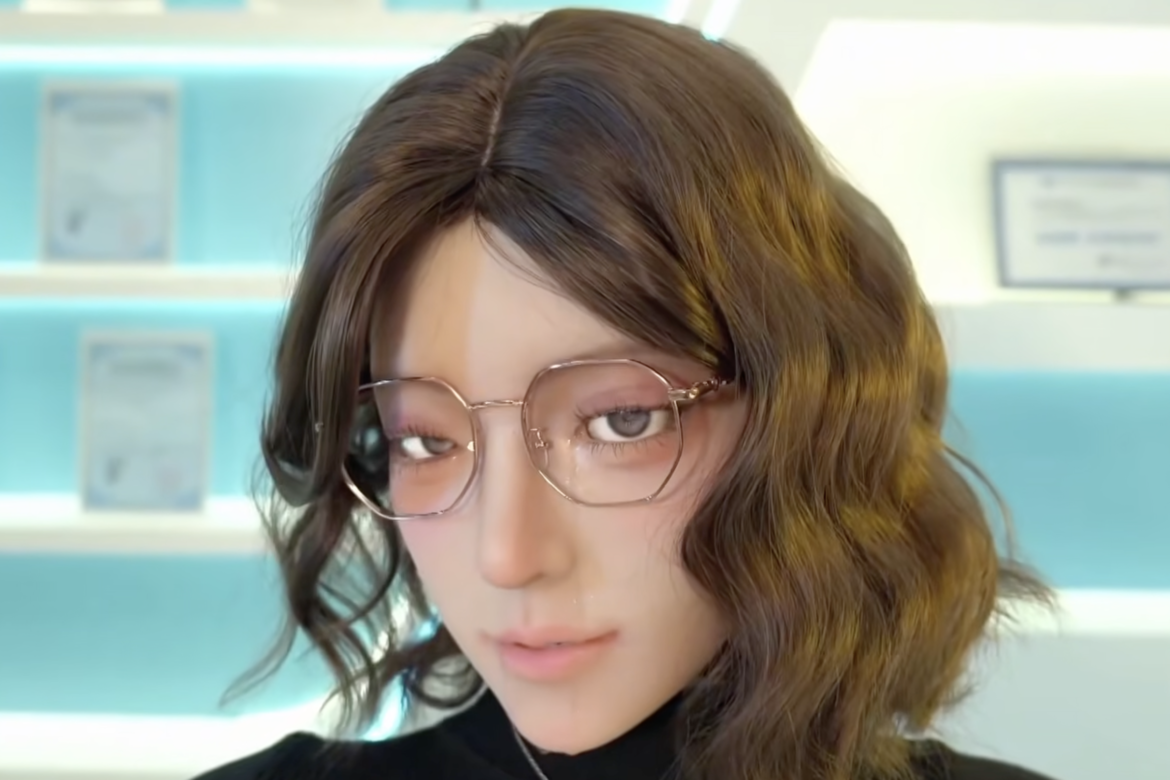
Yanxi Technology, a Chinese robotics firm based in Ningbo, demonstrated its Yansyn-X2 robot crying on command at the 2026 Inclusion Conference in Shanghai, in what appears to be the first public demonstration of a consumer humanoid robot producing real tears through an active microfluidic mechanism. Footage from the event shows a demonstrator asking the robot to shed tears, followed within seconds by a single tear rolling down the robot’s face.
The robot is not yet a walking platform – the current version is a static model that can turn its head, track people with its eyes, and gesture with its arms. Future versions are planned to use bionic muscles rather than servo motors for smoother and more varied facial expressions, with commercial pricing starting from 400,000 yuan.
The Three-Layer Technical Architecture
The crying capability is engineered across three distinct systems. A conversational AI layer analyzes the tone and content of dialogue to determine when an emotional response is contextually appropriate – detecting sad or empathetic language that warrants an emotional display. A bionic actuation layer beneath the robot’s medical-grade silicone face shifts its features into an expression matching the detected emotional context. A separate microfluidic system then dispenses fluid at the corner of the eyes, producing the physical appearance of tears at the moment the emotional expression is activated.
The engineering is a product of the affective computing field – the discipline concerned with teaching machines to recognize, interpret, and respond to human emotions. The goal, as researchers in the space describe it, is not to convince people that a robot genuinely experiences sadness, but to make human-robot interaction feel more natural and emotionally coherent.
The Research Behind Emotional Robots
A 2023 study published in Frontiers found that robots displaying facial expressions matching the emotional tone of a conversation were rated more likable, trustworthy, and human-like than robots with no expression or mismatched expressions. The finding provides the commercial rationale for the Yansyn-X2’s architecture: if emotional responsiveness makes robots more acceptable as companions and coworkers, then engineering that responsiveness – even through mechanical approximation – has practical deployment value.
The specific value proposition Yanxi Technology is pursuing is the companion and emotional support category, where the robot’s ability to respond to a user’s emotional state – including appearing to share in sadness when someone tells it something distressing – is the primary feature rather than a supporting capability.
The Uncanny Valley Question
The demonstration has drawn significant attention precisely because it sits at the intersection of capability and discomfort. A robot that produces tears when asked is technically impressive and commercially targeted at a real consumer need – loneliness, emotional support, companion AI for elderly users. It is also an experience that many observers describe as deeply unsettling.
The uncanny valley effect – the documented human discomfort that arises when something looks almost but not quite human – has been a persistent challenge for humanoid robot design. The Yansyn-X2’s medical-grade silicone face and microfluidic tears represent a design choice that moves decisively toward human likeness rather than away from it, accepting the discomfort risk as the price of the emotional authenticity the product requires.
Whether that trade-off is commercially viable – whether consumers seeking emotional AI companions will find the crying feature reassuring rather than unsettling – will be tested when the robot reaches market at the 400,000 yuan price point.
Disclaimer: RobotsBeat is an independent media brand owned and operated by NuvexMedia LLC, publishing news, research, and insights on artificial intelligence, emerging technologies, automation, and related industries. NuvexMedia LLC invests in and collaborates with companies across the AI, Robotics, technology, software, and digital innovation sectors. These relationships do not influence RobotsBeat's editorial coverage, and the publication maintains full editorial independence to provide accurate, timely, and objective information. © 2026 NuvexMedia LLC. All rights reserved. This content is for informational purposes only and should not be considered legal, tax, investment, financial, or other professional advice.