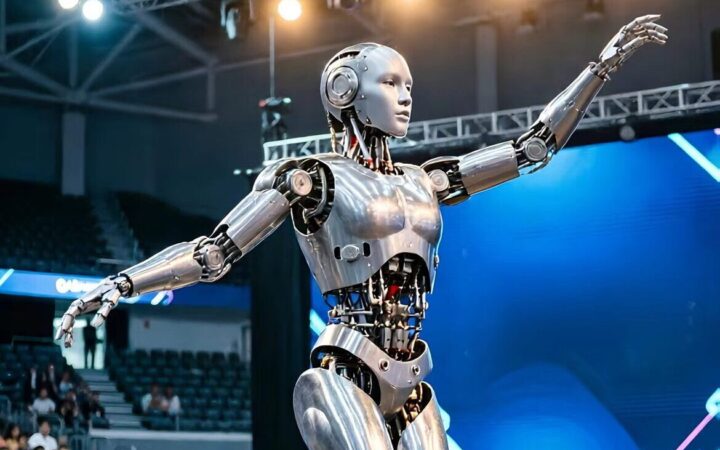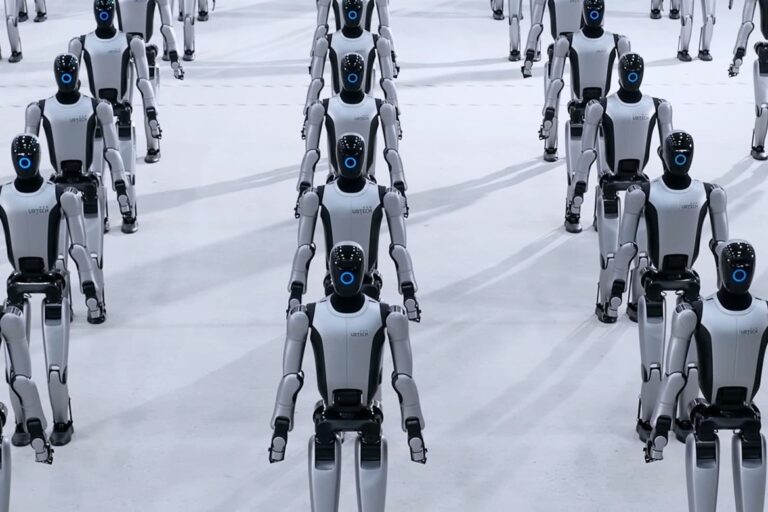
UBTECH began operations at its new industrial humanoid robot factory in Liuzhou, Guangxi on September 12, marking one of the most significant capacity commitments in the Chinese humanoid robot manufacturing sector. The 14,000 square-meter facility, with a ceiling height of 13.8 meters, is designed to produce more than 10,000 humanoid robots annually at a throughput rate of one completed robot every 10 minutes. UBTECH shares rose more than 3% in early trading on September 14 following the launch announcement.
The factory will primarily manufacture the Walker S Series industrial humanoid and Cruzr Series embodied intelligence robots, using a flexible mixed-line design that allows different models to be produced on the same manufacturing system without major hardware reconfigurations when production requirements shift.
Humanoids Building Humanoids
The production floor itself uses humanoid robots for manufacturing tasks. Walker S units perform depalletizing, palletizing, and material loading operations. Collaborative robotic arms work with 360-degree rotating assembly stations to tighten screws, with each completed robot requiring more than 2,000 screws of different specifications. Automated guided vehicles and unmanned forklifts transport materials between storage and production areas, with finished robots moving into an automated three-dimensional warehouse.
Every robot produced receives a unique serial number tracking its component sources, assembly parameters, and inspection records through the manufacturing process – creating a detailed traceability record for maintenance, quality control, and troubleshooting throughout the product lifecycle.
The Siemens Digital Twin Layer
UBTECH developed the facility in partnership with Siemens Digital Industries Software, covering factory planning, product lifecycle management, digital twin simulation, production scheduling, and quality control. Siemens’ Plant Simulation platform creates a 1:1 digital model of the factory – including aisles, workstations, storage areas, and AGV routes – allowing engineers to simulate material movement from warehouse through production to dispatch before implementing physical changes.
The companies developed the Yanshee MOM manufacturing operations management system using Siemens’ Intelligence Center X platform. It functions as the factory’s digital operational brain for production scheduling and operations management, coordinating across the automated systems on the floor.
The Manufacturing Challenge UBTECH Is Solving
Humanoid robot manufacturing has faced specific structural challenges: each machine contains hundreds of precision components, assembly requires exact tolerances, and fast product iteration cycles make conventional fixed production lines difficult to adapt. UBTECH’s flexible mixed-line design, combined with digital twin pre-commissioning and full component traceability, addresses all three simultaneously.
The 10,000-unit annual capacity is the largest single humanoid robot production facility capacity announced by any Chinese manufacturer to date. UBTECH’s industrial production targets include 5,000 Walker S Series robots in 2026 alongside 10,000 U1 consumer companion units – meaning the Liuzhou factory capacity covers the industrial segment of that ambition. Whether that capacity translates into equivalent shipments will depend on industrial customer demand, sales conversion from the Walker S deployment pipeline with customers including Hitachi and Terra Robotics, and manufacturing economics as the ramp progresses.
Disclaimer: RobotsBeat is an independent media brand owned and operated by NuvexMedia LLC, publishing news, research, and insights on artificial intelligence, emerging technologies, automation, and related industries. NuvexMedia LLC invests in and collaborates with companies across the AI, Robotics, technology, software, and digital innovation sectors. These relationships do not influence RobotsBeat's editorial coverage, and the publication maintains full editorial independence to provide accurate, timely, and objective information. © 2026 NuvexMedia LLC. All rights reserved. This content is for informational purposes only and should not be considered legal, tax, investment, financial, or other professional advice.