Key Notes
- Foundry Robotics announced a $100 million Series A led by Marlinspike Partners to expand its factory, AI deployment and engineering and operations teams.
- The company says its manufacturing footprint has grown to 130,000 square feet in Emeryville, where robotic assembly cells work alongside experienced manufacturing teams.
- Foundry owns and operates production capacity for customers through manufacturing-as-a-service, while its speed and first-factory claims remain company statements.
Foundry Robotics has raised $100 million in Series A funding to expand an AI-powered assembly factory in Emeryville, California, pursuing a manufacturing-as-a-service model for defense and commercial hardware. Marlinspike Partners led the oversubscribed round announced on October 28.
The company says it has increased its manufacturing footprint twentyfold to a 130,000-square-foot facility. The financing will support the factory buildout, deployment of AI models in production and hiring across robotics research, engineering and operations.
A Factory Business Built Around Robotic Assembly
Foundry’s funding announcement identifies returning investors Khosla Ventures and Red Glass Ventures, alongside new participants SE Ventures, Wing VC and Axiom Ventures. Existing investors Hanabi and Zero Shot Fund also participated.
Rather than selling a robot for a customer to integrate into its own plant, Foundry owns and operates the manufacturing environment. Customers use that capacity to assemble products without building a dedicated production line themselves.
The distinction changes what the startup has to deliver. Its output is finished hardware with the required quality and traceability, not simply a machine capable of demonstrating an assembly task.
FoundryOS Coordinates Robots and Production
The company describes a grid of robotic cells trained on assembly operations, connected by FoundryOS software across robots, factory systems and cloud infrastructure. It says production experience feeds back into its AI models so cells can improve and adapt to additional products.
On its company overview, Foundry emphasizes a combination of robotics, software and experienced manufacturing teams. Its use of the word autonomous therefore should not be read as a claim that the facility has no technicians or human oversight.
Applications listed in the release include drones, autonomous-vehicle subassemblies, wire harnesses, underwater vehicles, ground robots and computing hardware. These are the product areas Foundry is targeting or serving; the announcement does not disclose production volumes for each category.
Designing Products for Robot Assembly
Foundry’s manufacturing approach includes Design for Robotic Assembly, which seeks to simplify assembly steps and reduce the difficulty of producing a design with robots.
This addresses a practical constraint in automation. A product designed around a person’s dexterity may contain connections, fastening steps or flexible components that are awkward for a robotic cell. Changing the assembly process or product design can be as important as improving the robot’s model.
For a contract manufacturer handling different products, the challenge is to make that adaptation repeatable. Tool changes, inspection requirements and component variation all have to fit into the factory’s scheduling and quality systems.
Manufacturing Experience Behind the Company
CEO Adarsh Kulkarni co-founded Foundry with Emmanuel Lamacchia, formerly a program manager for Tesla’s Model Y. Kulkarni previously worked at Ghost Robotics and led robotics at Scale AI, according to the release.
The startup positions its approach as a way to expand domestic assembly capacity while allowing customers to change products or increase output. Its claim that customers can move from design to production in weeks remains a company statement, rather than an independently established timeline for every project.
The release calls the project America’s first autonomous factory for assembly. That description is Foundry’s positioning; it does not provide a comparative assessment establishing priority across the wider manufacturing industry.
From Funding to Repeatable Production
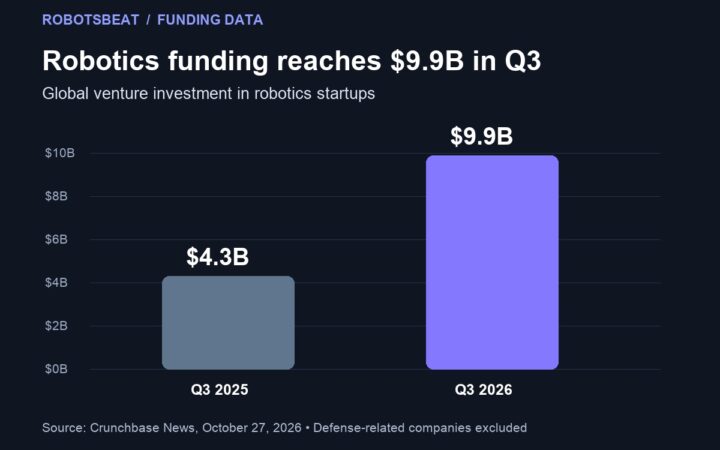
The round joins the broader investment wave examined in RobotsBeat’s robotics funding report. Foundry’s October financing falls outside that report’s third-quarter figures.
Its factory model also offers a comparison with 120ft’s microfactory plans: both put automated production capacity at the center of the business, although their scale and technical approaches differ.
For Foundry, the next evidence to watch is sustained throughput, quality performance and the time needed to introduce another product. Those operating results will show how effectively flexible robotic cells can translate fresh capital into dependable manufacturing capacity.
Disclaimer: RobotsBeat is an independent media brand owned and operated by NuvexMedia LLC, publishing news, research, and insights on artificial intelligence, emerging technologies, automation, and related industries. NuvexMedia LLC invests in and collaborates with companies across the AI, Robotics, technology, software, and digital innovation sectors. These relationships do not influence RobotsBeat's editorial coverage, and the publication maintains full editorial independence to provide accurate, timely, and objective information. © 2026 NuvexMedia LLC. All rights reserved. This content is for informational purposes only and should not be considered legal, tax, investment, financial, or other professional advice.