Key Notes
- NEURA’s training strategy links industrial process knowledge with physical interaction data, human demonstrations and simulation to develop practical robot skills.
- TUM RoboGym opened with around 100 humanoid and service robots across 48 training cells, initially focusing on industrial applications and internal logistics.
- A New York Times report highlights China’s larger training infrastructure, while NEURA’s wider gym network remains an expansion plan rather than a completed rollout.
NEURA Robotics is betting that Europe’s manufacturing expertise can become a valuable source of training data for intelligent robots, as China builds a much larger network of facilities teaching machines to work in the physical world.
An October 27 New York Times report places the German company’s robot-training strategy at the center of that competition. The question extends beyond building humanoids: Europe also needs enough real-world experience to teach them useful industrial skills.
A Training Gap Behind the Robot Race
The newspaper cites Interact Analysis figures showing more than 90 humanoid data-collection centers operating in China, with at least 50 more being developed, compared with fewer than 10 facilities in Europe. Those figures describe training infrastructure, rather than directly comparable measures of robot performance.
The report says NEURA aims to have five gyms operating globally by year-end, including a site already opened in Hangzhou, with ten more expected to follow. It also describes work with Bosch and other companies to equip more than 1,000 workers with sensor suits that capture movements during ordinary shifts.
Human demonstrations can help expose the sequence of a task: how a person approaches an object, positions a hand and adjusts a movement. Turning those recordings into a dependable robot skill still requires accounting for the machine’s different body, sensors and limits.
Inside the Munich RoboGym
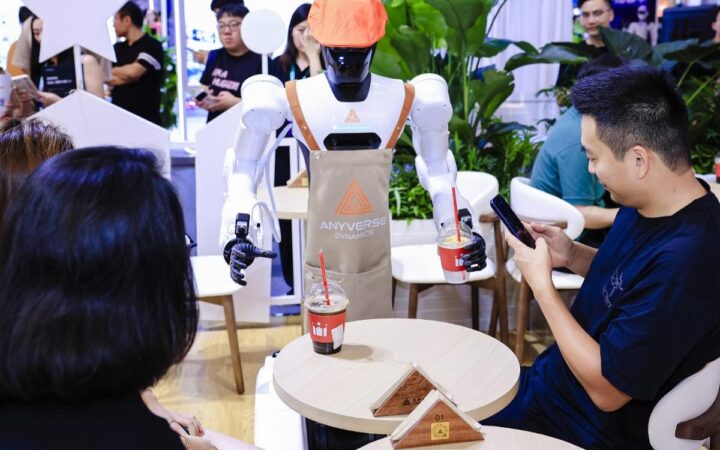
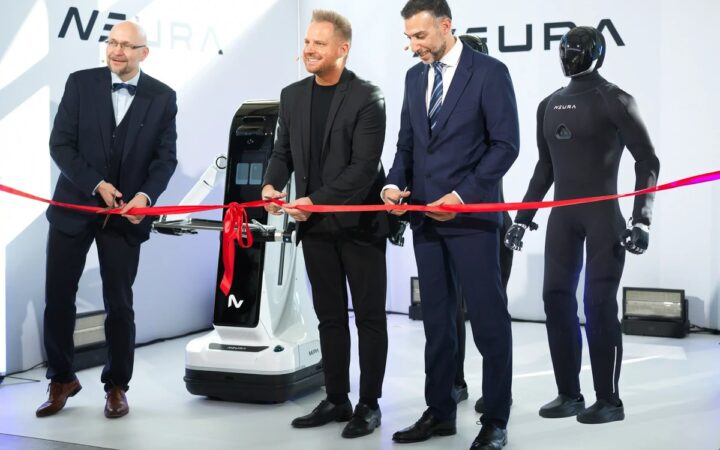
The Technical University of Munich and NEURA opened TUM RoboGym at Munich Airport’s LabCampus on October 22. TUM’s announcement describes around 100 humanoid and service robots across 48 training cells, initially focused on industrial work and internal logistics.
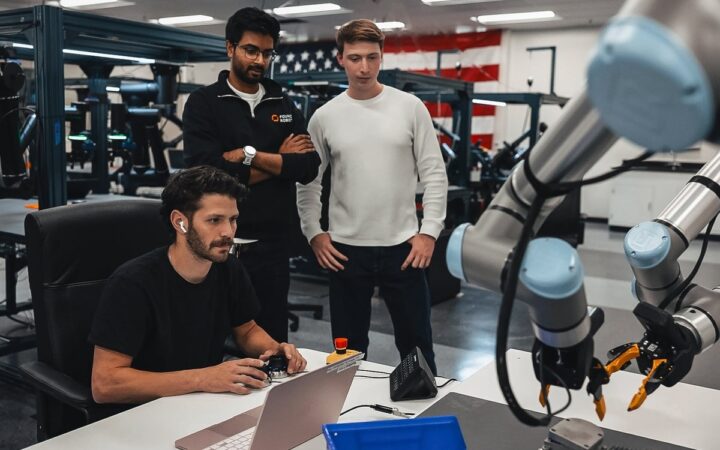
Tasks include folding boxes, assembling components and using tools. Data from those interactions enters a curated cloud repository for physical AI research and model training.
The mixed fleet is important to understanding the numbers: around 100 robots does not mean 100 units of NEURA’s latest humanoid. RobotsBeat’s 4NE1 Gen 4 coverage separately explains the hardware introduced alongside the facility.
Industrial Knowledge Becomes Training Material
NEURA’s RoboGym overview says companies contribute concrete tasks and process knowledge, while researchers investigate how robots can learn them more efficiently and reliably. The company combines physical interaction data, human demonstrations and simulation in its training approach.
That gives manufacturers a potentially useful role beyond buying finished robots. A business that understands a difficult assembly step can help define the task, identify acceptable outcomes and expose the situations that cause mistakes.
RobotsBeat has covered Neuron AI, NEURA’s effort to combine multiple senses for robot control. The training infrastructure supplies experiences from which such systems can learn; the model must then convert those experiences into actions that remain useful outside the original setup.
Training Capacity Must Become Reliable Work
More training cells can produce more attempts, but the number of attempts alone does not establish commercial readiness. Useful evaluation also needs to measure task completion, recovery from errors, human intervention and performance when materials or layouts change.
For European manufacturers, the opportunity is to connect robotics research with detailed knowledge of production processes. Whether that becomes a competitive advantage will depend on robots completing repeatable work at a cost and reliability level factories can accept.
The Munich project is an operating research facility, while the wider gym network remains an expansion plan. Keeping those stages distinct makes the progress easier to judge: training infrastructure is being built, and its industrial value will be demonstrated through the work robots can subsequently perform.
Disclaimer: RobotsBeat is an independent media brand owned and operated by NuvexMedia LLC, publishing news, research, and insights on artificial intelligence, emerging technologies, automation, and related industries. NuvexMedia LLC invests in and collaborates with companies across the AI, Robotics, technology, software, and digital innovation sectors. These relationships do not influence RobotsBeat's editorial coverage, and the publication maintains full editorial independence to provide accurate, timely, and objective information. © 2026 NuvexMedia LLC. All rights reserved. This content is for informational purposes only and should not be considered legal, tax, investment, financial, or other professional advice.