Key Notes
- Machenta announced a $40 million seed round co-led by Creandum and Union Square Ventures to develop faster robot learning.
- Its investor describes a simulation-trained foundation model that can adapt to a demonstrated task without another task-specific training run.
- One-demonstration performance remains a developer and investor claim that needs evaluation across repeated attempts, unfamiliar objects and real deployment conditions.
Machenta has raised $40 million in seed funding to develop robot models that can pick up a new task from a single demonstration. Creandum and Union Square Ventures co-led the round announced on October 27.
The London startup is pursuing a different answer to a familiar robotics problem: how to teach a useful skill without collecting a large task-specific dataset and running a separate training process every time.
Learning How to Learn in Simulation
In its investment announcement, Creandum describes a foundation model trained entirely in simulation, with the aim of enabling a robot to respond to a demonstration immediately. The investor says the system can adapt to variations without additional task training.
This does not mean an untrained robot learns without prior preparation. The initial model has already undergone training; the claimed advantage concerns adapting that trained system to a demonstrated task.
The distinction is central to evaluating the approach. Learning a general procedure for interpreting a demonstration could reduce deployment effort, but it still has to work with the objects, sensors and physical constraints of a particular robot.
From Imperial Research to a Startup
Machenta was founded by Edward Johns and Vitalis Vosylius. Creandum traces the work to Johns’ robot-learning research at Imperial College London and describes the team’s move into a new base in King’s Cross.
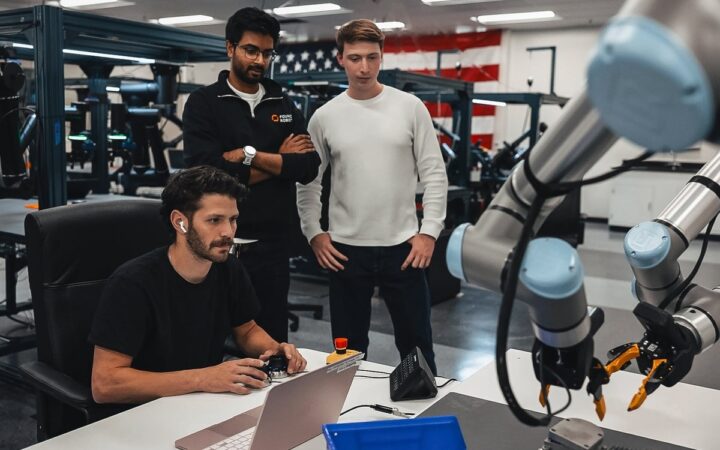
The investor recounts bringing unfamiliar props to a lab demonstration and watching the robot perform a task after being shown once. That is an investor’s account of selected demonstrations, rather than an independent measure of reliability across every task or environment.
A Different Route Through the Data Bottleneck
Much of the industry is building systems to collect more physical experience. RobotsBeat’s Maxinsights coverage examined one such data platform, while NEURA’s training gyms bring robots and industrial processes together in dedicated facilities.
Machenta’s simulation-first approach asks whether the model can learn enough general structure virtually to need much less teaching at deployment. The tradeoff is how well simulated experience transfers to contact, friction, deformation and other real-world behavior.
A clear demonstration can also carry more information than a short instruction. It can show order, spatial relationships and a desired outcome, giving the robot a concrete example of what the user wants.
The Commercial Test Is Repeatability
For customers, the important measures will include how many demonstrations a new workflow actually requires, how often a person intervenes and whether performance holds when objects move or conditions change.
The seed round funds development of that proposition. A strong first attempt is useful evidence, but a production application has to complete the task consistently across many attempts and recover when something goes wrong.
Machenta’s pitch is compelling because teaching effort is a real obstacle to robotics adoption. Its progress will be judged by how often the one-demonstration promise survives outside a carefully selected lab task.
Disclaimer: RobotsBeat is an independent media brand owned and operated by NuvexMedia LLC, publishing news, research, and insights on artificial intelligence, emerging technologies, automation, and related industries. NuvexMedia LLC invests in and collaborates with companies across the AI, Robotics, technology, software, and digital innovation sectors. These relationships do not influence RobotsBeat's editorial coverage, and the publication maintains full editorial independence to provide accurate, timely, and objective information. © 2026 NuvexMedia LLC. All rights reserved. This content is for informational purposes only and should not be considered legal, tax, investment, financial, or other professional advice.