Key Notes
- ABB has integrated AI Robot Trainer into Fashion Inductor to connect vision-based learning with robotic picking and ongoing application updates.
- The company claims up to 75% less engineering and commissioning effort, a comparison that should not be treated as an equivalent reduction in total warehouse costs.
- Retraining and a digital twin are intended to help integrators adapt cells as products and operating conditions change.
ABB Robotics has added AI Robot Trainer to its Fashion Inductor system, aiming to make automated fashion-logistics cells easier to deploy and adapt when products, packaging and operating conditions change.
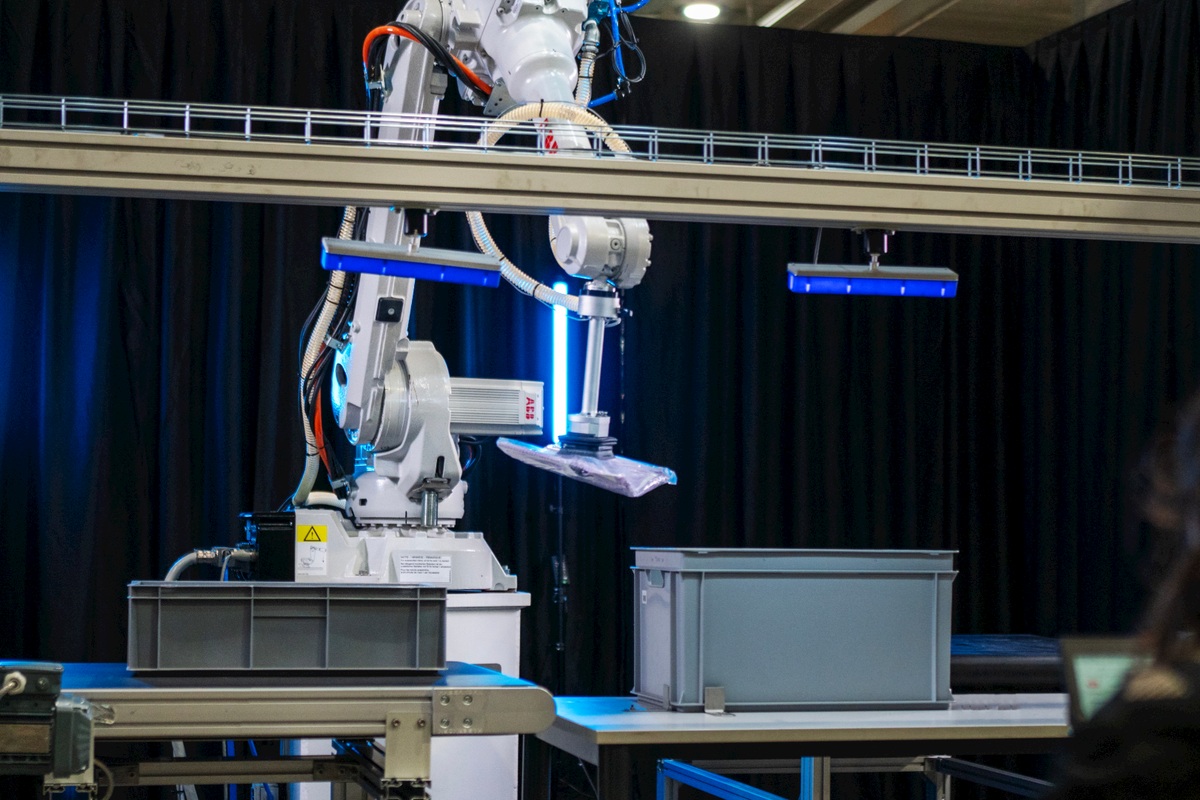
The upgrade focuses on a difficult warehouse problem: handling a stream of items whose appearance and physical behavior vary, rather than repeating a motion around one identical part.
Vision Models Connect to Robot Motion
ABB’s announcement describes pretrained fashion-specific vision models, application tools and retraining capabilities connected to the robot’s control software. The company says the combination can reduce engineering and commissioning effort by up to 75%.
That is a manufacturer comparison, not a demonstrated 75% reduction in total warehouse costs. The size of any saving will depend on the starting application, integration requirements and changes made to the cell.
ABB’s official demonstration video shows the Fashion AI Robot Trainer approach. The video illustrates the workflow; it does not establish that every customer installation will reach identical performance.
Retraining Becomes Part of Operation
The system is designed to monitor performance, identify anomalies, generate further training data and deploy improved models back to the physical robot. That creates a route for updating perception when the items arriving at a workcell change.
For fashion logistics, this matters because a successful pick is not just a question of recognizing an item. The system must choose a workable grasp, avoid neighboring products and move the selected item into the next process.
A cell that performs well on an initial product mix can lose accuracy when packaging, lighting or materials change. Making retraining accessible to the operator or integrator can therefore be as important as the initial model.
Digital Twin Supports Commissioning
ABB also connects the upgraded module to a digital twin through RobotStudio and its application-control and path-planning software. The aim is to validate and configure more of the application before changes reach the production cell.
The company cites throughput of up to 1,300 items per hour per cell and picking-accuracy targets above 99.5% for Fashion Inductor. These are stated performance figures and targets, rather than a universal independent benchmark for every combination of garments and packaging.
A Practical Physical AI Application
RobotsBeat’s Zalando returns coverage examined another approach to handling variable fashion items. Both stories put physical AI into a defined logistics workflow where performance can be measured against actual throughput and errors.
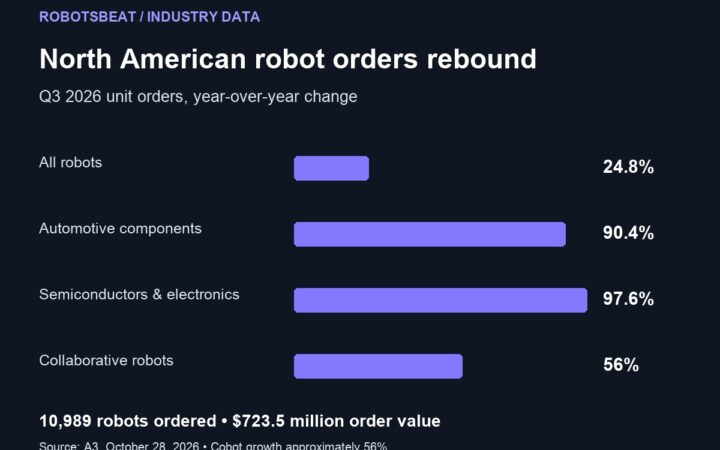
The new tools also fit the commercial demand reflected in industrial robot orders: customers need systems that can be commissioned, supported and adjusted to changing work.
ABB’s rollout makes adaptation part of the product lifecycle. Its value will be clearer in customer operating data showing how quickly a cell can recover performance after a new product mix or process change.
Disclaimer: RobotsBeat is an independent media brand owned and operated by NuvexMedia LLC, publishing news, research, and insights on artificial intelligence, emerging technologies, automation, and related industries. NuvexMedia LLC invests in and collaborates with companies across the AI, Robotics, technology, software, and digital innovation sectors. These relationships do not influence RobotsBeat's editorial coverage, and the publication maintains full editorial independence to provide accurate, timely, and objective information. © 2026 NuvexMedia LLC. All rights reserved. This content is for informational purposes only and should not be considered legal, tax, investment, financial, or other professional advice.