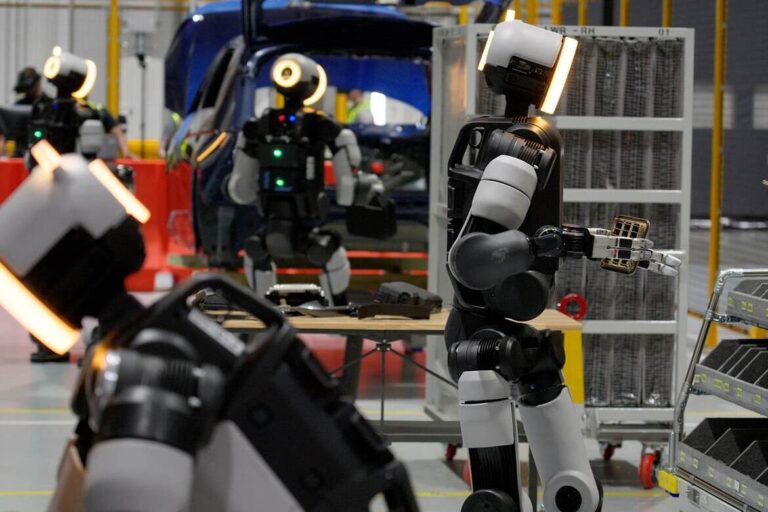
Boston Dynamics has launched the Robotics Metaplant Application Center inside Hyundai Motor Group’s Metaplant America campus near Savannah, Georgia, establishing a dedicated testbed and training hub for Atlas robots performing industrial work. Human trainers are currently teleoperating Atlas units in real factory conditions, teaching them to handle automotive parts logistics, sequence assembly lines, and organize heavy components. The facility marks the beginning of Hyundai’s 25,000-unit Atlas deployment program across its global Hyundai and Kia manufacturing plants.
“Together with Hyundai Motor Group, we are pioneering physical AI at enterprise scale,” said Zack Jackowski, Chief Product and Technology Officer at Boston Dynamics.
The Atlas Platform for Factory Work
The Atlas deployed at RMAC has a peak payload capacity of 50 kilograms and a continuous payload of 30 kilograms, 56 total degrees of freedom, and a roughly four-hour operating runtime with support for autonomous battery swaps enabling round-the-clock factory operations. Custom tactile grippers handle automotive components. The robot operates reliably across a temperature range of -20 degrees Celsius to 40 degrees Celsius, covering the environmental conditions of industrial facilities from freezing cold storage areas to hot manufacturing floors.
The current phase focuses on parts sorting, logistics, and assembly sequencing – structured, high-frequency tasks that are well-suited to the robot’s current capabilities and generate operational data that will inform the development of more complex autonomous behaviors.
The 25,000-Unit Deployment Plan
Hyundai’s stated target is 25,000 Atlas units across its global Hyundai and Kia manufacturing network, with a roadmap toward full autonomous component assembly and heavy-load labor by 2030. To supply that fleet, the group is building a dedicated U.S. production facility capable of producing 30,000 robots annually. The RMAC will relocate to a facility ten times its current size in 2027 to expand testing beyond automotive into aerospace, semiconductor fabrication, and life sciences – the sectors Boston Dynamics is actively targeting with existing clients.
By the end of the decade, Atlas robots are expected to take on component assembly line work, heavy lifting, and complex manufacturing operations across multiple production sites. Hyundai expects this transition to reduce physical strain on human workers by shifting high-risk and physically demanding tasks to automation.
The Workforce Dimension
The scale of the deployment has prompted a response from Kia Corp’s labor union, which has requested a dedicated body to safeguard labor rights in the AI era. Hyundai Motor Vice Chair Jaehoon Chang has addressed workforce concerns directly, stating that human personnel will remain essential to operate, train, and maintain the robotic fleet, and that workforce demands will persist rather than disappear.
The RMAC deployment is the most operationally concrete step in the Boston Dynamics and Hyundai program since the Atlas platform was unveiled as an electric production robot in January 2026. It establishes a direct line from the Georgia facility’s current teleoperated parts sorting work to the autonomous assembly operations planned for 2030 – a progression that will be the primary measure of whether the 25,000-unit target is achievable on its stated timeline.
Disclaimer: RobotsBeat is an independent media brand owned and operated by NuvexMedia LLC, publishing news, research, and insights on artificial intelligence, emerging technologies, automation, and related industries. NuvexMedia LLC invests in and collaborates with companies across the AI, Robotics, technology, software, and digital innovation sectors. These relationships do not influence RobotsBeat's editorial coverage, and the publication maintains full editorial independence to provide accurate, timely, and objective information. © 2026 NuvexMedia LLC. All rights reserved. This content is for informational purposes only and should not be considered legal, tax, investment, financial, or other professional advice.