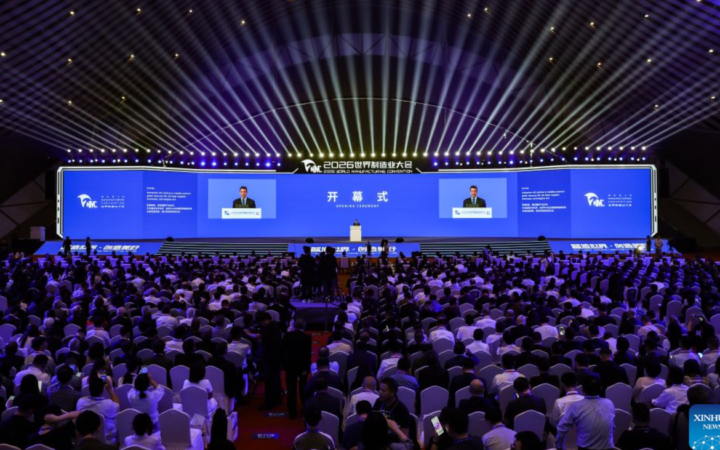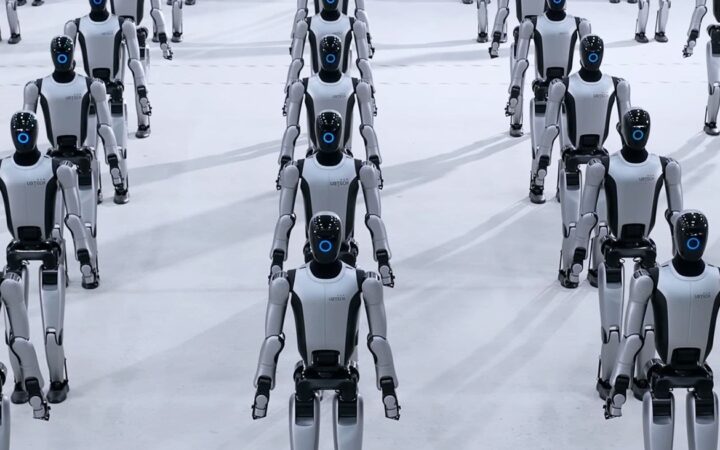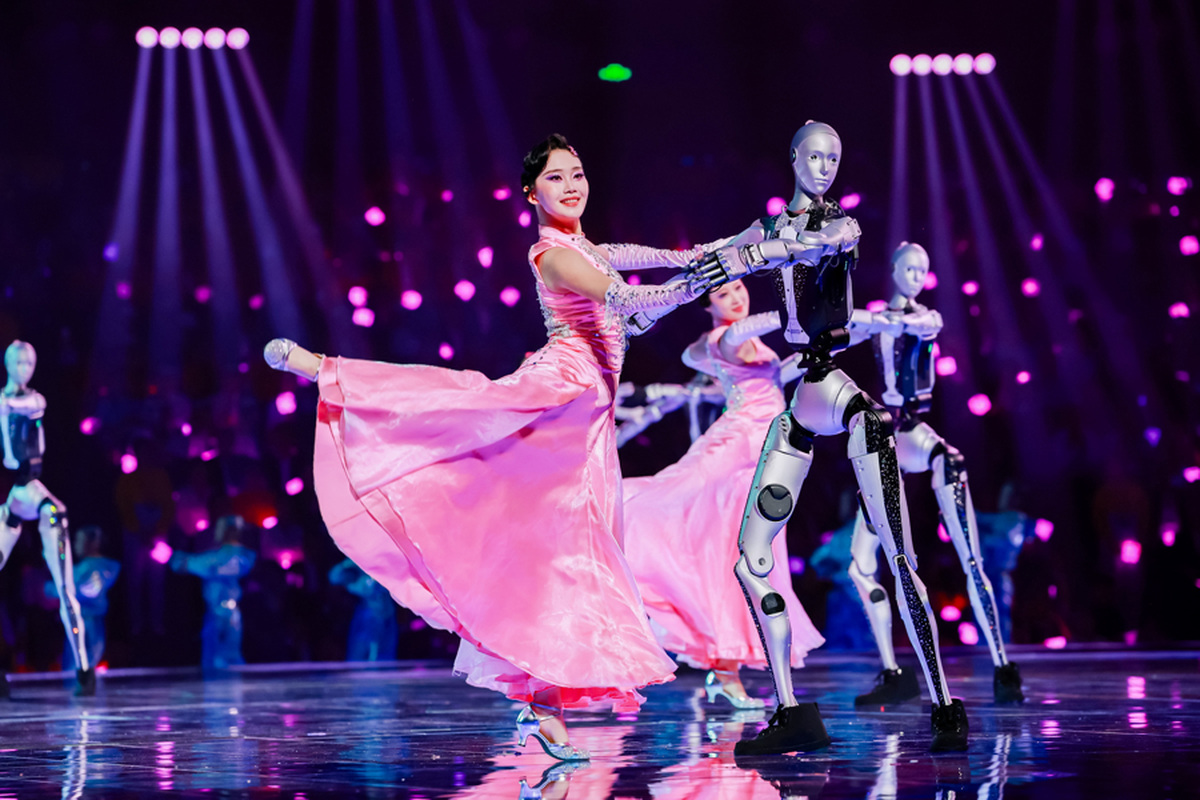

Unitree Robotics says 19 of its humanoid robots performed alongside 120 dancers at the opening ceremony of WorldSkills Shanghai 2026 on September 22. The company has released a video of the routine, describing it as an AI-driven autonomous robot cluster performance presented before more than 10,000 spectators and livestreamed worldwide.
The production brought humanoid robots into a large ensemble of human performers. Shanghai’s official account describes robots walking, changing formations and waltzing with their partners, with one also performing a short finger dance.
A Live Performance with Human Partners
The ceremony took place at the Shanghai World Expo Cultural Center. WorldSkills had announced a worldwide broadcast beginning at 12:00 GMT on September 22, equivalent to 8 p.m. in Shanghai, with recordings available afterward.
According to Shanghai’s official report, the smooth interaction followed extensive preparation. Dancers initially wore protective gear and were hesitant to approach the machines. Rehearsals helped them become comfortable at close range, while technical teams repeatedly tested and calibrated motion data.
That preparation is an important part of the story. A robot dancing alone has different coordination requirements from one extending its hand to a person or moving through a shared formation. Timing, spacing and repeatable movement affect both the visual result and the confidence of the people performing beside it.
The routine is therefore a public demonstration of human-robot interaction as well as locomotion. Its most relevant feature is the integration of multiple machines into a rehearsed production with human partners.
What Unitree’s Autonomy Claim Covers
Unitree calls the routine a fully AI-driven autonomous cluster performance. The description accompanying its video does not provide a technical breakdown of the control architecture, including how group timing, individual movement and any supervisory functions were divided.
Autonomous execution and extensive choreography are compatible. A robot can use learned control to maintain balance and carry out a prepared movement sequence. That does not establish that it independently selected the choreography, learned the dance during the ceremony or could perform equally well in an unfamiliar environment.
The event should also be distinguished from Unitree’s autonomous combat demonstration, which focused on a different set of behaviors. Evidence about one demonstration does not automatically establish which software or decision-making capabilities were used in another.
For the Shanghai routine, a detailed technical account would help explain how the machines maintained their positions, synchronized with the production and handled deviations. The public release establishes Unitree’s claim and shows the performance; it does not resolve those engineering questions.
A Narrowly Defined Scale Claim
Unitree describes the event as the world’s largest-scale performance featuring full-size general-purpose humanoid robots. That wording is narrower than a claim about the largest robot gathering or the largest synchronized dance of any kind.
The distinction matters because comparisons can change with robot size, form factor and the definition of a performance. The supplied announcement does not identify an independent record certifier or provide a comparison methodology. The superlative is therefore Unitree’s characterization, rather than an independently established record in this report.
The robot and dancer counts, along with the audience figure exceeding 10,000, also come from Unitree. WorldSkills independently confirms the ceremony and its livestream arrangements, while Shanghai’s report corroborates the robot-human dance sequence and describes the rehearsal process.
Coordination on Stage, With Broader Tests Still Ahead
The video offers a visible example of humanoids participating in a complex entertainment production. It does not measure how those robots would perform warehouse work, manipulate unfamiliar objects or operate across a full industrial shift.
Those are separate tests of usefulness. The immediate achievement is a coordinated stage routine in close proximity to human performers, supported by rehearsal and engineering work. For viewers, the footage makes that progress tangible while leaving the broader claims about general-purpose autonomy to be demonstrated elsewhere.
Disclaimer: RobotsBeat is an independent media brand owned and operated by NuvexMedia LLC, publishing news, research, and insights on artificial intelligence, emerging technologies, automation, and related industries. NuvexMedia LLC invests in and collaborates with companies across the AI, Robotics, technology, software, and digital innovation sectors. These relationships do not influence RobotsBeat's editorial coverage, and the publication maintains full editorial independence to provide accurate, timely, and objective information. © 2026 NuvexMedia LLC. All rights reserved. This content is for informational purposes only and should not be considered legal, tax, investment, financial, or other professional advice.