Key Notes
- Unitree says GPT-6 can support painting and board-game tasks without training a dedicated model for each skill, using supplied instructions and robot tools.
- The published framework uses calibrated motion software and a specialist chess engine, while its demonstration videos are accelerated and trimmed.
- The experiments illustrate a route to more flexible robot control, but do not establish unattended reliability across unfamiliar environments.
Unitree founder Wang Xingxing says GPT-6 can help its humanoid robots paint and play board games without additional task-specific model training, pointing to a growing role for general-purpose AI in robot control. The demonstrations offer a glimpse of machines following higher-level instructions, although Unitree’s published software makes clear that supplied skills, calibrated hardware and supporting tools remain essential.
The experiments were discussed at Unitree’s World Physical AI Conference in Hangzhou on October 22, according to 36Kr’s reporting. Wang described robots painting, handling brushes and playing board games as evidence that advances in general AI could accelerate embodied intelligence. His remarks concern company demonstrations, rather than an independently validated measure of performance across unfamiliar workplaces.
What “Without Training” Means
Unitree’s public RobotSkills framework connects GPT-6 Astra and other frontier models to robot cameras and bounded control tools. Its stated aim is to add skills without training a dedicated model for each one. The model still arrives with prior training, while developers provide instructions and interfaces through which it can act. That distinction matters when judging how much work is needed to turn a successful demonstration into a useful product.
Unitree also discloses that its demonstration videos are accelerated and omit some waiting time for reasoning and network requests. The footage therefore illustrates completed actions, but should not be read as a real-time productivity benchmark. Readers can watch the official painting demonstration alongside the project documentation.
Painting Combines AI Planning With Robot Engineering
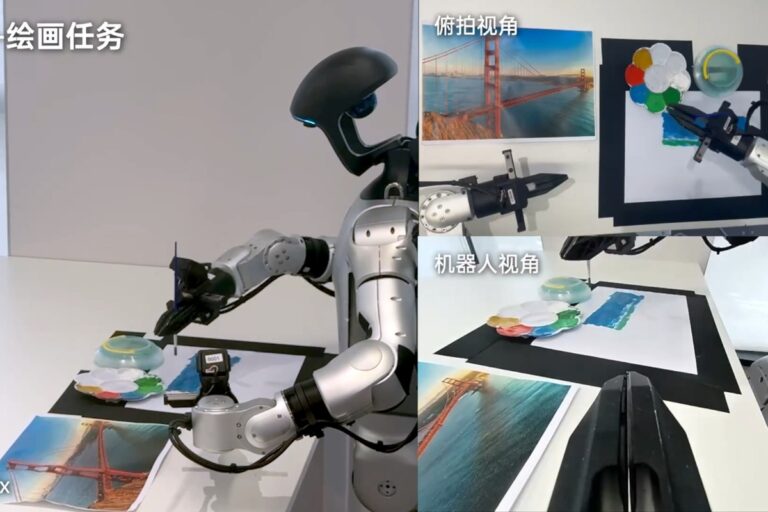
The painting module provides a concrete example of that division of labor. Unitree’s painting documentation describes a fixed-base G1-D with two seven-axis arms and grippers. The agent designs brush strokes and records the physical setup; software then compiles complete joint trajectories for execution. The model does not have to direct every individual brush stroke as the robot moves.
That approach could make a familiar robot platform easier to repurpose: a language-capable agent can help plan a task while established motion software handles its execution. The practical question is how consistently the complete system copes with changes in materials, positioning and surroundings. A painting video alone cannot establish that broader capability.
Chess Uses More Than a Language Model
The board-game demonstration has a similarly important qualification. Unitree’s chess documentation describes Chinese chess, or Xiangqi, with a model checking images and calling the Fairy-Stockfish chess engine. Supporting software checks plans and executes movements, including picking up pieces and handling captures. The repository explicitly says it does not include a single master program that automatically recognizes the board and plays an entire game.
The distinction prevents a misleading conclusion: moving pieces with AI assistance does not by itself establish that a humanoid has mastered chess or can complete every game without intervention. It does show how perception, reasoning, specialist software and physical manipulation can be assembled into a working task.
The Next Test Is Reliability
Wang’s enthusiasm builds on his earlier breakthrough forecast for humanoid robotics. For customers, the next useful evidence would be repeatable task completion, measured intervention rates and performance in settings that were not arranged for a demonstration.
RobotsBeat’s coverage of Unitree’s live-demo stumble highlights a separate challenge: stronger AI reasoning still depends on dependable hardware and control. The painting and board-game experiments make the software opportunity tangible, while leaving the larger commercial test – reliable work outside a prepared setup – open.
Disclaimer: RobotsBeat is an independent media brand owned and operated by NuvexMedia LLC, publishing news, research, and insights on artificial intelligence, emerging technologies, automation, and related industries. NuvexMedia LLC invests in and collaborates with companies across the AI, Robotics, technology, software, and digital innovation sectors. These relationships do not influence RobotsBeat's editorial coverage, and the publication maintains full editorial independence to provide accurate, timely, and objective information. © 2026 NuvexMedia LLC. All rights reserved. This content is for informational purposes only and should not be considered legal, tax, investment, financial, or other professional advice.