
Key Notes
- Engineer Do Minh Tam developed a mobile rubber-tapping robot that uses a trunk clamp and guided cutting head to harvest latex.
- VnExpress reports a current cycle of about 45 seconds and higher latex yield in a 51-tree trial, with speed and output representing different measures.
- The team is seeking investment for larger plantation trials and estimates a selling price of VND420 million per robot.
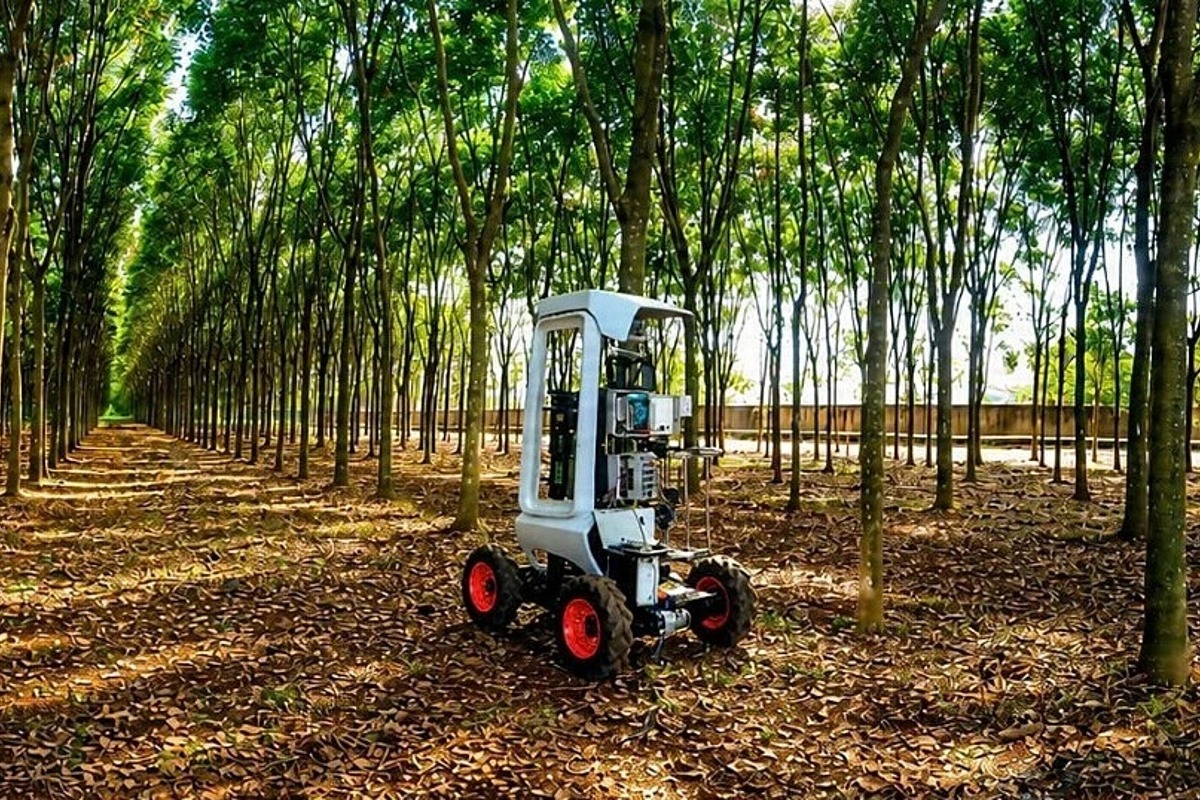
Vietnamese engineer Do Minh Tam has developed a mobile robot that cuts rubber-tree bark to harvest latex, targeting labor shortages in plantation work. The machine combines a trunk-clamping mechanism with a guided cutting head, tackling a job in which blade depth and steady contact directly affect the harvest and the health of the tree.
Tam, founder of Tan Y Robot and Rubber, spent four years developing the system, according to VnExpress. The report describes a current cycle of about 45 seconds, with the team targeting 20 seconds. It also reports more than 50% higher latex yield in a 51-tree trial with Dong Nai Rubber Corporation. These are separate measures of speed and output.
Controlling a Cut on an Uneven Surface
A tree trunk presents a changing surface, requiring the cutting mechanism to follow its contour while controlling depth. The robot’s clamping structure provides a guide for that motion, helping the blade maintain contact through a continuous pass.
According to the development team’s account in VnExpress, the machine uses lidar navigation and stores individual tree-depth profiles. The proposed operation pairs overnight tapping with daytime collection, charging and maintenance. The developer estimates a selling price of VND420 million per robot and is seeking investment for larger commercial-estate trials.
Plantation Work Requires More Than a Good Cut
Field deployment adds navigation, positioning and maintenance to the cutting task. A robot must reach the next tree, align its mechanism, complete the pass and move on. Time spent on each step contributes to the total operating cycle, so improving the cutting motion alone will only address part of the workflow.
RobotsBeat’s coverage of Bonsai’s field robots follows a related challenge of preparing autonomous machines for agricultural environments. Ground conditions and the arrangement of plants can change how a machine performs once it leaves a controlled development setting.
Moving Toward Larger Trials
The rubber-tapping project now faces the practical demands of operating across more trees and longer periods. Larger trials can show how often a technician needs to intervene and how consistently the cutting mechanism performs across varied trunks.
The wider effort to support agricultural automation is reflected in the UK’s farm-robot funding programme. Tan Y’s project focuses that engineering effort on a specific plantation task, with future field results needed to establish its operating economics at scale.
Disclaimer: RobotsBeat is an independent media brand owned and operated by NuvexMedia LLC, publishing news, research, and insights on artificial intelligence, emerging technologies, automation, and related industries. NuvexMedia LLC invests in and collaborates with companies across the AI, Robotics, technology, software, and digital innovation sectors. These relationships do not influence RobotsBeat's editorial coverage, and the publication maintains full editorial independence to provide accurate, timely, and objective information. © 2026 NuvexMedia LLC. All rights reserved. This content is for informational purposes only and should not be considered legal, tax, investment, financial, or other professional advice.