Key Notes
- Boston Dynamics launched Stretch Gen 2 with hardware updates focused on durability and faster maintenance for warehouse unloading.
- The company quotes throughput of up to 1,000 cases per hour, with results dependent on box weight and stacking conditions.
- The redesign cuts internal cabling by 81% and reduces a drive-module replacement from a full day to about an hour, according to Boston Dynamics.
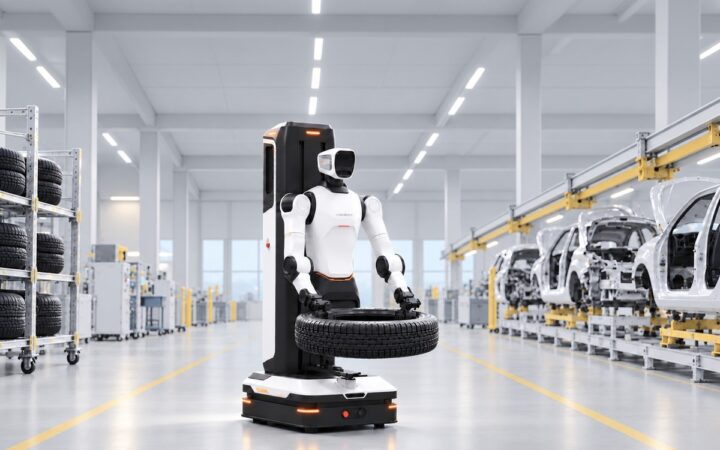
Boston Dynamics has launched Stretch Gen 2, updating its mobile trailer-unloading robot with hardware changes aimed at keeping warehouse operations running for longer between service interruptions. Announced on November 3, the redesign focuses on durability and repair access as the company builds on experience from its first-generation fleet.
In its announcement, Boston Dynamics says the robot can unload up to 1,000 cases per hour, with performance varying according to package weight and stacking conditions. It also reports an 81% reduction in internal cabling and a drive-module replacement time of about an hour, down from a full day.
Redesigning Around Warehouse Downtime
The engineering changes include stronger connectors, an updated gripper and joints that can rotate continuously. Boston Dynamics says the battery supports two shifts, while fast charging reaches 90% in about 75 minutes. These are manufacturer specifications, with actual operating results dependent on the installation and workload.
For a warehouse operator, service access can matter as much as the speed of an individual pick. A fast robot sitting idle leaves freight waiting at the dock. A design that lets maintenance teams replace a failed module more quickly can help make the unloading schedule easier to plan.
A Mobile Robot for Inbound Freight
Stretch combines mobility and manipulation for case handling. Boston Dynamics’ product overview describes deployment within existing warehouse infrastructure and handling of both orderly and messy box arrangements. Its applications include trailer unloading and case picking, placing the platform at the point where freight enters and moves through a facility.
That work connects to the broader logistics automation covered in RobotsBeat’s reporting on trailer-loading robots. Loading and unloading place different demands on machines, but both require reliable handling of variable boxes and coordination with the surrounding operation.
Serviceability Becomes Part of Robot Performance
The new Stretch also highlights a practical question for buyers evaluating warehouse automation. Throughput needs to be assessed alongside repair time, spare-part availability, operator training and the range of freight the system encounters. Those factors determine how much of a scheduled shift becomes productive work.
RobotsBeat’s coverage of Walmart’s automation expansion shows the scale of investment flowing into distribution operations. Stretch addresses a specific part of that workflow. Its next-generation design puts attention on maintaining repeatable service across long operating periods, with customer results providing the measure of how the changes perform on working docks.
Disclaimer: RobotsBeat is an independent media brand owned and operated by NuvexMedia LLC, publishing news, research, and insights on artificial intelligence, emerging technologies, automation, and related industries. NuvexMedia LLC invests in and collaborates with companies across the AI, Robotics, technology, software, and digital innovation sectors. These relationships do not influence RobotsBeat's editorial coverage, and the publication maintains full editorial independence to provide accurate, timely, and objective information. © 2026 NuvexMedia LLC. All rights reserved. This content is for informational purposes only and should not be considered legal, tax, investment, financial, or other professional advice.