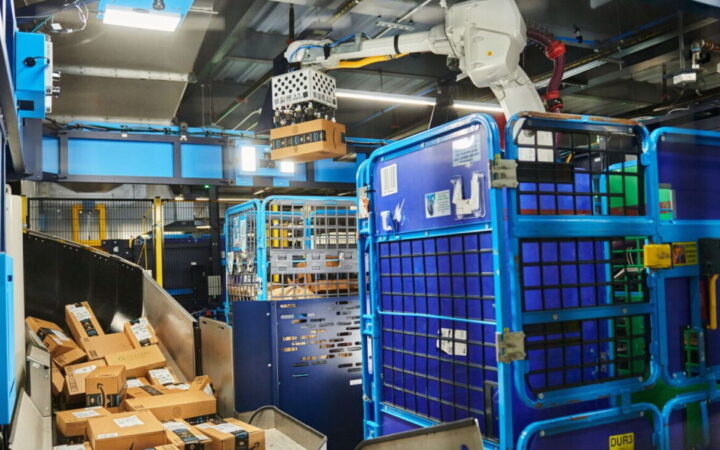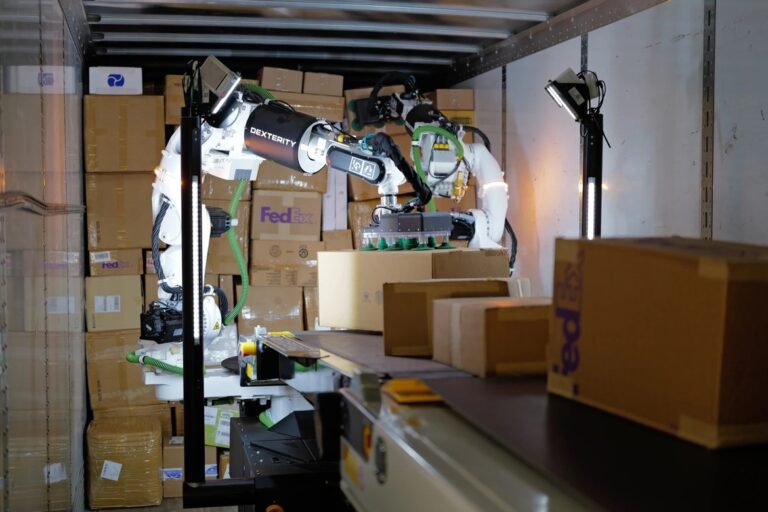

FedEx has announced expanded use of Dexterity’s AI-enabled trailer-loading robot at its Hagerstown, Maryland hub, following several years of technology validation. The expanded deployment allows FedEx to evaluate the system at larger operational scale in a high-volume environment, with additional use underway at a facility in Tracy, California. Separately, Pickle Robot Company and Ambi Robotics announced a successful integration of their respective unloading and stacking systems, creating an end-to-end trailer-to-warehouse automated solution for Fortune 500 retail and logistics operators.
Both announcements reflect the same underlying challenge: trailer loading and unloading is one of logistics’ most physically demanding and technically complex automation problems, requiring real-time adaptation to packages of every size, shape, and weight in a confined, variable environment.
Dexterity’s Trailer-Loading System
Dexterity’s system centers on Mech, a dual-armed robot designed for heavy industrial operations while remaining compact enough to operate inside trailers. Mech is controlled by Foresight, an AI model that combines vision, depth sensing, and touch to make real-time loading decisions. The system reasons across three spatial dimensions and time to optimize package placement for space efficiency, load stability, and throughput speed across variable conditions.
FedEx CEO Raj Subramaniam has described the problem in terms that explain why physical AI is required rather than conventional automation: “Packages come in every size, shape and weight. We’re not looking for humanoid robots. We’re looking for super humanoid robots because maybe they need to have a couple of elbows. More degrees of freedom.” He said in June that FedEx hopes to begin scaling automated trailer unloading at more facilities within a couple of years.
Future deployment decisions will be informed by safety performance, operational reliability, and integration with broader hub operations including destination planning, trailer assignment, and workforce processes.
Pickle and Ambi Robotics: End-to-End Integration
Berkeley-based Ambi Robotics and Charleston-based Pickle Robot have integrated their systems to cover the full inbound logistics flow from trailer to warehouse receiving. Pickle Robot’s unloading systems extract packages from trailers and induct them via conveyor into Ambi Robotics’ AmbiStack system, which handles identification, scanning, and stacking for downstream warehouse operations. The combined solution works with existing warehouse infrastructure without requiring major facility redesigns.
“As Physical AI transforms supply chains, interoperability will become increasingly important,” said Jim Liefer, CEO of Ambi Robotics. “We believe the future of warehouse automation will be built on collaboration across the industry, where specialized systems work together to solve complex operational challenges.”
The Competitive Landscape
FedEx is running parallel evaluations across multiple robotics providers. In February, it announced a pilot of Berkshire Grey’s Scoop autonomous robotic package unloader, with first live deployment expected this year. In 2021 and 2022, FedEx expanded its relationship with Berkshire Grey for robotic sortation and broader AI robotic capabilities.
DHL Group signed an agreement in May 2025 to deploy more than 1,000 additional Boston Dynamics Stretch robots for container unloading, following trials that achieved case unloading rates of up to 700 cases per hour. The scale of that commitment suggests the trailer unloading problem is approaching commercial viability even without a single dominant solution – the market appears to be moving toward deployment across multiple competing platforms simultaneously.
Disclaimer: RobotsBeat is an independent media brand owned and operated by NuvexMedia LLC, publishing news, research, and insights on artificial intelligence, emerging technologies, automation, and related industries. NuvexMedia LLC invests in and collaborates with companies across the AI, Robotics, technology, software, and digital innovation sectors. These relationships do not influence RobotsBeat's editorial coverage, and the publication maintains full editorial independence to provide accurate, timely, and objective information. © 2026 NuvexMedia LLC. All rights reserved. This content is for informational purposes only and should not be considered legal, tax, investment, financial, or other professional advice.