Key Notes
- The Mount Tai challenge brought nearly 90 teams to real mountain trails with uneven steps and steep gradients.
- The legged speed race covered about 3.9 km and more than 3,100 steps while the official humanoid race used a shorter 1.6 km course.
- Published race times demonstrate performance within defined events rather than proving full mountain ascents or unattended commercial reliability.
Humanoid robots, quadrupeds and wearable exoskeletons took on Mount Tai’s stone trails on November 2, bringing a robotics competition out of the exhibition hall and onto a working mountain route in eastern China.
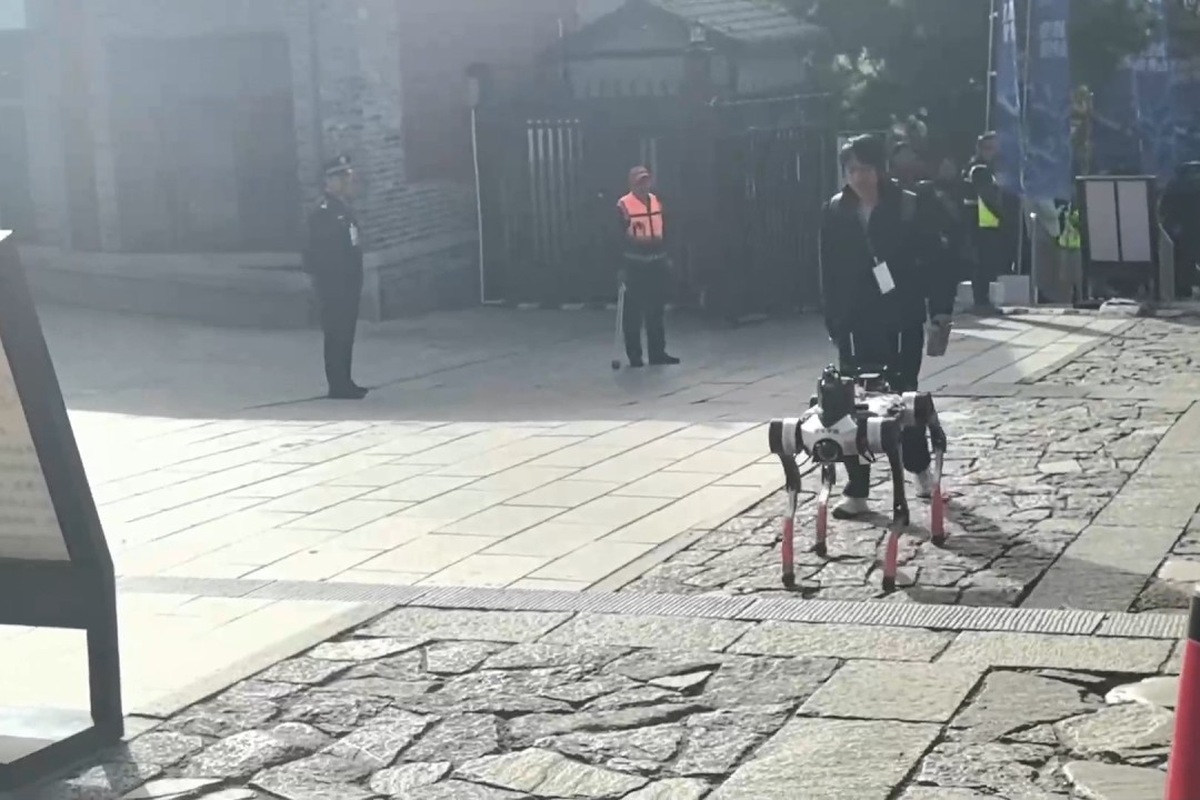
Nearly 90 teams gathered in Tai’an, Shandong, for the China Media Group World Robot Mount Tai Challenge. CCTV’s report describes a course with steep slopes, sharp bends and a climb of about 600 metres. The New China TV replay above shows the event’s mountain setting and participating machines.
Different Robots Faced Different Routes
The headline distance needs context. According to Xinhua, the legged speed race covered approximately 3.9 km from Hongmen Square to Zhongtianmen, with more than 3,100 steps. The official humanoid race covered around 1.6 km and more than 600 steps, while the load-bearing event extended roughly 3.3 km over more than 2,100 steps.
Beijing Lingyi Technology won the legged speed race in 43 minutes and 41 seconds. Zhishen Lingyue took the humanoid race in 27 minutes and 26 seconds, while the Lingshi team from Linxai won the load-bearing event in one hour, 51 minutes and 29 seconds, Xinhua reported.
Those times belong to different categories and routes. Comparing them as though each machine completed the same climb would obscure what the event actually tested. It was also a set of defined race sections, rather than evidence that every entrant climbed the mountain’s entire tourist route or reached its summit.
Uneven Steps Expose More Than Walking Speed
Mountain terrain links several engineering problems. A robot must identify a usable foothold, place its foot accurately and shift its weight without losing balance. The next step may have a different height, surface or angle, leaving less room for a fixed, repetitive walking pattern.
TechNode’s coverage describes motor overheating, automatic power reductions and changes in posture during the competition. It also reports unstable gaits on some load-bearing robots after payload changes. These observations point to the difference between demonstrating a short movement and sustaining it under changing physical conditions.
A load changes more than the amount of weight a machine carries. Its position can change the robot’s balance, while repeated uphill motion demands continued effort from its actuators. A useful assessment therefore needs to consider speed alongside stability, thermal behavior, energy use and any assistance required.
A Competition Is One Step Toward Outdoor Work
The relevance extends to inspection and material transport on routes that conventional wheeled equipment cannot easily use. RobotsBeat’s coverage of a Lynx research expedition examines a different outdoor use case, while our Unitree mountain report looks at another high-altitude demonstration.
A race result does not by itself establish unattended autonomy, rescue readiness or commercial reliability. Those claims would require more information about operating rules, human control, interventions and repeated performance. Mount Tai nevertheless provided a visible test of how different robot designs handle extended climbing on uneven ground.
Disclaimer: RobotsBeat is an independent media brand owned and operated by NuvexMedia LLC, publishing news, research, and insights on artificial intelligence, emerging technologies, automation, and related industries. NuvexMedia LLC invests in and collaborates with companies across the AI, Robotics, technology, software, and digital innovation sectors. These relationships do not influence RobotsBeat's editorial coverage, and the publication maintains full editorial independence to provide accurate, timely, and objective information. © 2026 NuvexMedia LLC. All rights reserved. This content is for informational purposes only and should not be considered legal, tax, investment, financial, or other professional advice.