Key Notes
- Pudu presented six robot lines at its November 4 Amsterdam summit and outlined a shared AI architecture intended to reuse software and skills across different machines.
- The D7 semi-humanoid and D5 quadruped illustrate its move beyond delivery and cleaning robots, with capabilities remaining subject to configuration and operating conditions.
- The strategy aims to reduce development and deployment costs, while practical benefits will depend on reliable integration and customer results.
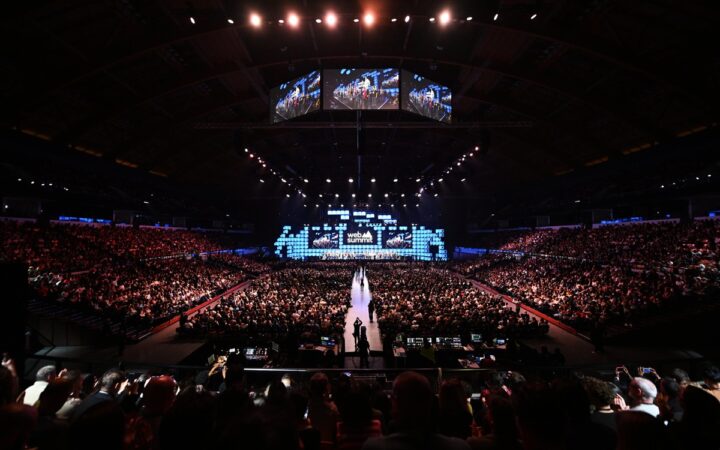
Pudu Robotics has presented a shared-AI strategy for its expanding robot portfolio, bringing six product lines together at its first European Partner Summit in Amsterdam. The November 4 event paired familiar delivery and cleaning machines with semi-humanoids, quadrupeds and lawn-care robots as the company seeks to make automation easier to deploy across different workplaces.
The Shenzhen-based manufacturer outlined the approach in a November 5 company announcement. Called “One Brain, Multiple Embodiments,” it is intended to let different robot platforms reuse AI capabilities, software modules and skills while retaining hardware and motion control suited to their individual jobs.
A Common AI Foundation for Different Machines
Pudu identifies its PuduFM embodied foundation model and PuduAgent OS agent platform as foundations of the architecture. The company argues that sharing these underlying technologies can shorten development and deployment cycles and reduce costs. Those are strategic objectives; the announcement does not establish a measured cost saving for customers adopting the combined portfolio.
The distinction matters because moving food, manipulating objects and maintaining lawns place different demands on a robot. Shared software could reduce repeated engineering work, but each machine still needs the right sensors, actuators and operational setup. Pudu’s proposal keeps those task-specific physical systems rather than suggesting one body should perform every job.
The D7 Brings Arms to a Wheeled Platform
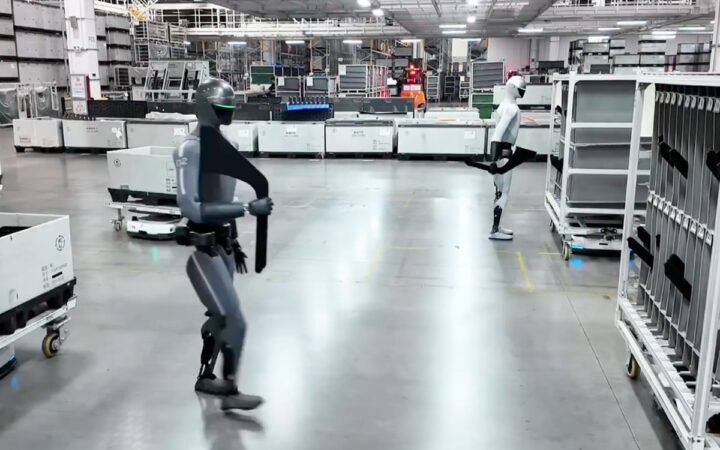
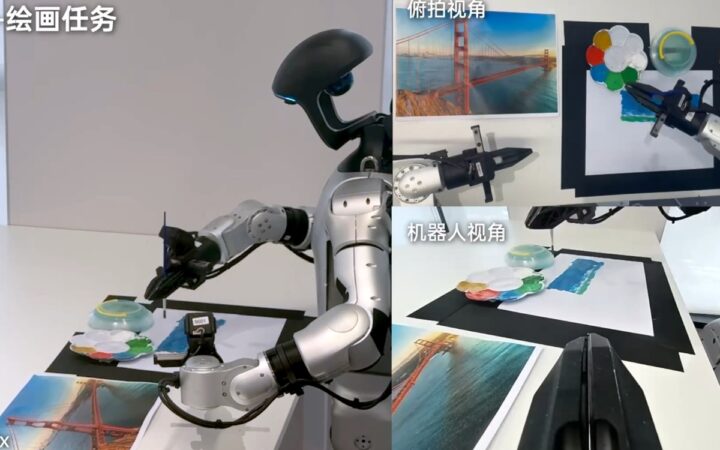
The D7 semi-humanoid was among the machines shown in Amsterdam, according to Interesting Engineering. Its appearance should not be confused with a new product debut: Pudu first introduced D7 in September 2024. The design combines a human-like upper body and robotic arms with an omnidirectional wheeled base.
Pudu lists a height of 1.65 meters, weight of 45 kilograms and 30 degrees of freedom, increasing to 50 with a dexterous hand attachment. Its published specifications include a battery larger than 1 kWh, more than eight hours of continuous operation and a 10-kilogram lifting capability. These are manufacturer figures, rather than independently measured results from the summit.
The company positions the platform for tasks such as moving and sorting items and operating elevators. Wheels offer a practical way to move around suitable indoor environments, while arms extend what the machine can do once it reaches a destination. Actual usefulness depends on completing those interactions reliably at a customer’s site.
The D5 Targets Inspection and Outdoor Mobility
Pudu also displayed its D5 quadruped family. The official D5 specifications describe NVIDIA Orin and RK3588 processors, with up to 275 TOPS of computing performance. Two LiDAR sensors and four fisheye cameras support perception and navigation, while optional payloads include inspection equipment and a delivery crate.
The manufacturer lists capabilities including 25-centimeter steps, slopes of up to 45 degrees and IP67 ingress protection. It explicitly notes that performance figures come from laboratory testing, that some features may not yet be available and that delivered configurations can differ from promotional material. Buyers therefore need to check the configuration and operating conditions relevant to their own sites.
From Service Robots to Lawn Care
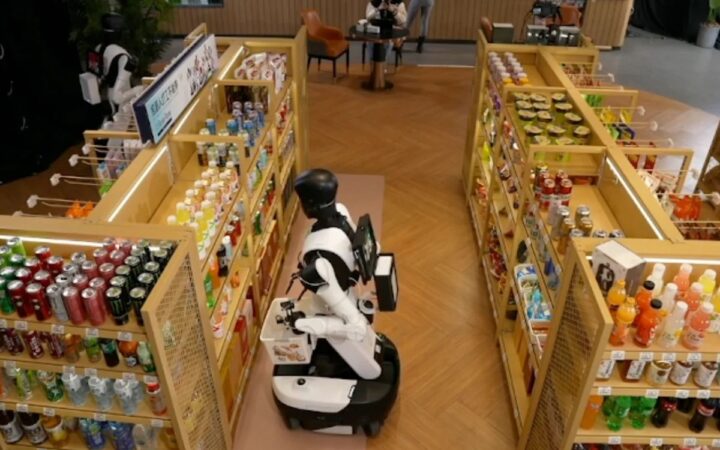
The Amsterdam display also included BellaBot Pro, cleaning robots and industrial handling equipment. The breadth of the lineup gives Pudu several routes into commercial automation, rather than tying its strategy entirely to the newer humanoid category.
Its outdoor expansion builds on the GT mower series, while the consumer-facing TOMO S lineup adds another setting for the company’s technology. The larger test for the shared-AI strategy will be whether customers can introduce and maintain those different machines with less integration work, dependable support and a clear operational return.
Disclaimer: RobotsBeat is an independent media brand owned and operated by NuvexMedia LLC, publishing news, research, and insights on artificial intelligence, emerging technologies, automation, and related industries. NuvexMedia LLC invests in and collaborates with companies across the AI, Robotics, technology, software, and digital innovation sectors. These relationships do not influence RobotsBeat's editorial coverage, and the publication maintains full editorial independence to provide accurate, timely, and objective information. © 2026 NuvexMedia LLC. All rights reserved. This content is for informational purposes only and should not be considered legal, tax, investment, financial, or other professional advice.