Key Notes
- SymSkill learns reusable actions from about five minutes of recorded play demonstrations.
- The experiment includes motion capture and tracked objects, not ordinary video alone.
- The 85% success rate refers to single-step simulation tasks, separately from physical robot demonstrations.
University of Pennsylvania researchers have demonstrated a robotic arm completing tasks with up to 12 steps after learning from roughly five minutes of recorded demonstrations. Their SymSkill system recombines learned movements and adjusts its plan when an action fails or a person changes the workspace.
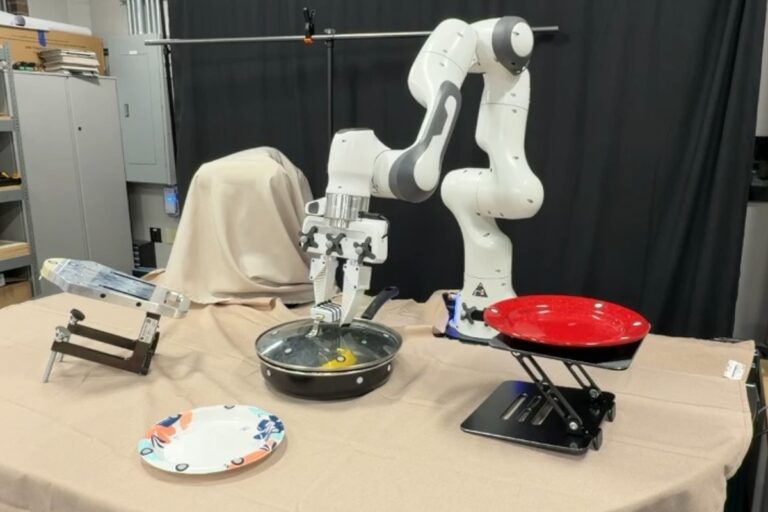
Penn Engineering’s research update describes a simple example: moving a banana from a covered pan to a plate. The robot must remove the lid before reaching inside, then respond if someone moves an object or interrupts the sequence.
Five Minutes of Data, Reusable Skills
SymSkill separates deciding what to do from controlling how the arm moves. A symbolic planner selects and orders actions, while dynamical-system movement policies carry them out. The aim is to reuse a small library of skills instead of collecting a separate demonstration for every complete routine.
The team’s project page shows a Franka arm recovering from disturbances and avoiding an obstacle during execution. Once the basic actions are learned, longer plans can combine them without additional demonstrations for those sequences.
What the Experiment Actually Measured
The research paper describes five minutes of unsegmented play data collected with a handheld gripper. A motion-capture system recorded object and gripper positions while a webcam captured video. The result therefore does not show a robot learning arbitrary chores from an ordinary internet clip alone.
The researchers report an 85% success rate across 12 single-step tasks in RoboCasa simulation. That figure is separate from the physical arm’s multi-step demonstrations. Five minutes describes the amount of demonstration data, rather than a measured end-to-end training duration.
The framework assumes that it can track the positions, orientations and types of relevant objects. Its learned rules can also reflect quirks of the demonstrations. Those dependencies matter when considering transfer to unfamiliar rooms, objects or household routines.
From Laboratory Recovery to Useful Work
The work predates this week’s coverage: the first preprint appeared in October 2025, with the current version revised in June 2026. Penn’s October 2 update discusses future extensions to language-guided tasks, dual-arm systems, humanoids and mobile manipulation.
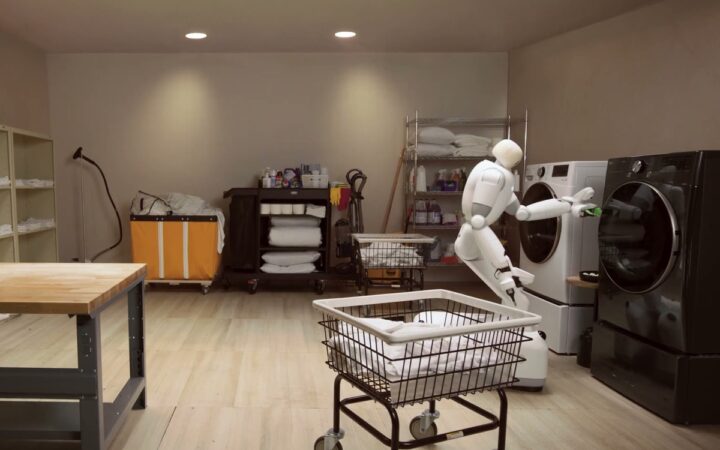
RobotsBeat’s coverage of Taku’s laundry workflow illustrates the practical sequencing problem at a larger scale. A useful robot must coordinate successive jobs and retain information about earlier actions.
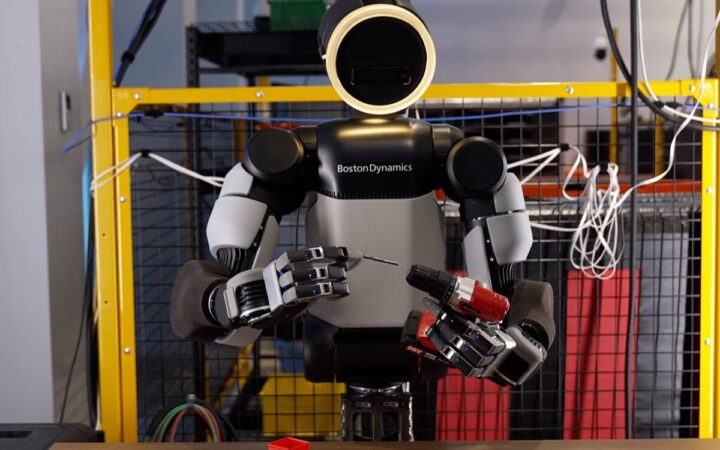
The same distinction appears in Atlas’ new hands: grasping and manipulating objects are essential capabilities, but completing a dependable routine requires more. SymSkill contributes a method for composing and recovering those actions; deployment across varied homes or businesses remains a further test.
Disclaimer: RobotsBeat is an independent media brand owned and operated by NuvexMedia LLC, publishing news, research, and insights on artificial intelligence, emerging technologies, automation, and related industries. NuvexMedia LLC invests in and collaborates with companies across the AI, Robotics, technology, software, and digital innovation sectors. These relationships do not influence RobotsBeat's editorial coverage, and the publication maintains full editorial independence to provide accurate, timely, and objective information. © 2026 NuvexMedia LLC. All rights reserved. This content is for informational purposes only and should not be considered legal, tax, investment, financial, or other professional advice.