Key Notes
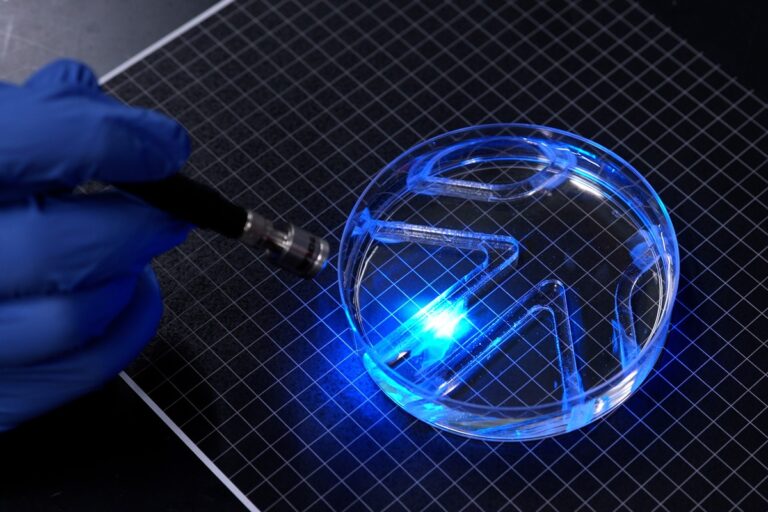
- The robot was guided through a laboratory maze by an external light source.
- Living muscle layers power two gel-supported fins, with speeds up to four body lengths per minute.
- Tissue longevity in culture is separate from continuous swimming endurance.
MIT engineers have built a thin swimming robot whose living muscle cells flap two flexible fins when illuminated. The prototype navigated a simple laboratory maze, demonstrating a way to turn a single layer of muscle into a useful motor for a soft machine.
The work, led by Maheera Bawa and Ritu Raman, was published in Advanced Functional Materials on September 28. MIT described the research in its September 29 announcement.
Light Controls the Fins
The muscle cells are engineered to contract in response to light. Illuminating selected regions makes the fins bend, while changing the pattern and frequency of stimulation lets researchers control movement. In the maze demonstration, a person moved the light source to guide the robot.
The study reports a maximum swimming speed of about four body lengths per minute. The device has no onboard navigation system: its movement is externally directed, rather than autonomous exploration.
A Thin Muscle Layer Needs the Right Skeleton
The gel beneath the cells is central to the design. MIT’s team replaced an earlier, softer material with gelatin methacrylate, or GelMA, and adjusted stiffness and microscopic grooves to encourage aligned muscle fibers. Square-bottomed grooves helped the cells form coordinated tissue.
The paper describes each fin as 7 millimeters wide, 15 millimeters long and 0.5 millimeters thick. The muscle layer itself is less than 15 micrometers thick. The hair-thin tissue and its thicker supporting gel are distinct parts of the actuator.
That distinction helps explain the result. A very soft support can absorb a muscle’s effort by deforming in the wrong way. A better-matched structure transfers more of the contraction into a fin stroke capable of moving water.
Better Force Density Does Not Mean Endless Swimming
The researchers report roughly 20x greater contractile force per unit of muscle volume than the 3D muscle actuators used for comparison. Their thin-film actuators also remained functional for more than 30 days in culture after being released from rigid supports.
Those measurements do not establish 30 days of continuous swimming. In a separate fatigue test, continuous light stimulation at 2 hertz reduced swimming speed until no measurable translation remained at 30 minutes.
Long-term tissue survival and sustained propulsion answer different engineering questions. A practical swimming machine would need to manage both, as well as carry or obtain the energy and control inputs needed to stimulate its muscles.
Environmental Monitoring Remains a Future Application
MIT identifies gentle exploration of fragile aquatic environments as a possible future use. The team plans to improve the body geometry to swim faster. The present work establishes a laboratory platform, rather than a deployed monitoring system.
RobotsBeat has covered Harvard’s soft robots, which encode motion through printed pneumatic channels, and the PROBOSCIS soft gripper, which draws inspiration from elephant trunks. MIT’s swimmer adds living tissue to the materials used to generate motion.
The next development steps include improved swimming geometry and onboard stimulation. Those advances would help determine how far this muscle-powered design can progress beyond a controlled dish.
Disclaimer: RobotsBeat is an independent media brand owned and operated by NuvexMedia LLC, publishing news, research, and insights on artificial intelligence, emerging technologies, automation, and related industries. NuvexMedia LLC invests in and collaborates with companies across the AI, Robotics, technology, software, and digital innovation sectors. These relationships do not influence RobotsBeat's editorial coverage, and the publication maintains full editorial independence to provide accurate, timely, and objective information. © 2026 NuvexMedia LLC. All rights reserved. This content is for informational purposes only and should not be considered legal, tax, investment, financial, or other professional advice.