
Key Notes
- MIT researchers have demonstrated a 1.29-gram flying robot that estimates its motion and controls flight using onboard sensors and computation.
- A 244-milligram electronics package combines a microcontroller with inertial, optical-flow and height sensing, enabling flight outside a motion-capture environment.
- The prototype still uses an external power source and high-level human commands, while batteries, onboard visual recognition and autonomous obstacle avoidance remain development goals.
MIT researchers have demonstrated an insect-scale flying robot that carries its own navigation sensors and computing hardware, allowing it to control flight beyond a laboratory motion-capture system. The advance removes a major dependency for tiny aerial robots, although this prototype still draws electricity from an external power source.
MIT reported the work on November 18 alongside publication in Science Robotics. The team includes researchers from MIT and Cornell University, with Kevin Chen, Jonathan How and Elizabeth Farrell Helbling among the corresponding authors.
Flight Control Fits Into a Tiny Electronics Package
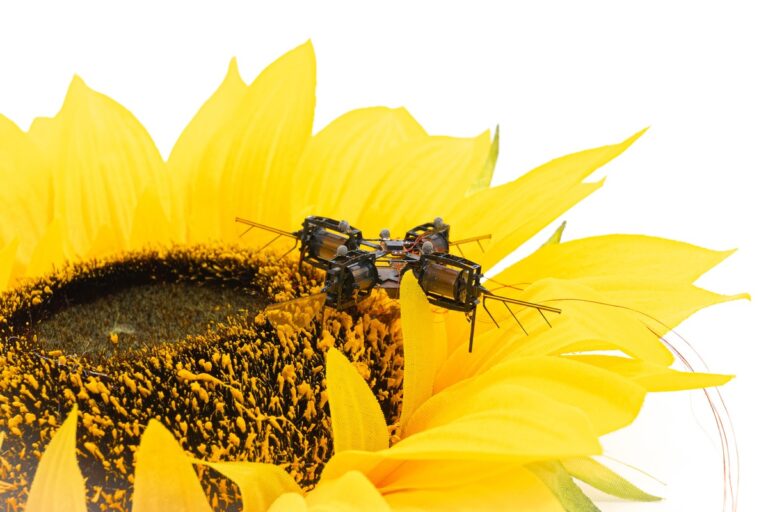
The paper’s open preprint describes a 1.29-gram robot capable of hovering and following trajectories using onboard sensing and computation. Its electronics package weighs 244 milligrams and combines a microcontroller with an inertial measurement unit, an optical-flow sensor and a time-of-flight sensor.
The sensors contribute different parts of the flight estimate. Inertial measurements help track orientation, optical flow supports estimates of sideways movement, and time-of-flight sensing measures height. The controller has to combine those observations quickly enough to keep a lightweight flapping-wing vehicle stable.
To carry the package, the researchers enlarged and retuned the soft artificial muscles that drive the wings. The design achieved a lift-to-weight ratio of 1.9, leaving enough lifting capacity for the added electronics while preserving maneuverability.
Onboard Sensing Does Not Yet Mean Untethered Flight
The team demonstrated hovering, point-to-point movement and a flight around plants ending with a landing on a sunflower. The preprint describes a 30-second experiment outside the motion-capture environment, with a human operator providing high-level commands and the onboard system handling lower-level flight control.
That division is important. The robot no longer needs external cameras to calculate every movement, but it does not independently choose an entire mission. Its power supply also remains offboard. MIT identifies batteries, power electronics and a camera for autonomous object recognition and obstacle avoidance as next steps.
MIT’s official flight video shows the robot and its sunflower demonstration. The reported positional error is on the scale of centimeters, and the electronics account for about 6% of the system’s power consumption; most energy goes into the wings and artificial muscles.
A New Step Beyond Earlier Agility Demonstrations
Our earlier report on MIT’s agile flyer examined faster movement and repeated somersaults using an AI-based controller. The latest study addresses another part of the problem: putting the measurements and computation needed for flight onto the vehicle itself. A version of this new study appeared as a preprint in February, before the November journal announcement.
The size constraints echo the design tradeoffs explored in our report on MIT’s muscle-powered swimmer, though the actuation and environment are different. For the flying robot, precision agriculture and inspection remain prospective uses. The demonstrated milestone is a compact sensing-and-control system that can support flight without a surrounding motion-capture installation.
Disclaimer: RobotsBeat is an independent media brand owned and operated by NuvexMedia LLC, publishing news, research, and insights on artificial intelligence, emerging technologies, automation, and related industries. NuvexMedia LLC invests in and collaborates with companies across the AI, Robotics, technology, software, and digital innovation sectors. These relationships do not influence RobotsBeat's editorial coverage, and the publication maintains full editorial independence to provide accurate, timely, and objective information. © 2026 NuvexMedia LLC. All rights reserved. This content is for informational purposes only and should not be considered legal, tax, investment, financial, or other professional advice.