Key Notes
- KAIST’s latest humanoid demonstration combines onboard visual feedback with whole-body control to push objects weighing up to 35 kilograms and lift objects up to 20 kilograms.
- DRCD Lab developed the platform with RAILAB supplying the arms, while the team identifies reinforcement learning and human demonstrations as training methods.
- The pushing and lifting results describe different tasks and do not establish a commercial payload rating or sustained industrial performance.
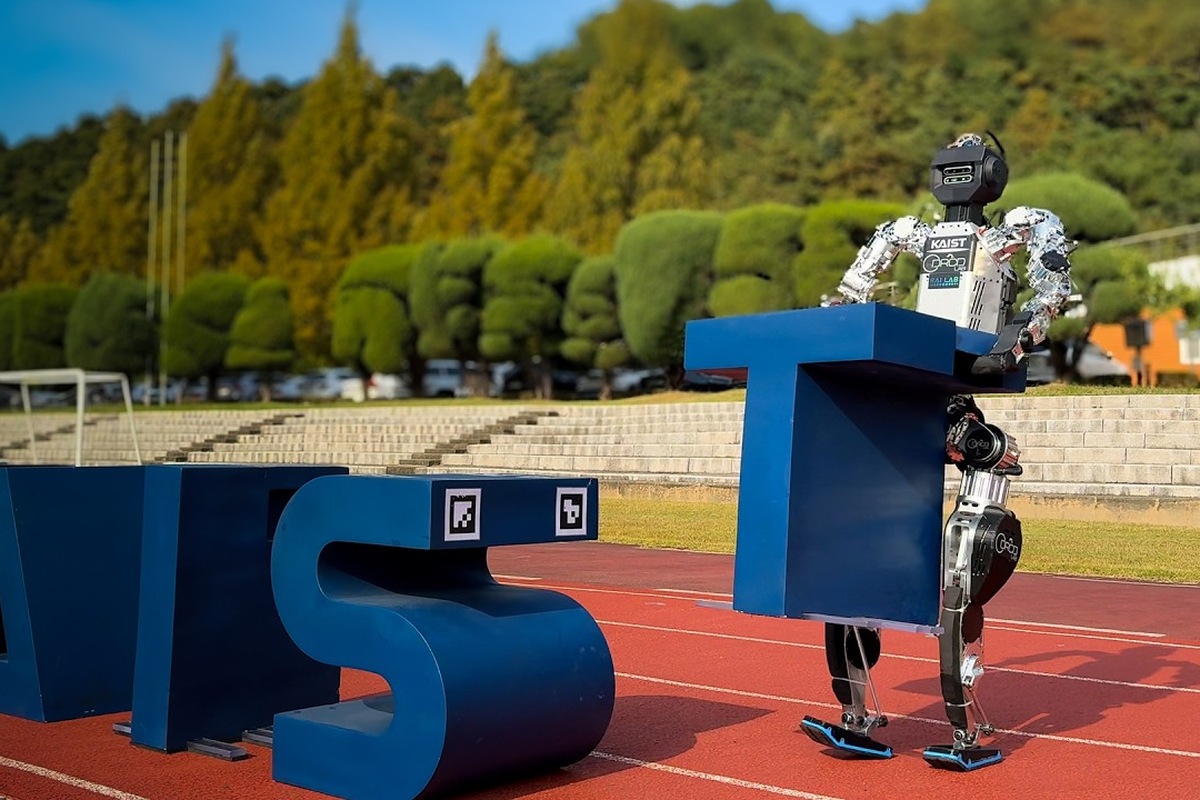
KAIST has demonstrated a humanoid that uses onboard vision to push objects weighing up to 35 kilograms and lift objects up to 20 kilograms. The October 19 video shows Humanoid v0.9 arranging large letters to spell the university’s name, combining object handling with whole-body movement.
The official demonstration comes from KAIST’s Dynamic Robot Control and Design Laboratory, working with RAILAB, which developed the arms. The team says its interaction skills use deep reinforcement learning and learning from human demonstrations.
Moving an Object Means Balancing the Robot
Handling a large object is not just an arm task for a walking machine. Force applied through the hands changes the load on the torso and feet, so the robot has to coordinate contact with its own balance.
The demonstration makes that relationship visible. Pushing requires the body to generate force without losing support, while lifting requires the robot to support the object’s weight and manage the changed position of its combined center of mass.
KAIST’s platform page describes the humanoid as a full-size system for dynamic locomotion with custom actuators. The latest video adds a concrete object-interaction example to that research platform.
Pushing and Lifting Are Separate Results
The two weight figures should not be treated as interchangeable payload ratings. An object resting on a surface is partly supported by that surface; the force needed to move it depends on friction and other contact conditions.
Lifting an object requires supporting its weight. A 35-kilogram pushing demonstration therefore does not establish that the robot can lift 35 kilograms, and neither result alone provides a commercial load rating for repeated factory use.
The distinction is relevant across robotics. Our coverage of Neo1’s payload claim discusses a very different machine, but comparing systems still requires knowing how a load was applied and under what conditions.
Learning Control for Contact-Rich Work
Reinforcement learning gives a controller feedback on attempted behavior, while human demonstrations can provide examples of useful movements. The lab identifies both methods, but the video description does not specify exactly how they are combined or how each task is commanded.
Onboard vision is part of the demonstrated feedback loop. It should not be taken to mean the platform can independently choose and execute arbitrary jobs outside the shown setup.
RobotsBeat’s reporting on SymSkill’s task learning follows another research route from demonstrations to robot behavior. KAIST’s update emphasizes the physical coordination needed when the robot’s body and an external load interact.
For industrial applications, the next questions concern repeatability, speed, recovery and safe operation around other activity. The current contribution is a research demonstration of visually guided pushing and lifting, with distinct limits for each task.
Disclaimer: RobotsBeat is an independent media brand owned and operated by NuvexMedia LLC, publishing news, research, and insights on artificial intelligence, emerging technologies, automation, and related industries. NuvexMedia LLC invests in and collaborates with companies across the AI, Robotics, technology, software, and digital innovation sectors. These relationships do not influence RobotsBeat's editorial coverage, and the publication maintains full editorial independence to provide accurate, timely, and objective information. © 2026 NuvexMedia LLC. All rights reserved. This content is for informational purposes only and should not be considered legal, tax, investment, financial, or other professional advice.