Key Notes
- Faraday Future’s compact FF Nova costs $2,490, with a separately listed $390 Developer Skills Package bringing the combined price to $2,880.
- The platform combines a small humanoid body, multimodal sensing and a simulation-to-hardware development workflow aimed at researchers and educators.
- Initial availability is an invitation-only phase of 100 units, while wider access and reliable application performance remain separate from the headline price.
Faraday Future and FF EAI Robotics Ecosystem have introduced FF Nova, a compact developer humanoid priced at $2,490. The robot targets researchers and schools, with a separate $390 Developer Skills Package bringing the listed combined cost to $2,880.
The October 15 launch release describes an invitation-only first phase of 100 units, with the first 20 ready for delivery at the time of the announcement. This article expands our earlier FF Nova brief with the hardware and development details.
A Small Body for Physical AI Experiments
According to the official specifications, Nova stands 49.7 centimeters tall, weighs 2.8 kilograms and has 20 degrees of freedom. Its size makes it a tabletop-scale learning platform rather than a full-size machine for moving factory loads.
The company lists 10 TOPS of compute, 8 GB of memory and 32 GB of storage. Sensors include 2D lidar, a roughly 4-megapixel wide-angle camera, a time-of-flight depth sensor and a three-microphone array.
Nova can walk on two legs or use a detachable wheeled base. Listed speeds are 0.1 meters per second walking and 0.8 meters per second on the base, with a maximum obstacle height of two centimeters.
The Development Workflow Matters
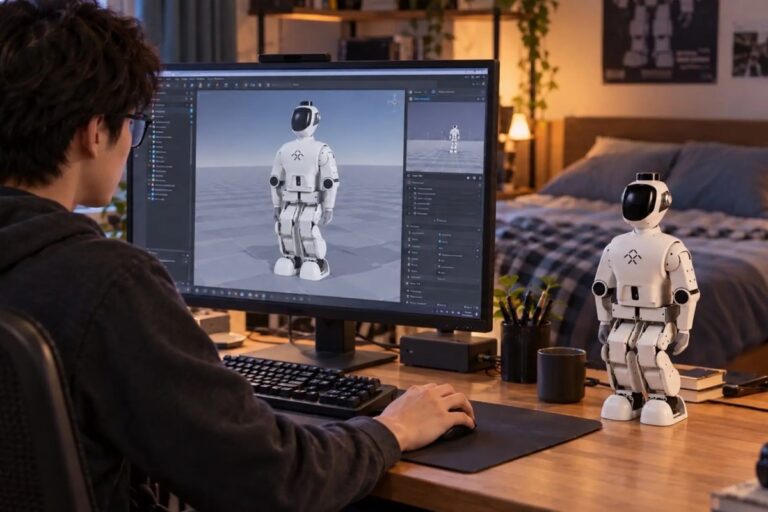
Faraday Future promotes an open SDK and a simulation-to-hardware workflow: train a policy virtually, export it and test it on the physical robot. Its developer platform also advertises reward configuration, data replay and model evaluation.
That workflow is the main distinction between a programmable research device and a robot purchased only for prebuilt routines. Students can examine what a controller learned, change the experiment and compare simulated behavior with the result on real hardware.
A small robot also limits what an experiment can establish. A policy that moves Nova successfully does not automatically transfer to a much heavier humanoid, where motors, balance, contact forces and the consequences of a fall are different.
Price and Availability Need to Be Read Together
The headline price covers the device, while the launch release lists the developer package separately. Prospective users should evaluate the complete setup, including the tools and support needed for their intended coursework or research.
The initial invitation program is not the same as unrestricted retail availability. The companies outline broader developer, education and eventual consumer access, but the launch release does not provide firm dates for every phase.
RobotsBeat has also covered Microduck’s research platform and RoboParty’s open platform. These systems offer different bodies and development environments; their prices should not be read as equivalent packages.
An Education Push Within a Broader Robotics Business
The same launch introduced FF Nova Mini, Physical AI Spark coursework and developer-community recruitment. That makes Nova part of an education and software effort alongside the company’s larger robot products, rather than simply a lower-priced version of an industrial humanoid.
Our earlier report on Faraday’s robotics rollout tracked that broader direction. For Nova, the useful test will be whether developers receive accessible tools, repeatable experiments and continuing support after the launch.
Its compact size and listed price lower the hardware threshold for physical AI work. They do not, by themselves, establish the breadth or reliability of the autonomous skills a buyer can deploy.
Disclaimer: RobotsBeat is an independent media brand owned and operated by NuvexMedia LLC, publishing news, research, and insights on artificial intelligence, emerging technologies, automation, and related industries. NuvexMedia LLC invests in and collaborates with companies across the AI, Robotics, technology, software, and digital innovation sectors. These relationships do not influence RobotsBeat's editorial coverage, and the publication maintains full editorial independence to provide accurate, timely, and objective information. © 2026 NuvexMedia LLC. All rights reserved. This content is for informational purposes only and should not be considered legal, tax, investment, financial, or other professional advice.