Key Notes
- Figure CEO Brett Adcock reports that Figure 03 completed 348 treadmill miles and about 1,200,000 steps during an ongoing nine-day hardware stress test.
- The controlled setup tests repeated walking and hardware durability, rather than proving battery endurance or autonomous navigation over the same distance.
- Figure has not published a detailed maintenance record or standardized reliability report for the run, leaving the milestone as a company-reported result.
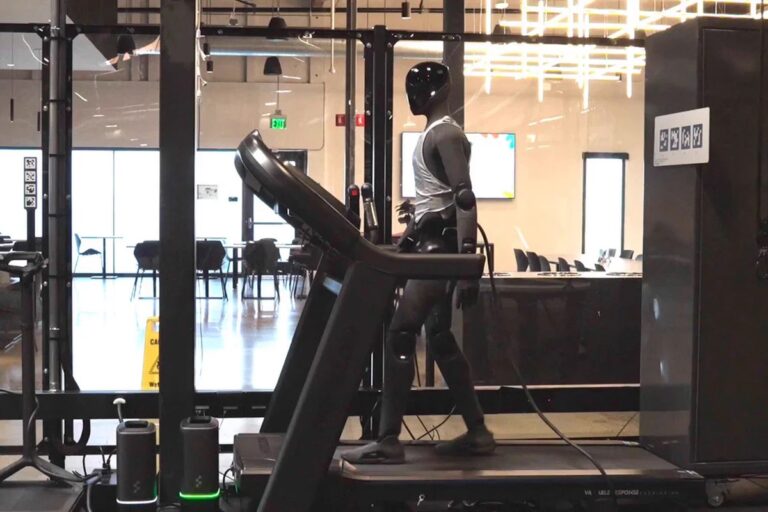
Figure’s third-generation humanoid has covered 348 miles on a treadmill during a nine-day hardware stress test, according to CEO Brett Adcock. His October 19 update put the total at 1.2 million steps and said the test was still running.
Adcock’s original update presents the run as an effort to expose failures under repeated walking. The footage shows a controlled indoor test, not an untethered journey or a measurement of how far the robot can travel on one battery.
Figure’s ongoing treadmill endurance test.
Repeated Walking Tests the Hardware
A treadmill lets engineers repeat a walking cycle under relatively consistent conditions. That can reveal problems in joints, drives, wiring or thermal behavior that are difficult to identify during a short demonstration.
The value of such a test is cumulative use rather than scenery. A machine can look convincing during a few minutes of movement and still develop wear, intermittent faults or overheating when the same operation runs for much longer.
Adcock did not publish a detailed maintenance log or a standardized reliability report alongside the update. The distance and step count are company-reported milestones; they do not establish that every component ran without adjustment throughout the test.
Endurance Is Different From Battery Life
The visible test setup includes an external connection. Nine days of walking should therefore not be presented as nine days of autonomous battery operation, and treadmill distance is not equivalent to navigating the same distance through a building.
A working robot also has to turn, stop, avoid obstacles and recover from interruptions. Carrying a load changes balance and energy use, while physical contact with tools or parts adds demands that a repetitive walking test does not measure.
Those are complementary engineering questions. Demonstrating one does not make the others irrelevant, but sustained mechanical testing is still useful evidence that a developer is examining durability beyond a short promotional routine.
Figure 03 Moves Beyond the Launch Demo
Figure introduced the platform in its 2025 announcement, describing a design built around its Helix AI system, revised hands and sensing, softer exterior materials and wireless charging. The treadmill update concerns that platform’s hardware endurance, rather than a new model launch.
RobotsBeat previously covered the company’s F.02 retirement. Moving from an older fleet to a new robot generation makes repeatable testing important: new components and manufacturing choices still need to be checked in use.
The same availability question appears in Digit’s charging plans, although rapid recharging and mechanical durability are different measures. For an operator, both contribute to whether a robot is ready when a job needs doing.
Figure’s latest result is a clearly defined endurance claim. The next useful evidence would be disclosed test conditions and sustained task performance that connect repeated walking to actual customer workloads.
Disclaimer: RobotsBeat is an independent media brand owned and operated by NuvexMedia LLC, publishing news, research, and insights on artificial intelligence, emerging technologies, automation, and related industries. NuvexMedia LLC invests in and collaborates with companies across the AI, Robotics, technology, software, and digital innovation sectors. These relationships do not influence RobotsBeat's editorial coverage, and the publication maintains full editorial independence to provide accurate, timely, and objective information. © 2026 NuvexMedia LLC. All rights reserved. This content is for informational purposes only and should not be considered legal, tax, investment, financial, or other professional advice.