
New York state senators have introduced a bill that would prohibit school districts and charter schools from using AI-enabled humanoid robots to perform teaching responsibilities, including delivering classroom or one-on-one instruction, tutoring students, and grading work. The legislation was introduced Thursday by Senate Education Chair Shelley Mayer and co-sponsored by Senator Kristen Gonzalez, in direct response to reporting by New York Focus on Salamanca City Central School District’s plan to deploy a humanoid robot as a teaching assistant this fall.
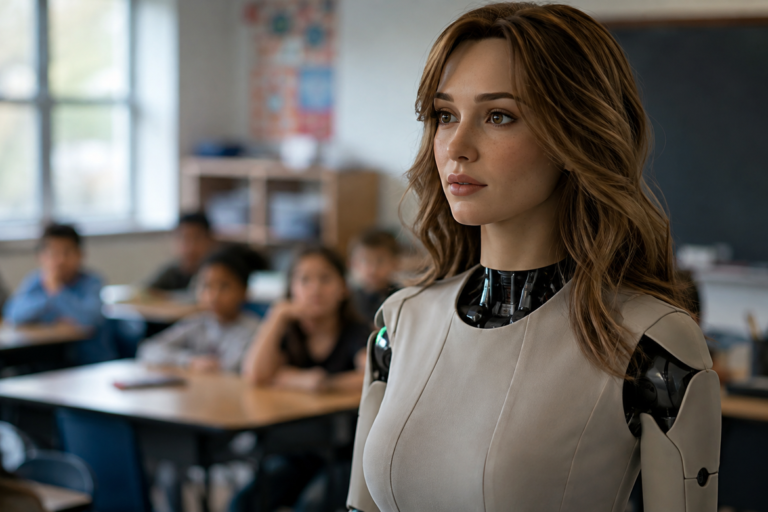
Salamanca’s partnership with Realbotix – described as one of the first of its kind in the country – would have brought a robot named Sally into classrooms. Sally features lifelike silicone skin, long hair, and a range of upper-body movements and facial expressions. The robot and an accompanying AI-powered digital avatar would have provided students with personalized learning support. The plan is currently on hold while Salamanca works through student data privacy agreements with the state, following a letter from State Education Commissioner Betty Rosa expressing concern about “the effect that a humanoid robot may have within a high school classroom.”
The Legislative Response
Mayer said she introduced the bill after reading the New York Focus investigation and described Salamanca’s plan as a “glaring mistake of judgment.” Her objection centers on the developmental role of human presence in education. “As someone who cares about kids and education and how we learn – not just academically, but socially – that all requires human interaction,” she said. “This is absolutely replacing a human being with a machine for instruction and other functions of education.”
Gonzalez, whose co-sponsorship follows her earlier work on AI chatbot legislation that passed both chambers unanimously and is awaiting the governor’s signature, said schools should only adopt technologies supported by evidence. “There is no research on how AI-powered robots affect the social and emotional development of children,” she said.
The bill will be considered when the legislature reconvenes in January. It is supported by the New York State United Teachers union, which called for strict limits on AI and screen time in schools in May and is pushing for statewide enforceable guardrails on educational technology adoption.
Realbotix’s Position
Realbotix CEO Andrew Kiguel pushed back on the legislative approach, arguing that the bill was introduced before the Salamanca deployment had even occurred. “What concerns us about this bill is that it appears to have been introduced without anyone involved having seen the technology in action or evaluated a live pilot,” Kiguel said. “The Salamanca project that prompted this bill has not even been deployed. Making a sweeping statewide prohibition on that basis, before any facts or evidence exists, is a premature step.” He said the company welcomes the opportunity to demonstrate the technology to legislators so that policy can be based on direct observation rather than assumption.
The Broader Context
The Salamanca controversy has unfolded during a period of heightened scrutiny of educational technology across New York. New York City Public Schools Chancellor Kamar Samuels announced an educational technology purchasing freeze in July while the school system finalizes AI procurement guidance. Parent groups have formed to push for stronger oversight and clearer screen time limits. The state teachers union has called for strict AI guardrails, and Mayer is leading a broader legislative effort to slow rapid adoption of new education technologies.
“This is the first step in what’s going to be a much larger conversation about AI in New York schools,” Mayer said.
The bill represents the first legislation in the United States specifically targeting humanoid robots in educational settings – a regulatory response that arrives as companies including Realbotix and others are actively marketing AI-powered robot platforms to school districts nationally.
Disclaimer: RobotsBeat is an independent media brand owned and operated by NuvexMedia LLC, publishing news, research, and insights on artificial intelligence, emerging technologies, automation, and related industries. NuvexMedia LLC invests in and collaborates with companies across the AI, Robotics, technology, software, and digital innovation sectors. These relationships do not influence RobotsBeat's editorial coverage, and the publication maintains full editorial independence to provide accurate, timely, and objective information. © 2026 NuvexMedia LLC. All rights reserved. This content is for informational purposes only and should not be considered legal, tax, investment, financial, or other professional advice.