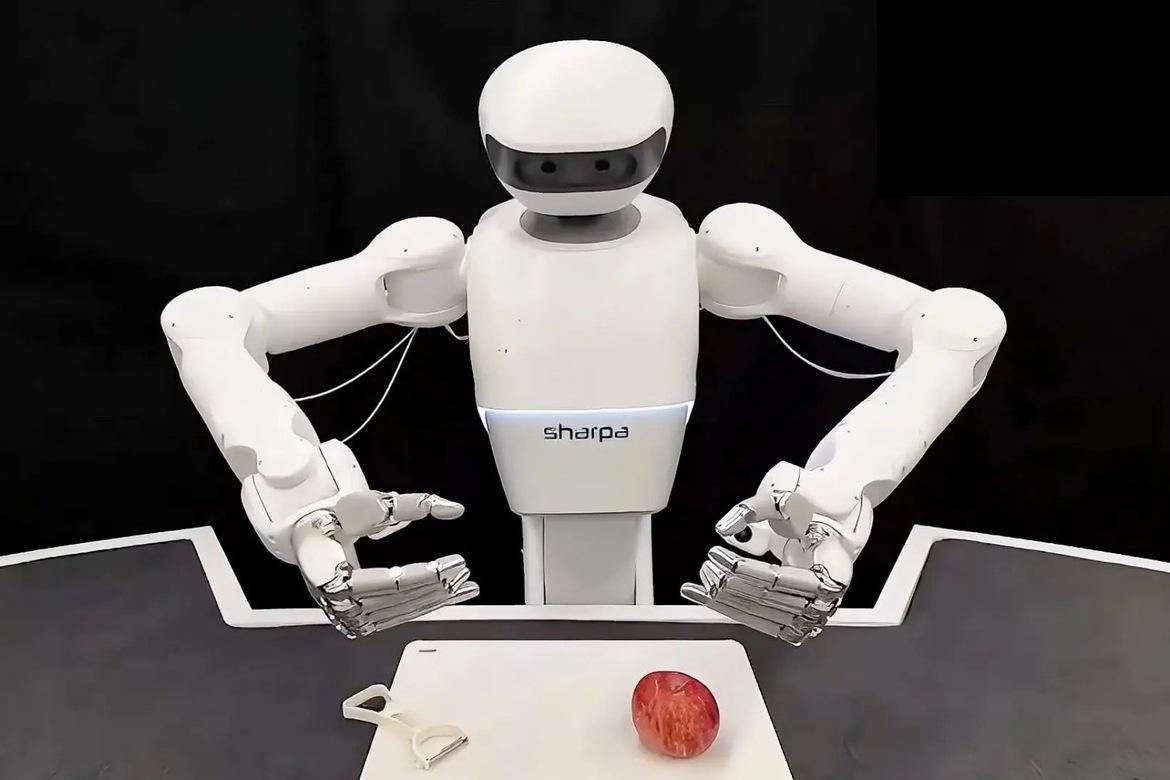

A humanoid robot peeling an apple may appear trivial, but for robotics researchers it represents a significant milestone.
Singapore-based Sharpa has demonstrated a system capable of autonomously performing the task using two human-like hands, addressing one of the most difficult challenges in robotics: precise, contact-rich manipulation.
The achievement highlights a broader shift in the field, where advances in artificial intelligence are beginning to unlock levels of dexterity previously limited to humans.
Moving Beyond Pick-and-Place
Robotic manipulation has improved rapidly in recent years, particularly with the rise of Vision-Language-Action (VLA) models that allow machines to interpret visual input and execute tasks.
However, most systems remain constrained to relatively simple actions such as picking up objects or sorting items. Tasks that require continuous adjustment – like peeling an apple – introduce additional complexity.
These actions demand coordination across multiple degrees of freedom, precise force control and the ability to adapt to subtle changes in the object being handled.
Sharpa’s system addresses these challenges through a combination of hardware and software innovations.
Its dexterous hand, featuring 22 active degrees of freedom, is designed to approximate the flexibility of human hands. But the key advancement lies in how the system coordinates movement.
A New Approach to Dexterity
The company’s framework, known as MoDE-VLA (Mixture of Dexterous Experts), integrates multiple sensory inputs – including vision, touch and force – and processes them through specialized AI modules.
Rather than relying on a single model to handle all aspects of a task, the system dynamically activates different “experts” depending on the situation. For example, one component focuses on detecting contact events, while another manages force control.
This is paired with a secondary system, described as a “copilot”, which handles fine motor control.
In practice, humans provide high-level guidance during training, while the AI manages the detailed coordination required for finger movements and object manipulation.
The result is a system capable of executing complex sequences – such as peeling and rotating an apple – with greater stability and precision than previous approaches.
In testing, the robot achieved a peel completion rate of 73 percent, significantly outperforming baseline models and doubling success rates in contact-rich tasks.
Toward Human-Level Manipulation
The implications extend beyond a single demonstration.
Dexterous manipulation is widely seen as one of the last major barriers to deploying robots in unstructured environments such as homes, kitchens and workshops.
Tasks like cooking, cleaning or assembling delicate components require a level of adaptability and sensitivity that robots have historically struggled to achieve.
Sharpa’s approach suggests a path forward: combining multimodal sensing with modular AI systems that can specialize in different aspects of manipulation.
The system has also demonstrated improvements in other tasks requiring high precision, such as inserting connectors – an operation that demands millimeter-level accuracy and careful force application.
Still, challenges remain.
Achieving consistent performance across diverse real-world conditions will require further advances in data collection, training and system robustness. The current results, while promising, highlight how far the field still needs to go to match the full range of human dexterity.
Even so, the ability to peel an apple autonomously marks a step toward a broader goal: robots capable of performing everyday tasks with the fluidity and precision of human hands.
Disclaimer: RobotsBeat is an independent media brand owned and operated by NuvexMedia LLC, publishing news, research, and insights on artificial intelligence, emerging technologies, automation, and related industries. NuvexMedia LLC invests in and collaborates with companies across the AI, Robotics, technology, software, and digital innovation sectors. These relationships do not influence RobotsBeat's editorial coverage, and the publication maintains full editorial independence to provide accurate, timely, and objective information. © 2026 NuvexMedia LLC. All rights reserved. This content is for informational purposes only and should not be considered legal, tax, investment, financial, or other professional advice.