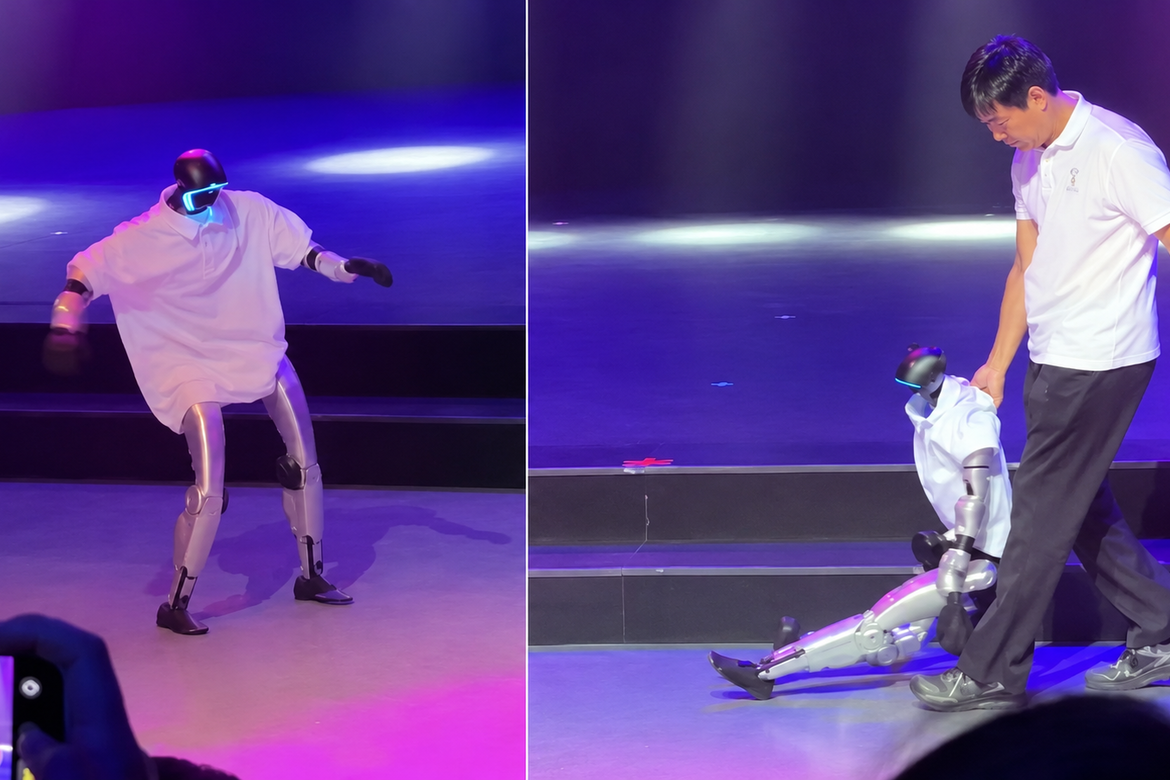

A Unitree humanoid robot fell twice during a live performance of Michael Jackson’s moonwalk in Shenzhen and had to be dragged off stage by event staff, in a video that accumulated more than 5 million views on X within days of being posted. The robot was performing at an event organized by robot store Future Era, dancing to “Billie Jean” in front of a crowd and camera crew.
The performance began smoothly, with the robot executing coordinated footwork before trouble started when it stepped onto a raised stage platform and lost balance. After recovering and continuing, its movements became increasingly unstable before it collapsed a second time and could not stand independently, requiring staff intervention to remove it from the stage.
The Public Response
The clip drew a predictable mix of mockery, sympathy, and more considered reaction online. One viewer compared the robot to “a drunk uncle having a dance at a wedding reception.” Another wrote: “Wow, the new Michael Jackson movie looks terrible.” A commenter noted that the staff member who removed the robot “could at least have done so while dancing – make it look like part of the act.”
Others offered a more measured reading. “Everyone laughing at the robot and failing to appreciate what a technical achievement it is that it stayed upright the first time it trips on the steps” was one response that pointed to the underlying engineering rather than the failure alone.
The dual reaction reflects where humanoid robotics sits in public perception: impressive enough to perform coordinated movement that would have seemed remarkable five years ago, but unreliable enough in unexpected situations to generate viral failure content with regularity.
A Pattern of Public Mishaps
The Shenzhen incident is not isolated. In March, a robot was removed from a California restaurant after losing control during a dance performance and smashing dishes. Last year, a Unitree robot lunged toward a crowd at a festival after surging forward unexpectedly and colliding with an elderly woman behind a safety barrier.
The pattern matters beyond the entertainment value of the clips. Each incident reinforces a legitimate question about deployment readiness: robots capable of impressive performance in controlled conditions have demonstrated consistent vulnerability to unexpected environmental variation – a raised platform, a crowded restaurant floor, an uneven surface. The same adaptability gap that researchers including Jonathan Hurst and Alan Fern have described in technical terms is what these public failures make visible to general audiences.
As Futurism noted in covering the moonwalk incident, humanoid robots will only become truly useful when they can handle everyday tasks reliably in unpredictable environments – a threshold that performance demonstrations, however polished, do not constitute.
Disclaimer: RobotsBeat is an independent media brand owned and operated by NuvexMedia LLC, publishing news, research, and insights on artificial intelligence, emerging technologies, automation, and related industries. NuvexMedia LLC invests in and collaborates with companies across the AI, Robotics, technology, software, and digital innovation sectors. These relationships do not influence RobotsBeat's editorial coverage, and the publication maintains full editorial independence to provide accurate, timely, and objective information. © 2026 NuvexMedia LLC. All rights reserved. This content is for informational purposes only and should not be considered legal, tax, investment, financial, or other professional advice.