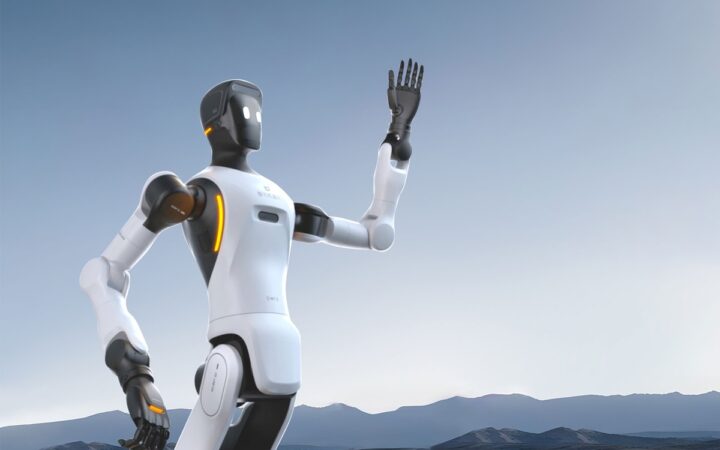
Greece has introduced MARK One, described as the country’s first domestically developed industrial humanoid robot, ahead of its official debut at the Automation & Robotics Expo 2026 in Athens. Designed and built by Greek company Axl Imperial, the robot combines autonomous movement with dual robotic arms capable of handling palletizing, machine feeding, quality control, and material transport on factory floors. Chief executive Konstantinos Gouliaris characterized the machine as an industrial worker intended to assist with repetitive and potentially dangerous tasks.
Unlike fixed robotic systems, MARK One can move independently, adapt to changing environments, and operate alongside human workers in industrial settings. The robot is equipped with dexterous fingers, cameras, and voice interaction technology, which the developers frame as part of a broader shift toward physical AI. It was built largely using Greek-made components, a point the company emphasizes as evidence of domestic engineering capability rather than reliance on imported platforms.
MARK One is expected to begin operating this summer at the KAFEA TERRA coffee factory, marking a transition from demonstration to a real production environment. Engineers are working to expand the robot’s capabilities through voice commands and limited decision-making functions, with a stated long-term goal of building a collaborative assistant rather than a direct replacement for human labor. The planned factory deployment distinguishes the project from purely promotional unveilings, though sustained operational performance at the site will be the more meaningful test.
The unveiling reflects the widening geographic spread of humanoid robotics development, which has been concentrated in China, the United States, and parts of Western Europe and East Asia. A domestically developed industrial humanoid from a smaller robotics market signals growing interest among nations seeking to establish local capability rather than depend entirely on established suppliers. Whether MARK One scales beyond an initial deployment will depend on reliability, cost competitiveness against established industrial automation systems, and the depth of the supply chain supporting Greek-made components.
Disclaimer: RobotsBeat is an independent media brand owned and operated by NuvexMedia LLC, publishing news, research, and insights on artificial intelligence, emerging technologies, automation, and related industries. NuvexMedia LLC invests in and collaborates with companies across the AI, Robotics, technology, software, and digital innovation sectors. These relationships do not influence RobotsBeat's editorial coverage, and the publication maintains full editorial independence to provide accurate, timely, and objective information. © 2026 NuvexMedia LLC. All rights reserved. This content is for informational purposes only and should not be considered legal, tax, investment, financial, or other professional advice.